


From atop the earthen berm and the additional fortifications surrounding the outpost, there is, on these spring days, an excellent view of al-Mawasi in the southern Gaza Strip from end to end. In an area where the greenhouses of the former Gush Katif settlements once flourished, about 400,000 Palestinians are now crowded into tents, makeshift shelters made of plastic sheeting and scrap metal and, above all, partially ruined buildings.
"Hamas is there too, trying to blend in among the homeless so they can serve as human shields," a senior Southern Command officer told me. "At the moment, they are mainly gathering intelligence and occasionally trying to carry out shooting attacks or plant explosive devices."
Gallery
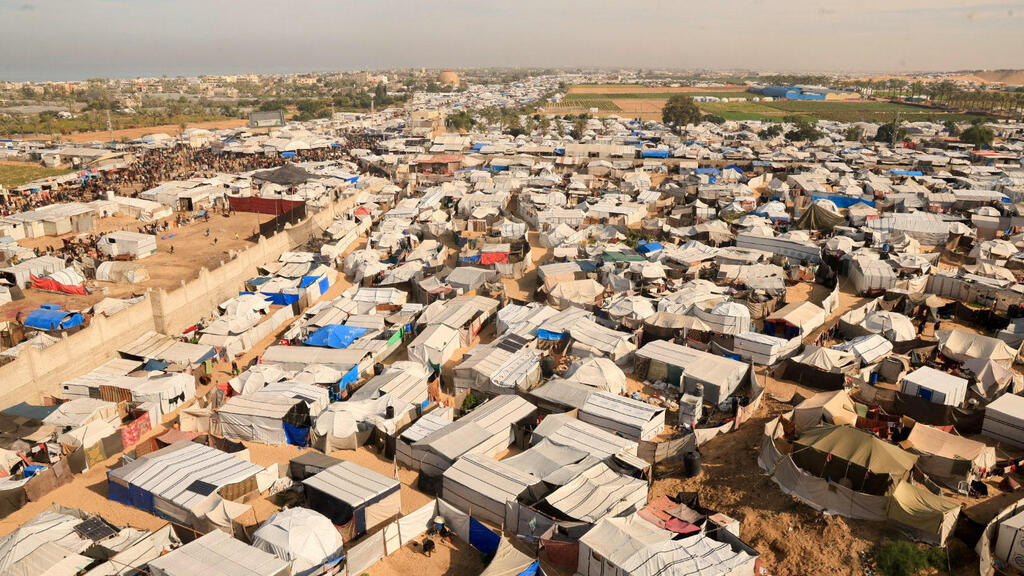
Tents housing displaced Palestinians in the al-Mawasi area of Khan Younis, November 2025
(Photo: REUTERS/Haseeb Alwazeer)
I had not been in Gaza in recent months, and what surprised me was what I saw in the area controlled by the IDF. The outpost bustling with activity below us did not resemble any IDF defensive complex I had known in the past, not during the War of Attrition along the Suez Canal and in the Jordan Valley in the 1970s, nor in the security zone in Lebanon during the 1980s and 1990s.
For security reasons, details cannot be provided, but there were no massive bunkers designed to withstand heavy artillery or aerial bombardment. Instead, there were concrete structures that provide solid protection against direct fire and high-trajectory attacks. They are positioned so that troops can reach shelter within seconds and can also be moved relatively quickly if the outpost itself needs to be relocated.
More than anything, the outpost resembled the fortified compounds the Americans built in Iraq and Afghanistan to protect their forces from guerrilla attacks: a base housing a relatively large force with extensive capabilities, whose personnel can shift from routine operations to combat within minutes.
The IDF has established 40 such outposts throughout the Gaza Strip. All are intended to house combined combat teams of varying sizes, made up of armor, infantry and engineering forces. Most are complete, particularly in northern Gaza, while some are still under construction. Each outpost costs about 5 million shekels. The outposts support one another with observation and fire coverage.
20,000 terrorists remain
The outpost I visited overlooks the ruins, and what remains of the buildings, in the village of Bani Suheila. About 600 to 700 meters south and slightly east of us, atop a high dune, another earthen-walled outpost could be seen, also positioned on terrain commanding observation and fire all the way to the sea.
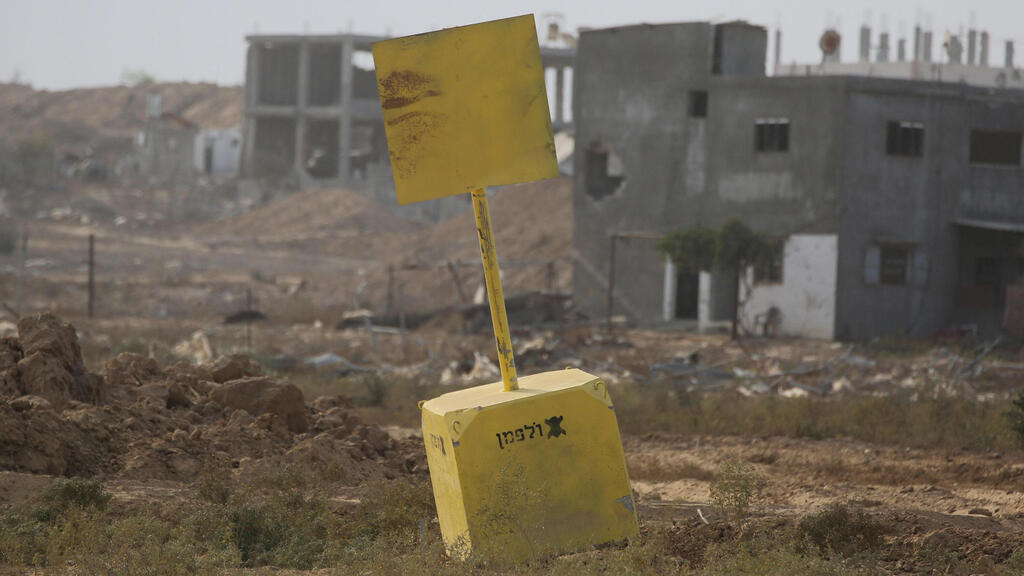
'The Yellow Line' in al-Bureij
(Photo: Bashar Taleb / AFP)
The outposts are not located directly on the "Yellow Line" but several hundred meters inside territory controlled by the IDF. The goal is to prevent assaults launched directly from areas controlled by Hamas, whether above ground or through tunnels, and to reduce vulnerability to short-range direct fire.
From the observation position, it was easy to see that the "Yellow Line" in this sector runs directly along Salah al-Din Road (the "Tancher" route) in central Gaza. Once, this road connected the northern and southern parts of the Strip from end to end. Today, only scattered stretches of asphalt and broken traffic islands remain, though the route is still clearly visible by day and night. The soldiers stationed there know that anyone crossing that road must be stopped or killed.
In the area, hundreds of meters wide between the two outposts and the "Yellow Line", the IDF is establishing a buffer and security zone. A trench is currently being dug along it to prevent rapid incursions by motorcycles, pickup trucks and other vehicles into IDF-controlled territory and potentially toward communities near the Gaza border.
In addition, the IDF is conducting drilling operations in the area to expose tunnels that existed before Oct. 7 or that Hamas is digging now. The aim is to prevent surprises for forces stationed in the outposts or moving through the area.
Since the Oct. 7 massacre, the IDF has uncovered and destroyed about 450 kilometers (280 miles) of tunnels. Some were blown up and others filled with concrete. Commanders in the field say they are no longer operational along their entire length.
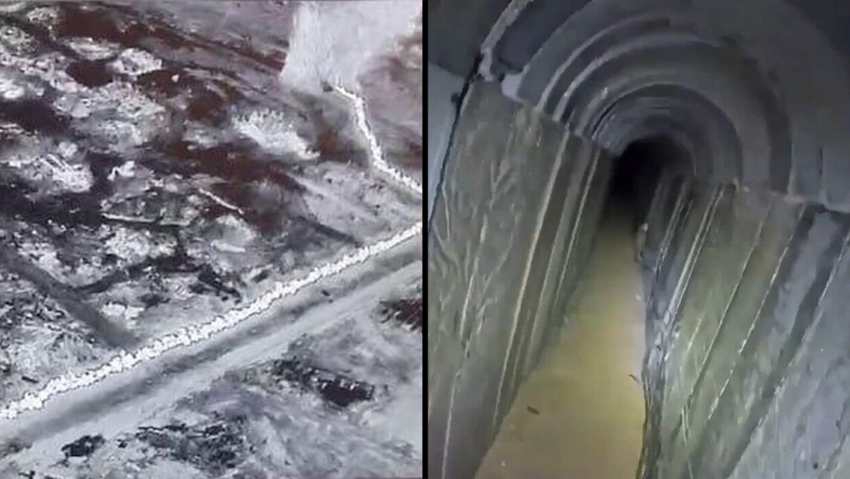
Footage from an underground complex discovered and destroyed in the Zeitoun area
(Photo: IDF)
All of this is reinforced by the major barrier running along Gaza's border with Israel. The "Hourglass Fence," which was breached on Oct. 7, has been rebuilt and strengthened along its entire length, including special gates and advanced remotely operated "see-shoot" positions that the IDF says are resistant to FPV drones.
The primary concern among Israeli forces is roadside bombs and mines along supply and access routes. As a result, most roads leading to and between the outposts have been paved.
Hamas possesses drones and likely explosive UAVs as well, but for now it lacks the fiber-optic capabilities Hezbollah developed in Lebanon. The IDF currently enjoys near-total drone and UAV superiority over Gaza's skies.
Using high-quality military and Shin Bet intelligence, including both human and technological sources, the IDF is systematically eliminating senior commanders, key military specialists and police officials responsible for maintaining governance.
According to the IDF Spokesperson's Unit, 13 terrorists were killed in airstrikes during the past week alone, including four senior members of Hamas' General Security apparatus in Gaza and a terrorist involved in advancing attacks against forces stationed there. That terrorist infiltrated Israel on Oct. 7 and participated in the abduction of four Israelis from the roadside shelter at Re'im Junction.
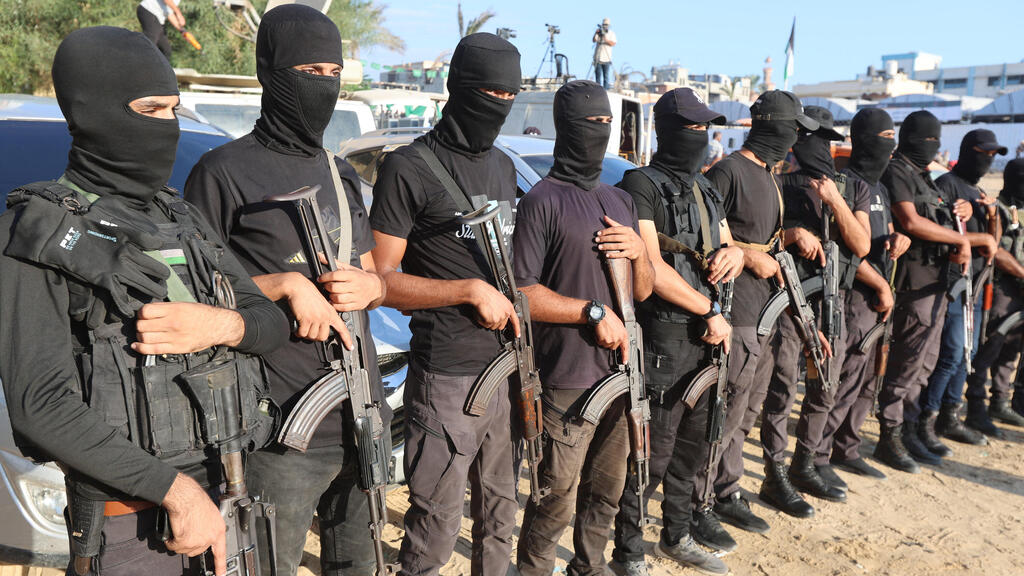
About 20,000 Hamas terrorists are still operating in the Gaza Strip
(Photo: REUTERS/Ramadan Abed)
Despite this, according to current information, Hamas' military wing still has about 20,000 operatives throughout Gaza. Of these, roughly 8,000 are experienced fighters, most belonging to the elite Nukhba force. The remainder are young men and teenagers recruited hastily and provided with basic training and light weapons, including RPGs.
Hamas members refuse to disarm and continue trying, at a minimum, to wage a guerrilla campaign. They are still manufacturing explosives, gathering intelligence and sending adults — and especially teenagers, whom the IDF refers to as "shoots" — to test when the IDF detects them, how quickly it responds and by what means.
A dangerous governance vacuum
But Hamas has been severely weakened and in recent days has initiated little beyond intelligence gathering, so as not to provoke a major Israeli response.
Another factor troubling Hamas and undermining its rule is the presence of armed clans whose members and families, numbering in the tens of thousands, live in IDF-controlled areas and continually challenge Hamas authority.
Public support for the terrorist organization appears to be declining. Evidence of this was seen at the funeral of Izz al-Din Haddad, the Gaza City commander who became Hamas' leader in Gaza after the elimination of the movement's senior leadership. Only a few dozen Gazans attended, compared with the tens of thousands who once attended funerals of commanders less senior than he was.
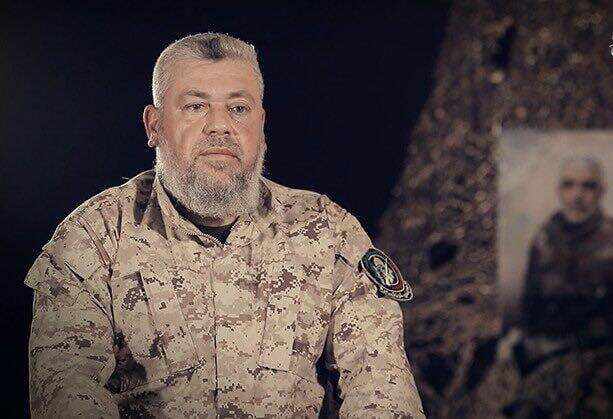
Izz al-Din Haddad
Haddad was succeeded by Mohammed Oudeh, who has also since been killed. Having learned from experience, Hamas no longer publicizes the identity of its new leader. However, reliable Arab media outlets report that Mohand Rajab, the former commander of the Gaza Brigade and a close associate of Haddad, has assumed the role.
He is expected to be no less hawkish and militant than his mentor. Fearing that Rajab could also be targeted and seeking to preserve command continuity, Hamas' military wing is reportedly considering establishing a collective leadership structure alongside four other remaining brigade-level commanders.
It is true that Hamas has not been completely destroyed, but its military wing has been severely battered and, according to reliable information, is not rebuilding at the alarming pace sometimes claimed in the media.
Its civilian governance in areas still under its control is also limited. The systematic targeting of Hamas police officers — who attempt to enforce the authority of its civilian administration and collect taxes from merchants — has forced the police to reduce their presence outside major intersections and crowded marketplaces, where Hamas believes the IDF is less likely to strike.
Unlike in the past, civilians who are neither Hamas members nor relatives of Hamas members now have access to food, water and medicine in Gaza. This is due to the substantial humanitarian aid flowing into the territory through the American headquarters in Kiryat Gat, with Egyptian assistance and funding from the United Arab Emirates and other members of the so-called Board of Peace.
However, Hamas still seizes a significant portion of that aid and sells it, primarily to finance the recruitment of new operatives. Civilians receive far less than what enters Gaza, partly because international attention has shifted from Gaza to the Persian Gulf and because the closure of the Strait of Hormuz has dried up cash sources for Gulf states.
As a result, international aid organizations, whose budgets are dwindling, have been forced to close public kitchens serving cooked meals to hundreds of thousands and clinics providing health care services. Yet the more troubling issue is that, in the absence of effective law enforcement, a governance vacuum prevails across about 40% of Gaza, where everyone does as they please.
Not only criminal groups exploit this situation. Ordinary civilians do as well. There are numerous reports of attacks against women and exploitation of their vulnerability, as well as theft and disputes among neighbors in the crowded encampments that sometimes end in murder. Under such conditions, tribal and clan structures are what prevent the total collapse of Palestinian society into chaos.

Strait of Hormuz
(Photo: REUTERS/Stringer/File Photo)
Meanwhile, in roughly 64% of Gaza's territory, now almost devoid of residents, the IDF controls the area and protects Israeli border communities through two divisional commands: Division 143 in the south and Division 99 in the north, which together operate six brigades and 18 battalions. That compares with the two brigades and four battalions defending the Gaza border communities from the frontier line on Oct. 7.
The IDF's options
The way the IDF is currently deployed and operating in Gaza has almost completely neutralized Hamas' ability to carry out attacks involving more than a small cell of two to six operatives. Simply put, Hamas is no longer a terrorist army. It has reverted to being a guerrilla organization.
Its members may still occasionally attack an outpost or plant bombs along access and supply routes between the Gaza border and the "Yellow Line," but the threat to communities in southern Israel has been almost entirely removed, at least as long as the IDF maintains its current posture.
Moreover, the IDF has effective capabilities to prevent Hamas from rebuilding its military and governing structures in Gaza, even if the organization refuses to disarm voluntarily and its senior commanders refuse to surrender or go into exile.
The commander of the Southern Command and field commanders are convinced that seizing the territory currently controlled by Hamas, including Gaza City, would take no more than a few weeks. Plans already exist and require only government approval.
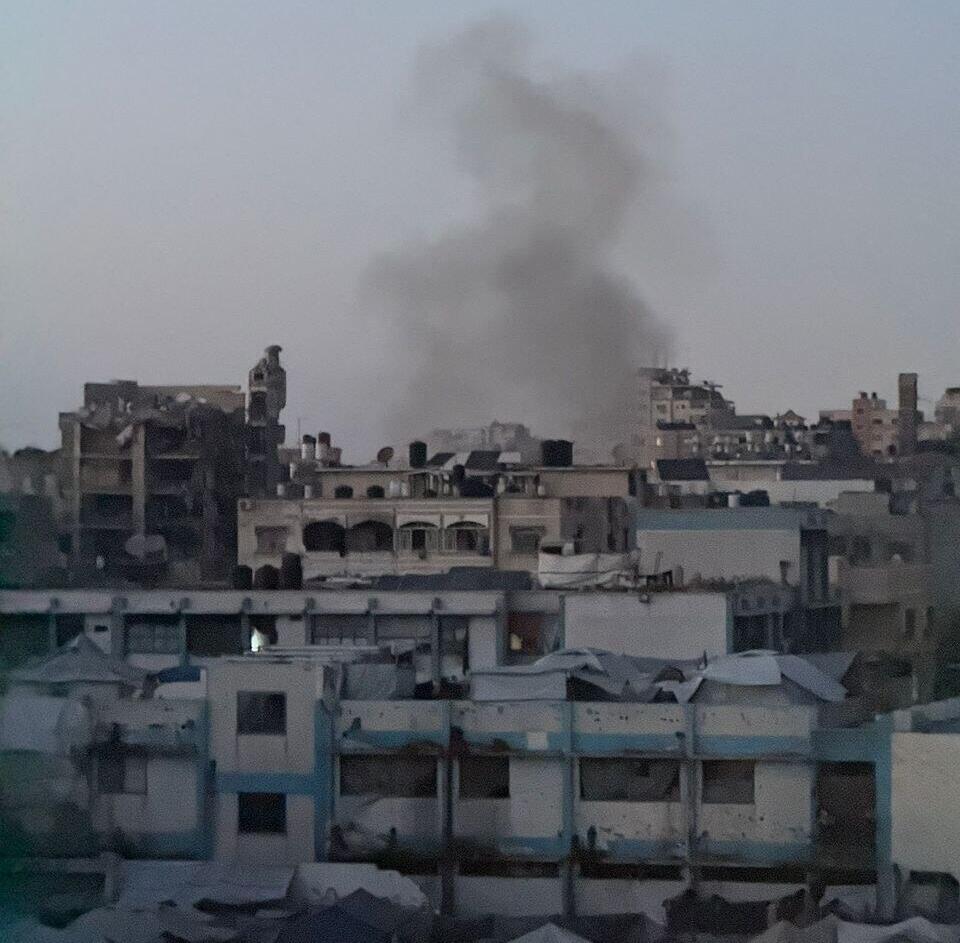
Gaza City
But Prime Minister Benjamin Netanyahu is not rushing ahead — and not only because of concerns about angering President Donald Trump, nor solely because the IDF must remain capable of responding rapidly in Lebanon.
The reason is that a decisive operation in Gaza would require concentrating a force at least twice the size of the one currently deployed there. Such an operation would also result in Israeli casualties, and it could take months, perhaps more than a year, before the military fully disarms Hamas and captures or kills the remaining Nukhba commanders and operatives.
It is also reasonable to assume that if the IDF resumes large-scale ground maneuvers in Gaza, Israel would once again face intense international opposition, possibly even from the U.S. president. Yet a campaign to disarm Hamas is not the only option.
There is also an alternative strategy, both defensive and offensive, that is less costly in manpower, casualties and resources. It would also pose less of a challenge to the international legitimacy of Israeli military operations. This strategic course of action, which the IDF has likely already presented to political leaders, calls for intensifying the current operational model in order to achieve the desired outcome.
On the defensive side, the plan focuses on continuing to protect southern Israeli communities and forces stationed in the outposts through barriers, intelligence collection and early-warning systems.
But the offensive component would be the main effort. The IDF and Shin Bet would use the extensive, detailed and reliable human and technological intelligence now at their disposal — together with the large number of UAVs and drones operating over Gaza — to grind down Hamas and prevent it from governing or rebuilding. This would continue until the time comes to end its rule in Gaza through military or political means.
The danger lurking in Gaza
Both military options exist and both are feasible. But the decision over which to pursue depends on what does, or does not, happen in the civilian sphere.
Under current conditions, the real ticking time bomb and long-term threat in Gaza is not Hamas, struggling to survive, but the approximately 2.1 million Gazans it is holding in inhumane conditions as hostages.
They are confined to an area of about 120 square kilometers (46 square miles), roughly 36% of the Gaza Strip, an area comparable in size to the municipal boundaries of Beersheba or greater Jerusalem, whose populations are less than half that size.
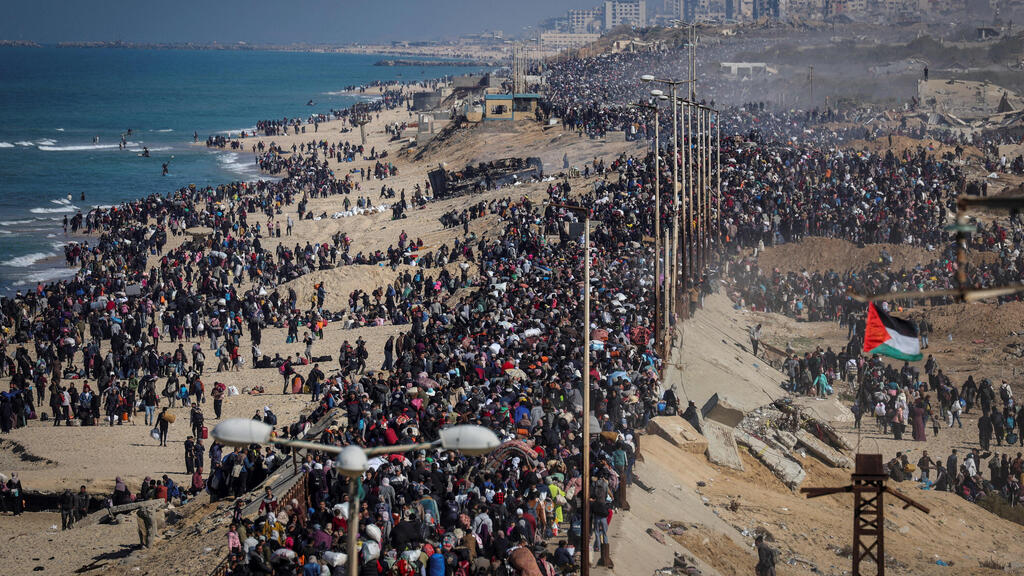
Palestinians return to northern Gaza in January
(Photo: REUTERS/Ramadan Abed)
What will happen to them, and to us, if an epidemic breaks out there, or if an aerial bomb strays from its intended path? Not to mention the thousands of children growing up and being educated to hate Israel and sacrifice themselves simply to hurt Jews.
That is why it is a near-existential Israeli strategic interest to provide a solution that allows Gaza's population to live under reasonable conditions, preferably before a catastrophe occurs that the world will blame on Israel.
A population with hope and prospects for recovery is also less likely to send its sons to enlist with Hamas for a few dollars.
The problem is that, at the moment, the chances of implementing, or even launching, Trump's 21-point plan appear slim, and are likely to remain so even after the confrontation with Iran ends.
Not only does Hamas refuse to disarm, but the international stabilization force that is supposed to deploy in Gaza and guarantee the authority of a technocratic Gaza government has yet to materialize.
In addition, the Peace Council Trump launched with considerable fanfare has failed to secure even one-third of the funding pledged by its member leaders. It should be remembered that the Gulf states have suffered significant financial losses because of the closure of the Strait of Hormuz and are unlikely to rush into allocating the tens of billions of dollars required to clear the rubble and rebuild Gaza.
Under such circumstances, the plans prepared by Steve Witkoff and Jared Kushner for Gaza's reconstruction may remain on paper for a long time, perhaps indefinitely. And if Israel decides to conquer the Gaza Strip in order to disarm Hamas, the IDF would likely have to establish a military administration, leaving Israel responsible for the welfare and well-being of millions of Gazans — and requiring it to undertake Gaza's reconstruction itself.
For that reason, under current conditions, it would be better for Israel's government not to rush into conquering the Strip but instead to continue the slow, intelligence-driven attrition of Hamas and prevent the rehabilitation of its military wing.
That should continue until Trump, the international community or a future Israeli government, if it proves more pragmatic than the current one, succeeds in formulating a realistic, adequately funded, phased long-term solution for Gaza's population without endangering Israel. Then Hamas' day will come as well.