


The combined offensive launched in Iran on Saturday morning was first and foremost aimed at neutralizing the initial Iranian missile barrage that was already positioned on launchers, both underground and above ground.
Alongside what were defined as regime targets, the strikes also sought to damage what remains of Iran’s air defense systems, including short-range batteries, to prevent them from intercepting U.S. Tomahawk missiles.
Footage of IDF strikes in Tehran
(Video: IDF spokesperson unit)


The opening blow appears to have inflicted significant damage on the command and control capabilities of Iran’s launch array. Where they were not hit, ballistic missile and attack drone launches now seem to be managed by local commanders.
They are firing quickly, either out of concern that their launchers will be exposed during preparations or destroyed shortly afterward. The missiles at their disposal must be aimed at clusters of Israeli targets and U.S. bases scattered across the Middle East, forcing them to replan in real time under fire.
This helps explain why the launches toward Israel are in the dozens rather than the hundreds, carried out in a steady drip rather than in intense barrages. The result is that Israelis are required to remain in protected spaces for extended periods, even as the overall threat level is reduced.
The IDF is reinforcing troop deployments along the borders with Lebanon and Syria, and likely Jordan as well, due to intelligence assessments warning of a possible surprise “pickup truck assault.”
Such an attack could be attempted by Shiite militias in Iraq, in coordination with the Houthis and possibly remnants of Hezbollah’s Radwan force, targeting the Golan Heights border and potentially Lebanon. The assessment also includes the remaining Sunni jihadists affiliated with the Islamic State group operating in the Daraa region of southern Syria’s Golan area.
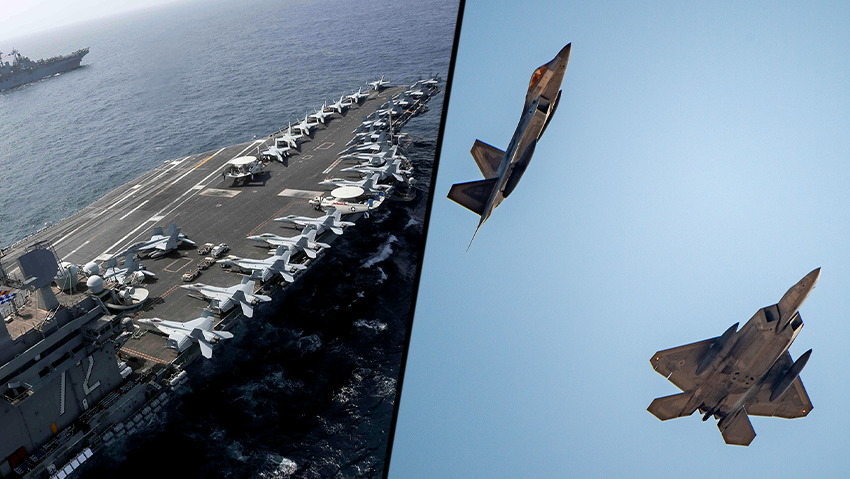
U.S. Air Force F-22 fighter jets and preparations aboard the aircraft carrier Abraham Lincoln
(Photo: Reuters from X)
The joint operational pattern recalls the U.S. strike on Fordo and additional targets in June. Israel first clears threats to itself and to U.S. interests, including risks to the Israeli home front and American bases in the region, after which U.S. forces enter with full force.
American forces joined the operation shortly after Israel to preserve the surprise element. They initially operated mainly from the aircraft carrier Abraham Lincoln, focusing on southwestern Iran, the Islamic Revolutionary Guard Corps navy and other naval assets, as well as the port of Bandar Abbas, in an effort to prevent the closure of the Strait of Hormuz.
The strike in Lebanon against Hezbollah targets a day earlier was intended to blind the terrorist organization’s detection systems, which were expected to alert Iran to the Israeli Air Force’s departure for the preemptive strike.