

Air raid sirens sounded across Israel on Saturday morning after the country launched a “preemptive strike” against Iran, warning citizens of an expected retaliatory attack.
In a statement, Defense Minister Israel Katz said the operation was intended “to remove threats against the State of Israel.” The announcement indicated that missile and drone attacks against Israel and its civilian population were anticipated in the immediate term.
Airstrikes across Tehran
(Video: Sabereen TV )


Airstrikes across Tehran
Katz declared a special nationwide state of emergency under his authority pursuant to the Civil Defense Law. He signed an order imposing a “special emergency situation” on the home front across the entire country.
The military said sirens were activated nationwide as a precautionary measure and that an early warning directive was pushed directly to mobile phones, instructing civilians to remain near protected spaces. The IDF emphasized that, for now, there was no requirement to remain inside shelters.
Home Front Command urged residents to avoid nonessential travel and to confirm the location of the nearest optimal protected area.
Airstrikes across Tehran
Preparations for the strikes were conducted under strict secrecy in Israel. Over the past month, IDF Chief of Staff Lt. Gen. Eyal Zamir and Air Force Commander Maj. Gen. Tomer Bar held compartmentalized briefings with operational personnel. As part of what officials described as a deception effort, Zamir attended a routine public dinner on Friday.
Military officials said the latest wave consisted of an intense series of bombings carried out approximately 90 minutes earlier. The Israeli military said it is prepared for prolonged, multi-wave attacks similar to previous operations. Zamir is maintaining direct coordination with the commander of U.S. Central Command. Israel has also mobilized reservists, primarily for border defense.
Transportation Minister Miri Regev said Israel’s airspace had been closed to civilian traffic following the security escalation. “The safety and security of passengers are our top priority,” Regev said in a statement. She instructed the public not to travel to airports until further notice and urged Israelis abroad to follow updates from airlines and media outlets regarding flight schedules once the airspace reopens.
The Transportation Ministry said the airspace would reopen when security conditions permit, with at least 24 hours’ notice before flights resume. Officials said the ministry is in continuous contact with security agencies and conducting ongoing assessments.
The Culture and Sports Ministry announced that, following a new security assessment, Home Front Command ordered a shift from full activity to essential operations nationwide. All sports, cultural and educational events have been suspended, and workplaces will operate only if classified as essential services. All games and public events are canceled until further notice.
Earlier Saturday, the military said it also struck Hezbollah launch positions and underground shafts in several areas of southern Lebanon. According to the army, the sites were used by Hezbollah “to advance terror plans against the IDF and the State of Israel.” Qatar’s Al Araby TV reported that more than 10 strikes were carried out in the al-Qatrani and Wadi Barghoz areas of southern Lebanon.
Gallery
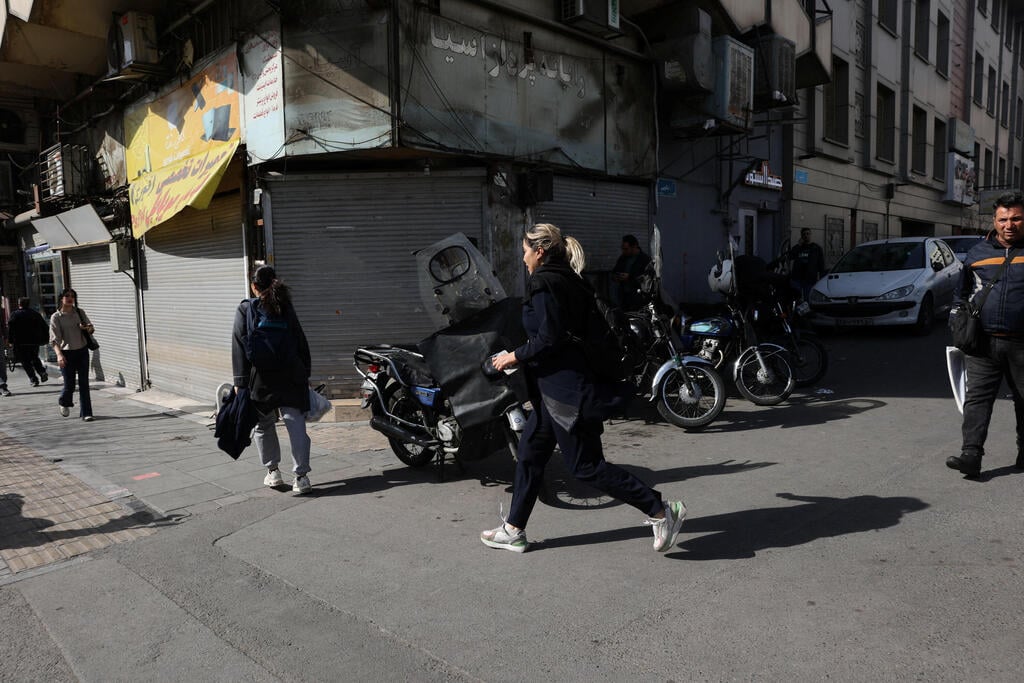
Panic in the streets of Tehran amid US-Israeli strikes
(Photo: Majid Asgaripour/WANA (West Asia News Agency) via REUTERS)
Officials said the strikes against Hezbollah earlier were intended to disable the group’s detection capabilities in Lebanon, which they said could have been used to alert Iran to Israeli Air Force movements.
The operation in Iran was aimed at neutralizing what officials described as a first missile barrage already positioned on above- and below-ground launchers, as well as degrading remaining elements of Iran’s air defense systems, including short-range capabilities.
Senior Israeli ministers were placed on alert ahead of the operation, receiving secure calls Friday and being instructed to remain available throughout the weekend. They were also directed not to comment publicly on Iran.
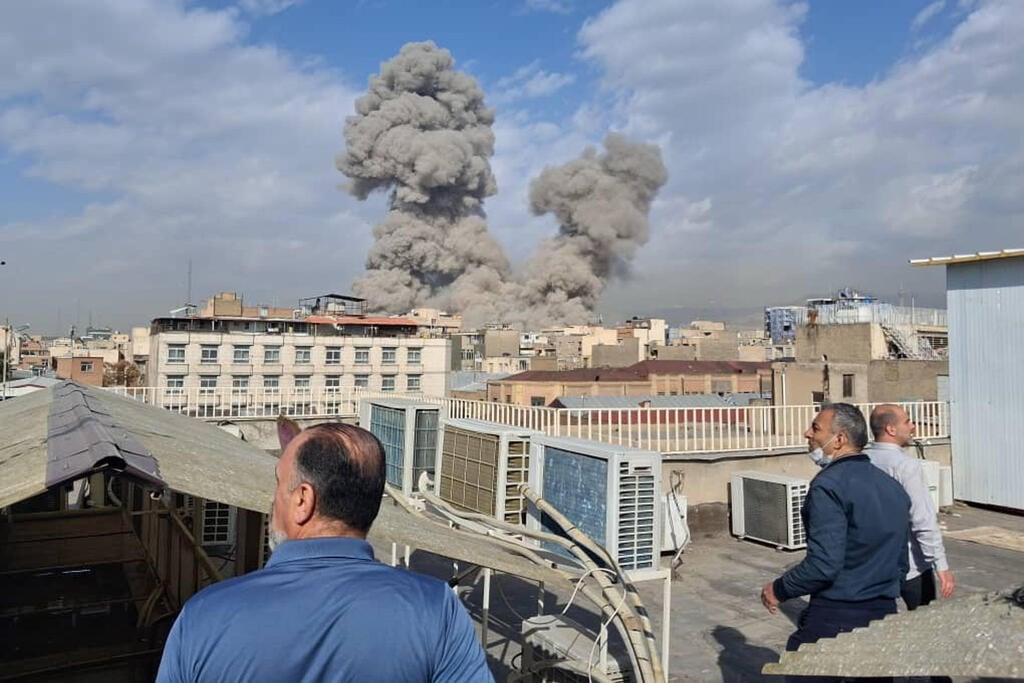
US-Israeli strikes across Tehran
(Photo: AP Photo)
According to reports, the United States was involved in the strikes on Iran, as plumes of smoke rose over Tehran and explosions were reported in both the capital and the city of Tabriz. Iranian media said sites hit in Tehran included the Intelligence Ministry, the Defense Ministry, the office of Supreme Leader Ayatollah Ali Khamenei on Pasteur Street, the Atomic Energy Organization of Iran and the Parchin military complex. Reuters, citing official sources, reported that Khamenei was not in Tehran at the time of the strike and had been moved to a secure location.
Iranian media also reported cyberattacks and intrusions targeting news websites.
A U.S. official told The New York Times that dozens of American strikes were carried out by attack aircraft operating from bases across the Middle East and from one or more aircraft carriers.
Saudi-owned Al Arabiya TV, citing sources, reported additional explosions in eastern Tehran near several Islamic Revolutionary Guard Corps bases, as well as blasts near Iranian intelligence facilities in the capital.
Reports of widespread strikes in Iran continued throughout the morning, with explosions reported in Isfahan, Kermanshah, Qom and Karaj. A senior U.S. official told Al Jazeera that the airstrikes were intended to “dismantle Iran’s security apparatus.”
Security officials described the operation as a coordinated Israeli-American assault targeting regime assets. “Everyone is striking. The target is regime infrastructure,” one official said. Another said the timing of the morning attack was based on operational considerations and intended to mislead Iranian forces, adding that preparations had been underway for weeks.
An Iranian official told Reuters that Tehran is preparing for retaliation, with the response set to be "crushing."
Ebrahim Azizi, head of Iran’s parliamentary committee on national security and foreign policy, issued a warning on the social media platform X, writing: “We warned you! Now you have started down a path which end is no longer in your control.”
Opposition leader Yair Lapid said that in times of escalation “there is no coalition and opposition, there is only one people and one army that we all stand behind.” He added: “The people of Israel are strong, the IDF and the Air Force are strong, and the strongest power in the world stands with us. In moments like these, we stand together and we win together.”