

The American announcement of the composition of the Board of Peace and the first meeting of the Gaza Strip Management Committee in Cairo over the weekend illustrate that, despite ongoing gaps in implementing the first phase of the Gaza agreement, we have effectively entered phase two.
A dramatic change on the ground is not expected immediately. But President Donald Trump’s desire to present a tangible achievement runs deep. As a result, we may soon see scenes designed to market a new reality, such as the arrival of management committee representatives in Gaza, the deployment of its teams at border crossings or government offices, and perhaps even a symbolic display of weapons collection as supposed proof that the strip’s demilitarization has begun.
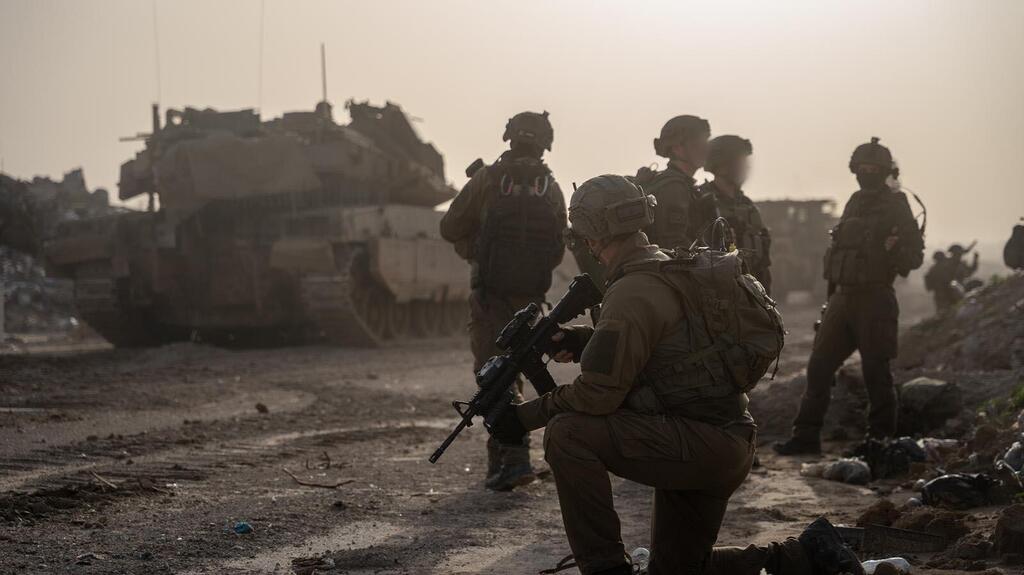
IDF forces in Gaza
(Photo: IDF)
The Israeli discourse must be grounded in recognition of hard truths and as few slogans as possible. The first is the link to the Palestinian Authority. Although the management committee is not clearly defined as subordinate to Ramallah, this is reflected in the makeup of its members. The committee’s head, Ali Shath, previously served as director general of the Transportation Ministry. Another member held ministerial rank in the Palestinian government, and a third is a former senior official in the Palestinian General Intelligence Service. The Palestinian Authority, unsurprisingly, welcomed the committee’s establishment, and many of its members have been photographed in the past, or continue to be photographed, with a portrait of Mahmoud Abbas hanging behind them.
A second truth, painful and deeply troubling, concerns Hamas. The organization welcomed the committee’s creation, likely reflecting its assessment that it has little to fear. Hamas appears to view the body as a cosmetic cover that will take responsibility for supplying Gaza’s civilian needs while leaving its security activity and its civil apparatus, the dawa network, untouched. In effect, Hamas is seeking to entrench a Hezbollah-style model in Gaza, remaining the dominant force on the ground alongside a weak formal government.
A particularly unsettling truth relates to Israel’s room for maneuver. Israeli leaders continue to insist that the military can return to fighting at any stage. In practice, however, Israel’s freedom of action in Gaza is steadily eroding. It is falling behind the moves being accelerated by Trump, who is effectively becoming the primary decision-maker.
This is evident in the executive committee of the Board of Peace announced by Trump, which includes senior figures from Qatar and Turkey, including the Turkish foreign minister. These are two countries Israel does not want present in Gaza the day after the war. Against this backdrop, what appears to be the first public clash between Jerusalem and Washington over Gaza is taking shape. This was reflected in the unusual statement issued by the Prime Minister’s Office, which claimed the council’s composition was not coordinated with Israel and runs counter to its policy.
More troubling still, the phase two train has left the station despite the failure to resolve two issues that are fundamental for Israel: the return of Ran Gvili and the disarmament of Hamas. On the weapons issue, there even appears to be an effort to pull Hamas’ chestnuts out of the fire by the mediators, chiefly Qatar and Egypt, by formulating a compromise that would require Hamas to give up only ‘offensive weapons.’ The current effort is to persuade Trump that this constitutes precise implementation of his demands. It cannot be ruled out that he may accept it.
Israel is already facing growing pressure to open the Rafah crossing in both directions, even though the conditions of the first phase have not been met, foremost among them Gvili’s return. If Gvili does return to Israel, pressure will also mount to deepen the withdrawal from the Yellow Line, which was presented as Israel’s central achievement at the end of the war and Hamas’ greatest concession.
A question mark also continues to hover over Israel’s ability to block, over time, Turkish involvement in a multinational force in Gaza and to prevent reconstruction efforts as long as Hamas has not been disarmed.
In this context, Israel would be well advised to hold a necessary debate over the essence of its grip on the Yellow Line, which many believe will remain in place for years. This is presented as the updated national security doctrine, centered on maintaining a presence deep inside enemy territory. Beyond Gaza, this approach is also being implemented in Syria, and some are seeking to apply the same logic in the West Bank.
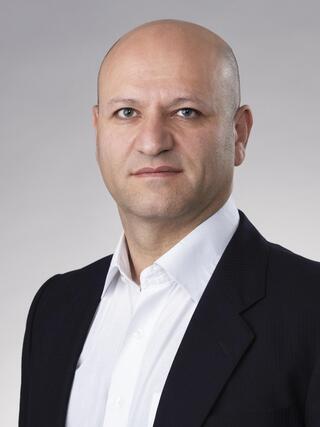 Dr. Michael Milshtein
At its core, this approach reflects a military response to the trauma of October 7, but it is not anchored in a thorough strategic discussion. As a result, several fundamental questions remain unresolved. How long is this security buffer supposed to exist? How serious are the ideas of annexation and the establishment of settlements there, as recently declared by the defense minister and firmly rejected by Trump? Is the concept of creating an alternative Gaza on Israeli territory feasible, and if so, when would it occur?
A show of force without deep strategic thinking, and certainly continued adherence to fantasies and slogans, will widen the growing gap between what Israel has demanded since the Gaza cease-fire began and the reality taking shape on the ground.
Israel must define which of its goals are achievable and adhere to three core demands: the return of Gvili, the preservation of freedom of action against any emerging threat in Gaza, as is being implemented in Lebanon, and ensuring strict oversight under American control along the Philadelphi Corridor, particularly at the Rafah crossing.
The committee that has been established is far from the beginning of a positive transformation in Gaza, and it is doubtful it will be able to seriously confront Hamas. Still, under the current circumstances, it represents the lesser evil. This is certainly preferable, for now, to a ‘policy of refusal,’ and even more so to a return to intensive war and an attempt to seize control of the strip, moves that stand in direct contradiction to what Trump is seeking.
Dr. Michael Milshtein is head of the Forum for Palestinian Studies at the Moshe Dayan Center at Tel Aviv University