

"Response, failure and correction." That is how Dr. Menachem (Mena) Bachrach, a retired brigadier general and internationally recognized expert in counterterrorism and aviation security, describes the ongoing battle against terrorism. "Terrorists," he says, "don't need more than one breach."
That, perhaps, is the central lesson of his new book, Aviation Under Threat: Fifty Years of Fighting Terrorism in the United States and Israel. The book, the first of its kind, chronicles the relentless race between attack and defense: a terrorist attack, a response, the discovery of a new vulnerability, another attack, another response, and so on.
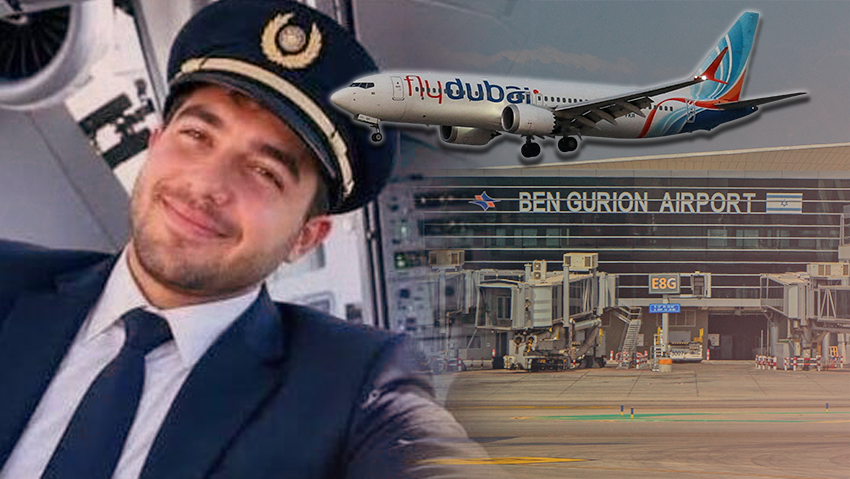
(Photo: Davidi Vardi/shutterstock, REUTERS/Ammar Awad)
"Every attack is also a test of memory," Bachrach says. "A test of the system's ability to learn and apply the lessons." It is a test he believes the aviation security system failed aboard Flydubai flight FZ1073 from Dubai to Tel Aviv.
"The incident is still under investigation," Bachrach says, "but what is clear is that the possibility of an insider, someone with legitimate access to an aircraft and its systems, carrying out an attack was already a recognized threat. What makes this incident particularly serious is not only that the system was aware of the danger, but that it could also have known this was a pilot who had been flagged as a risk."
Bachrach draws a comparison to the failures surrounding the October 7 Hamas massacre, arguing that both incidents reveal a dangerous gap between recognizing a threat and preparing to confront it.
"The warning signs had been there for years, but those responsible never bothered to take the initiative, to think one step ahead," he says. "For example, cameras could have been installed in cockpits to allow air traffic control towers to monitor what was happening inside, alongside the development of a mechanism for opening cockpit doors remotely."
"And just as on October 7, just as in the Yom Kippur War, and just as in this incident, it was the people on the front lines who responded and saved the day."
Bachrach's experience spans nearly half a century. An expert witness in aviation terrorism cases who has conducted risk assessments at 10 of the largest airports in the United States, he traces the evolution of aviation terrorism back to 1968, when an El Al aircraft was hijacked and diverted to Algeria.
That, he writes, was the moment "the passenger aircraft became a strategic weapon."
Bachrach began his career as a security guard in the early 1970s. He explains that the wave of hijackings prompted the creation of effective aviation security systems. Terrorists then shifted to attempts to plant explosives in checked baggage.
When baggage screening became more effective, they adapted again, using passengers themselves as unwitting carriers of explosives. "Often without them even knowing what they were doing," he says.
Another stage in the confrontation came with the attempted downing of an El Al aircraft using shoulder-fired missiles in Nairobi, an incident Bachrach says illustrated the shift toward attacks carried out from a distance.
"Aviation security is supposed to protect an enormous number of vulnerable points," he explains. "For terrorists, a single point that the system has failed to prepare for properly is enough."
One of the most revealing chapters in Bachrach's book examines American aviation security and what he describes as an approach characterized by "lots of technology, too little human involvement."
"Technological systems are an essential component of modern security," he writes. "The problem begins when technology becomes everything."
The most extreme example, he argues, was the September 11 attacks. "In retrospect, it emerged that an American computerized system already operating at the time to identify passengers who might pose a security risk had done precisely that. But identifying the threat did not translate into operational action."
Israel developed what Bachrach calls the "human model," an approach based on systematically learning from previous incidents to identify recurring patterns, including how airline tickets were purchased.
That approach addressed an important security need, but it also had an inherent limitation. "Good security isn't security that knows how to respond to what has already happened," he says. "It's security that knows how to ask what the adversary will try next."
Still, Bachrach's book is not a chronicle of uninterrupted failure. He emphasizes that aviation security systems, particularly those developed in Israel and later in the United States, have been largely successful in their mission. The ability of terrorist organizations to carry out attacks aboard aircraft has declined significantly.
That success, he explains, resulted from a combination of regulation, technology, intelligence sharing and a multilayered approach to defense.
But the fundamental paradox remains. "The great paradox is that the system is still one step behind terrorism," Bachrach says. "All it takes is one link in the chain, arrogant or negligent, or both, failing to do its job to expose the vulnerability of the entire system."