

Three weeks into the war between Israel and the United States and Iran, the need for caution in assessing the situation has sharpened amid reports ranging from optimism that the Islamic Republic is on the verge of collapse and its military capabilities have been destroyed, to forecasts of a prolonged war of attrition that could ultimately leave a more extreme and dangerous regime in place.
Not only is it difficult to form definitive assessments in the midst of war, especially given the media blackout in Iran, but it is also impossible to know when it will end, what military steps are expected next and how they will affect the various actors. The question of Iran’s internal situation is the most complex to assess. It involves a wide range of variables, including the regime’s resilience, its leadership’s perception of reality, command and control capabilities, public sentiment and the ability of a potential protest movement to organize.
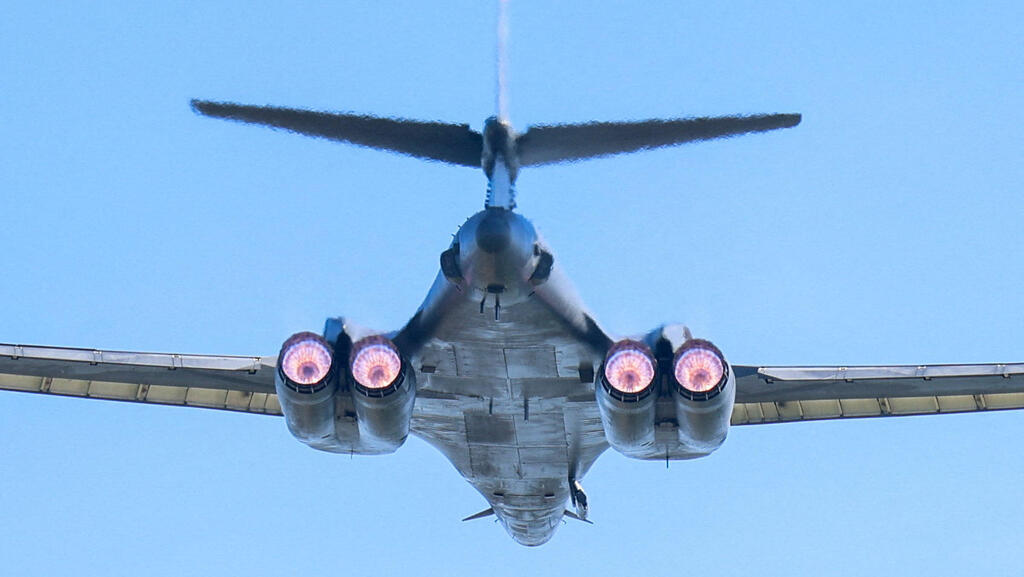
US Air Force B-1 bomber
(Photo: REUTERS/Toby Shepheard)
What is clear at this stage is that there is no indication the regime is nearing a breaking point or is prepared to make any concessions. On the contrary, while at the outset of the campaign its primary objective appeared to be survival, it now seems to be seeking to exploit the war as a strategic opportunity — both to prevent future attacks against it and to reshape the regional order. In this context, Iran aims to encourage Gulf states to end the American military presence in the region and to establish regional arrangements based on recognition of its status and its capacity for harm.
At the same time, the regime has so far demonstrated an ability to adapt to the wave of assassinations targeting senior officials. There is no evidence of a loss of control by the security forces, including the Basij militia and internal security units, which continue to operate and adjust to the changing reality, for example by shifting activity from attacked headquarters and bases to civilian institutions and by altering their methods of operation. Arrests and executions of civilians accused of espionage or collaboration with the regime’s enemies have also continued and even intensified.
Even sensitive public events, such as the “Fire Festival”, marked on the last Wednesday before the Iranian New Year (Nowruz), passed without significant incidents, aside from isolated clashes between protesters and security forces.
That said, the elimination of senior regime figures should not be underestimated. Key figures with experience and influence, foremost among them Supreme Leader Ayatollah Ali Khamenei and Supreme National Security Council Secretary Ali Larijani, are not easily replaced. It remains unclear to what extent Mojtaba Khamenei, who according to assessments continues to function despite his injury, is able to effectively assert control. Moreover, there are indications of tensions between the political and military leadership and growing difficulties in maintaining an effective chain of command.
Public sentiment is also difficult to assess. There are early signs of growing criticism from the public, including regime critics, directed at Israel and the United States over the continued strikes, particularly damage to national infrastructure that some view as evidence of a war against Iran itself, not just against the regime
The central question is whether and when a breaking point will be reached that could undermine the regime’s stability and lead to its internal collapse.
Public sentiment is also difficult to gauge. There are early signs of increasing criticism among the public, including regime critics, directed at Israel and the United States over the continued strikes, particularly damage to national infrastructure that some perceive as a war against Iran itself and not just against the regime. An Iranian sociologist identified with the reformist camp recently warned that many citizens who were once among the regime’s fiercest opponents and who viewed its foreign policy as a key driver of the country’s economic problems have changed their views and developed deep hostility toward President Donald Trump and Prime Minister Benjamin Netanyahu.
Even so, the significance of this trend should not be overstated. Past experience suggests that public protest could resume, especially given the regime’s inability — now more pronounced than ever — to address citizens’ hardships. However, it is difficult to assess whether and when protests will reemerge and, in particular, whether they will succeed in bringing about meaningful change.
On the missile front, there appears to be a more systematic effort this time to target not only launch capabilities but also production chains, in an attempt to delay the system’s rehabilitation after the war. While this does not guarantee the prevention of future recovery — especially if some missiles and launchers were merely neutralized, meaning they remain in blocked underground tunnels, rather than destroyed — it could significantly extend the time required for restoration. Meanwhile, the recent increase in launches from Iran indicates it is capable of continuing missile fire — at least at the current scale — for several more weeks.
The nuclear program remains a central source of concern. As long as Iran retains significant capabilities, chief among them hundreds of kilograms of uranium enriched to 60 percent, there is a real risk of renewed acceleration of the program after the war. Absent an operational or diplomatic solution that would remove or destroy critical nuclear components, the regime — led by Mojtaba Khamenei and the Islamic Revolutionary Guard Corps — may decide to alter its nuclear doctrine and move toward developing nuclear weapons. This leadership is not necessarily bound by the concept of a nuclear threshold state and is not constrained by the religious ruling attributed to Khamenei’s predecessor that prohibited the development of nuclear weapons.
Finally, the energy issue has become a central focus. Iran has identified the potential of this lever through its control of the Strait of Hormuz, attacks on regional energy infrastructure and its influence on oil prices. From Tehran’s perspective, this is a strategic card that allows it to prolong the war until it secures guarantees that serve its interests, while exacting a heavy economic price from both the regional and global systems.
The Israeli strike on a gas field in southern Iran once again demonstrated that Tehran does not intend to relinquish this leverage and is even prepared to escalate further. However, it remains unclear to what extent Iran will be able to sustain this strategy over time. If the United States is willing to bear the risks associated with broader military action — possibly including the use of ground forces and at the cost of extending the duration of the war — an opportunity may emerge to gradually reduce Iran’s ability to threaten the global energy market.
Dr. Raz Zimmt is director of the Iran and the Shiite Axis Program at the Institute for National Security Studies.