

One of the most prominent features of Israeli discourse since October 7 has been the way basic assumptions are handed down from above and absorbed as “facts” into the collective consciousness. This happens without encountering too many questions from those meant to mediate the leadership’s actions to the public, foremost among them the media, leading to the creation of new misconceptions.
Most of these assumptions are eventually exposed as wrong, but the pattern keeps repeating itself: from the assertion that Israel can achieve decisive victories over the enemies it has faced in recent years, often accompanied by promises that they can in effect be eradicated, to the claim that Hamas would retain hostages under any scenario, and the contention that Egypt harbors offensive intentions toward Israel.
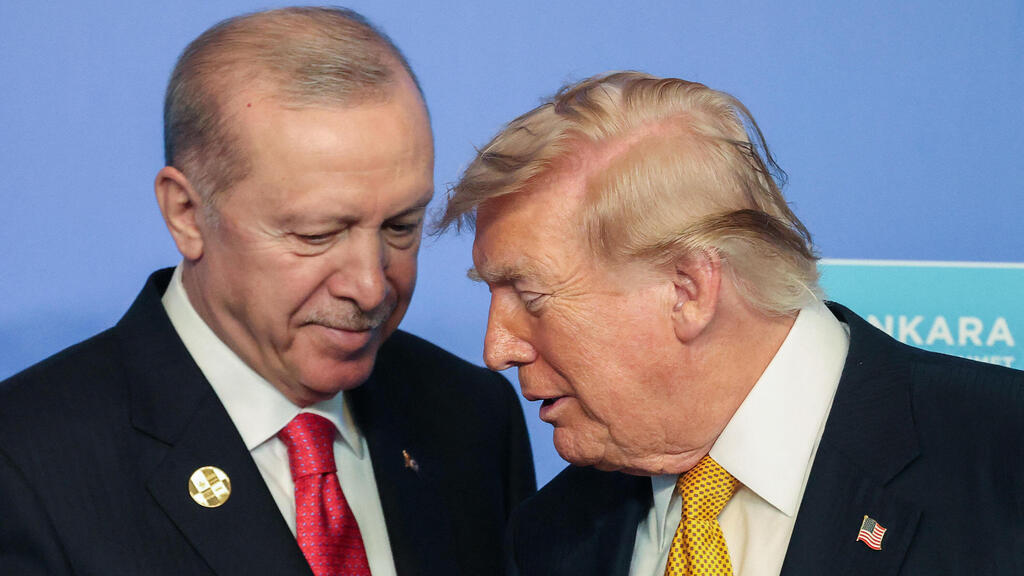
US President Donald Trump with Turkish President Recep Tayyip Erdogan
(Photo: Ludovic Marin/Pool/AFP)
Against this backdrop, a particularly prominent recent assertion is that a threatening “new Sunni axis” is taking shape following the weakening of the Iran-led axis of resistance. Political and security decision-makers state with certainty that a hostile bloc led by Turkey is gradually emerging, including Qatar, Syria and Hamas. Some, in the heat of the discussion, also include Pakistan and Saudi Arabia, which recently signed a defense agreement with Erdogan.
Those who proclaim the existence of a Sunni axis confidently argue that the new threat is filling the vacuum left by the “collapse of the Shiite axis,” without dwelling on the fact that the Iran-led resistance camp did suffer severe blows during the war but survived and is, in fact, gradually rebuilding.
For an “axis” to exist, there must be a shared vision and common goals among the players described as its members — and those players themselves should define the axis as existing and identify themselves as members of it. There must also be close cooperation, particularly military cooperation, as exists within the axis of resistance, along with joint forums for discussion and decision-making.
It is doubtful that all these elements exist in what is being described as an “emerging Sunni axis.” As has often been the case since October 7, this reflects a significant gap between Israelis’ prevailing assumptions about reality and the situation on the ground, with fantasies, slogans and false images seeping into the discourse and distorting it.
For many Israelis, the term “Sunni axis” is inseparable from the claim that Turkey is the new strategic threat facing Israel and that confrontation with it is effectively unavoidable, perhaps even in the near future.
This argument draws on the deep, and largely justified, hostility among the Israeli public toward Erdogan’s government, which has adopted an extreme and antisemitic approach toward Israel, and portrays him as a “neo-Ottoman ruler” seeking to build a powerful empire whose overarching goals include Israel’s destruction.
Given the profound and continuing impact of the trauma of the October 7 massacre on the Israeli public, the country’s leadership does not find it difficult to sell this argument — naturally without a complex and candid discussion that includes, among other things, acknowledging failures and drawing lessons from them.
The troubling byproduct of a national discourse focused obsessively on identifying enemies and treating war as a permanent condition of the state is the development of a mobilized and obedient society whose basic existential anxiety, vital for survival, is amplified out of proportion.
At the same time, contempt is cultivated for any criticism, alongside deep suspicion of the outside world and an extreme, even irrational belief in self-reliance — combining the notions of “a people that dwells alone” and a “new Sparta” — and in Israel’s ability to impose any outcome it chooses, foremost among them redrawing the country’s borders and opening more and more wars across the region.
Erdogan’s regime is unquestionably a hostile adversary of Israel, and Israel therefore must remain vigilant in the face of its efforts to establish itself along Israel’s border and work to thwart them. This was ostensibly the justified background to the strike carried out last week in northern Syria, which the prime minister made clear was intended as a signal to the Turks.
Yet in the spirit of the lessons of October 7, foremost among them the need for independent judgment and skepticism toward sweeping assertions, the public must ask: Can threats from Turkey not be neutralized through diplomacy, especially when its president is close to Trump and Turkey is a key NATO member? Was the strike in northern Syria truly a necessary last resort? Has Israel fully analyzed and weighed the scenario of a confrontation with Ankara and its implications on every level — military, diplomatic and economic, including air travel, trade and energy supplies?
More broadly, what does it mean to open yet another front when all the other fronts active since October 7 remain unresolved, foremost among them Iran, whose nuclear program should be at the center of Israel’s agenda?
Above all hangs the not-unreasonable suspicion that political motives may lie behind moves we are being asked to regard as purely professional, substantive and deserving of broad domestic consensus.
Too many measures advanced in recent years have shown the opposite and justify raising such questions. The public, for its part, must ask them and reject any claim that criticism itself is a sign of weakness or a lack of patriotism.
It is essential now to ask how tangible and immediate the Turkish threat really is and whether a “Sunni axis” is indeed taking shape that will pose a challenge to Israel. The approaching election could intensify efforts to identify new enemies and therefore demands a sharp and courageous internal debate.
- Dr. Michael Milshtein is a senior researcher at the Moshe Dayan Center at Tel Aviv University.