


Israel’s October 27 election has left the country with arithmetic in an unfamiliar setting. With almost all ordinary ballots counted by October 29, preliminary projections gave Benjamin Netanyahu’s bloc 53 seats, Gadi Eisenkot’s opposition bloc 48, and Arab parties 19 in the 120-seat Knesset.
No bloc can govern alone, and double-envelope ballots remain uncounted. The figures may shift, but the central question is clear: does the transition constrain Israel’s use of force, or could it create a brief period in which leaders consider decisions they might avoid once coalition bargaining begins?
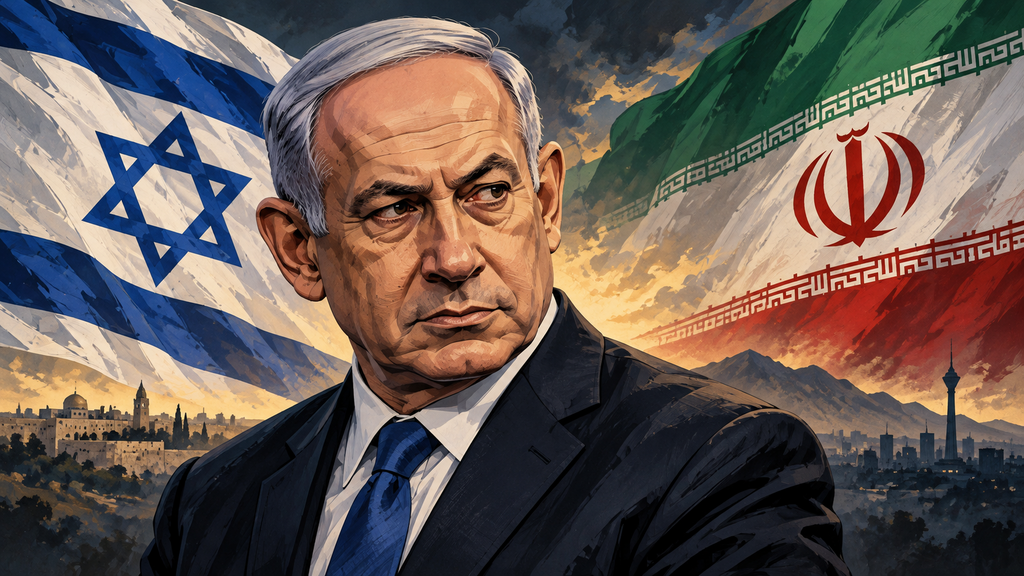
Could Netanyahu expand the Iran war before forming a government?
(Photo: AI-generated illustration)
The question matters because the conflict with Iran has not ended. The United States and Israel began strikes on February 28, and ceasefire efforts have not produced a durable settlement. Intermittent attacks, threats and diplomatic proposals continue to shape the confrontation.
Washington is weighing renewed military action even as Vice President JD Vance has reportedly opened a channel to senior Iranian security official Mohsen Rezaei. Israel’s caretaker period is therefore more than a domestic story. It could influence the timing and political consequences of another round of fighting.
Some regional observers see the transition as a possible window for escalation. They do not claim Netanyahu has decided to strike or that Arab governments share one assessment. Their argument is that a leader without a settled coalition may calculate political costs differently from one dependent on daily bargaining. If he believes diplomacy could leave Iran with nuclear or missile capabilities, he may see an opportunity to act before a new coalition constrains him. This remains unproven. No public evidence establishes a decision or timetable.
There are strong reasons to doubt a caretaker period would make escalation easier. An offensive could invite retaliation against Israel, American forces, Gulf infrastructure and shipping. It could undermine diplomacy and leave the next government with a wider war. Netanyahu’s bloc is eight seats short of a majority, but the incentives are mixed. Military action might rally Israelis, but could fuel accusations that national security is being used to influence coalition talks. The consequences would depend on the operation, Iran’s response and public opinion.
Israeli law does not leave a caretaker government powerless. Section 40 of Basic Law: The Government requires a government decision to begin a war or significant military operation likely, with near certainty, to lead to war. The government may delegate that authority to a ministerial committee, including the Security Cabinet, under conditions set by law. The prime minister has no unilateral power to authorize a campaign. Nor does caretaker status erase the outgoing government’s duty of restraint, especially when a decision could bind its successor or create irreversible consequences.
That distinction should shape the argument. The caretaker cabinet retains authority to make urgent security decisions, but it receives neither a legal exemption nor automatic expansion of its powers. Oversight may be disrupted during the transition, and Knesset committees may not be fully active. Still, the government remains responsible for its decisions under existing law. The question is whether the environment changes Netanyahu’s calculation of risk, benefit and timing.
The opposition’s projected 48 seats and the Arab parties’ 19 total 67, more than the 61 needed for a majority. But those numbers do not constitute a ready-made government. Several opposition leaders reject Arab-party support, while Netanyahu has promised his right-wing and religious partners he will not abandon them. After certification, President Isaac Herzog consults party representatives before asking a candidate to form a government. Negotiations could produce a unity arrangement, minority government, defections or another election. The deadlock is real, not a constitutional vacuum.
The escalation theory is straightforward. Netanyahu may believe he has less to lose by making a security move now than by entering talks where each partner can demand concessions. A successful operation could shift the agenda, pressure opposition parties toward an emergency government and strengthen his claim that security comes before politics. But the reverse is possible. If an operation fails, causes heavy casualties or triggers sustained attacks on Israeli cities, it could damage public confidence and make cooperation harder. A military crisis does not automatically produce unity.
The Pentagon’s removal of Lieutenant General Brett Sylvia has added uncertainty. Sylvia was director for strategy, plans and policy on the Joint Staff, a military planning post. The Pentagon has offered no public explanation. Its timing, as President Donald Trump considers renewed strikes on Iran, has drawn regional attention. Yet timing is not proof of motive. Available reporting does not establish that Sylvia opposed an operation, was dismissed to silence dissent, or that his departure signals a decision to attack. It merits attention, not claims of an imminent strike.
The diplomatic channel to Tehran raises a question. Axios reported that Vance sent Rezaei a letter saying negotiations to avert American strikes would have to address Iran’s nuclear program. Trump described the contact in humanitarian terms, saying it concerned supplies for people in need. The accounts suggest Washington is keeping communications open while maintaining military pressure, but do not reveal the full exchange or show that a deal is near. Diplomacy is not necessarily a cover for military action. Governments pursue talks and prepare contingencies together to improve their leverage.
For Israel, Washington and Jerusalem may define an acceptable outcome differently. An interim agreement could reduce fighting while leaving disputes over enrichment, missiles, sanctions and maritime security unresolved. Israeli leaders might fear a pause would let Iran rebuild its arsenal; American officials might judge renewed strikes would deepen the conflict without securing a lasting settlement. These are competing assessments, not proof of an imminent rupture between allies. Any claim that Netanyahu would strike specifically to sabotage Vance’s channel requires evidence not available publicly.
The American electoral calendar adds pressure but does not determine the outcome. Midterm elections are scheduled for November 3, and energy costs make escalation politically sensitive. Brent crude settled above $115 a barrel on October 28 before easing on renewed diplomacy. An attack could increase Iranian retaliation and disrupt energy supplies. Yet the administration may argue military pressure is necessary if negotiations fail. The election shapes incentives, but is neither an absolute veto on action nor proof that an Israeli move would be coordinated with Washington.
Arab governments face different calculations. Saudi Arabia and the UAE regard Iran’s military reach as a security concern, but risk retaliation against energy facilities, ports and shipping. Egypt is exposed to disruption around the Red Sea and Suez Canal. Jordan must consider missiles and drones crossing its airspace. Iraq could become a battlefield if Iranian-aligned militias and American forces trade attacks. Lebanon fears a wider strike could draw Hezbollah into renewed confrontation with Israel. Interests differ; evidence does not show the region expects or welcomes an offensive.
 Amine Ayoub
The risks are visible. On October 29, the Saudi-led coalition said it intercepted a Houthi ballistic missile launched toward the Eastern Province. The announcement does not establish its intended target, but shows how the conflict affects states beyond the main combatants. Renewed strikes could threaten energy infrastructure, shipping and air routes while provoking retaliation without resolving the nuclear dispute. Claims that a short campaign would set Iran’s capabilities back by a specific number of years require independent technical evidence.
The most useful indicators are concrete: changes in force posture, civil-defence instructions, Security Cabinet decisions, confirmed deployments and credible reporting about negotiations. Speeches, dismissals and alerts can signal urgency, but can also serve deterrence or domestic politics. If no major campaign begins by mid-November, that would not prove diplomacy succeeded or that leaders rejected escalation permanently. It would show only that the feared decision was not taken during that window.
Israel’s caretaker government can respond to urgent threats but remains bound by restraint. The Pentagon shake-up and Vance’s outreach sharpen uncertainty; neither establishes a decision to attack. Arab governments face risks they cannot control, and their interests diverge. The question is whether leaders judge military action safer than pressure and incomplete diplomacy. Until evidence shows a decision has been made, there is no established countdown. A fragile political transition has coincided with a dangerous strategic choice.
- Amine Ayoub, a fellow at the Middle East Forum, is a policy analyst and writer based in Morocco. Follow him on X: @amineayoubx