


At a time when the government is working to blur the Green Line — seeking to align realities in the West Bank with those inside Israel’s pre-1967 borders through expanded infrastructure, legislation and settlement growth — the area is increasingly becoming an “extra-territory” due to unprecedented violence by Jews against Palestinians. This is reinforcing an image of the West Bank as a separate space, with its own norms, laws and values, and in the eyes of many Israelis, as a sectoral project with a distinct ideological character.
To obscure the fact that the deepening hold on the West Bank is driven primarily by religious-ideological motives, it is often framed as a “collective interest.” Arguments presented as strategic — such as “Arabs only understand when territory is taken” or “where there is settlement there is no terror” — are used to justify expansion, often under the banner of lessons learned from October 7. This is done without acknowledging that some of the same advocates helped shape the flawed concepts that led to that failure and have yet to take responsibility.
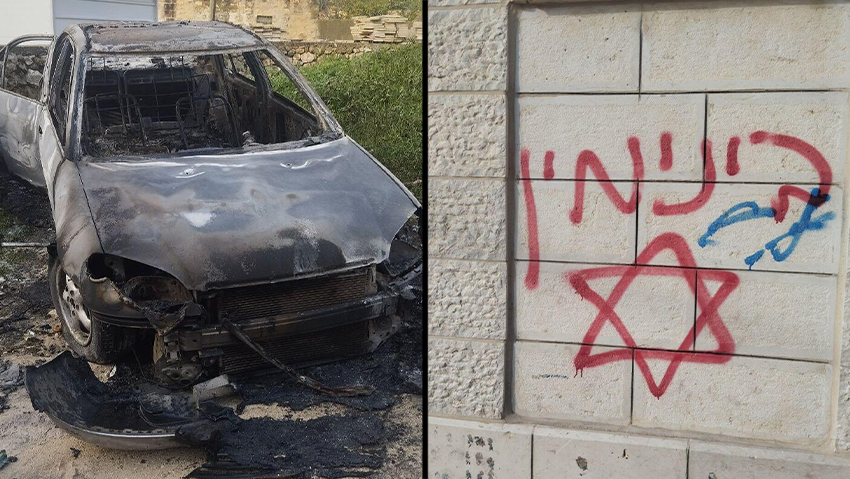
Attack in the village of Jalud
A central claim today is that the growing number of outposts and farms in the West Bank represent a modern form of Zionist pioneering and serve as a protective buffer for Israel, allegedly enjoying broad public consensus. These assertions — including the idea that perpetrators of violence are merely a “fringe” and that “there is no Jewish terrorism” — must be challenged.
As senior security officials have recently noted, the proliferation of settlement points — many lacking clear strategic logic — requires ever-increasing troop deployments, while some residents exacerbate tensions, including through violence against security forces.
Decision-makers in Israel, including some within the security establishment, are gradually realizing that it is impossible to have it both ways: to encourage dramatic settlement expansion, allocate significant resources, label all outpost residents a “national asset,” portray the Palestinian Authority as an enemy to be dismantled and cast all Palestinians as hostile — and then express surprise at escalating violence. These contradictions undermine core Israeli and Jewish values and damage Israel’s international standing, particularly with the U.S. administration, which has begun to voice sharper criticism and growing distrust.
A perception of Israel as lacking balanced judgment and control over events in the West Bank could gradually lead to externally imposed measures, including steps toward internationalizing the conflict — potentially even with U.S. support under President Donald Trump. The West Bank could follow the trajectory of Gaza, where the international community concluded that Israel lacked a coherent strategy beyond prolonged warfare and territorial control. This resulted in diminished Israeli influence, reflected in mechanisms such as the U.S.-led CMCC and arrangements that diverge from Israel’s declared goals, particularly regarding the disarmament of Hamas.
The deepening crisis in the West Bank also exposes a troubling reality within Israeli society. Amid the war, two distinct groups are emerging with sharply different worldviews and perceptions of time and space. On one side is a large segment — likely a majority — that lacks awareness of developments beyond the Green Line and does not fully grasp the implications of a de facto single state between the Mediterranean and the Jordan River, particularly regarding the fate of 3 million Palestinians in the West Bank. On the other is a group driven by a sense of destiny, replacing complex strategic thinking with biblical terminology and pursuing territorial expansion through ideological ventures, including attempts at settlement in Gaza, Syria and Lebanon.
No matter how many setbacks are experienced by those who believe that October 7 created a historic opportunity to reshape reality between the sea and the river, they continue to cling to the conviction that their goals are within reach. Trump has bluntly rejected annexation, referenced a Palestinian state in a U.N. initiative he advanced, abandoned the idea of transferring Gaza’s population and imposed arrangements in Gaza — yet none of this has prompted reassessment or doubt among them.
As a result, the West Bank is gradually replacing Gaza as the focal point of Israeli strategic illusions — a region where pragmatic policy is supplanted by wishful thinking. Such illusions inevitably collapse, yet their proponents, dismissive of terms like “inquiry” and “strategy,” move quickly on to new ones.
The escalating tensions in the West Bank are also undermining Israel’s broader national effort focused on Iran and Lebanon. First, forces must be diverted to the West Bank, and second, Israel’s image is tarnished at a time when international legitimacy is critical for those arenas. For more than a decade, security officials have warned of the need for strategic change in the West Bank due to shifts on the Palestinian side, but this has not materialized. The risk of escalation has grown in recent weeks — this time driven primarily by developments on the Israeli side — and must be recognized by decision-makers as a strategic threat.
The future character of Israel will be shaped in the West Bank, and the question of its trajectory must be central in the upcoming elections. The public must demand clear, substantive answers from leaders — not slogans about sovereignty or vague notions of conflict management.
Dr. Michael Milshtein is head of the Forum for Palestinian Studies at the Dayan Center at Tel Aviv University.