

There are moments in life, personal and national alike, when what is required is not agreement but responsibility. Not romantic reconciliation, but a willingness to pay a price. Parashat Vayigash is such a moment.
Judah approaches Joseph. Not as a hero, not as one who is right, and not from a place of confidence. He steps forward without knowing how it will end. He comes on behalf of another brother, on behalf of a father, on behalf of an entire family. This is not an impressive moral speech, but a single, simple act: taking responsibility for someone who depends on me—even if he is different from me, even if he entangles me and puts me at risk.
Rabbi Yitzhak Arama explains that the sale of Joseph stemmed from a fateful question: how to shape the character of the Jewish nation for generations to come.
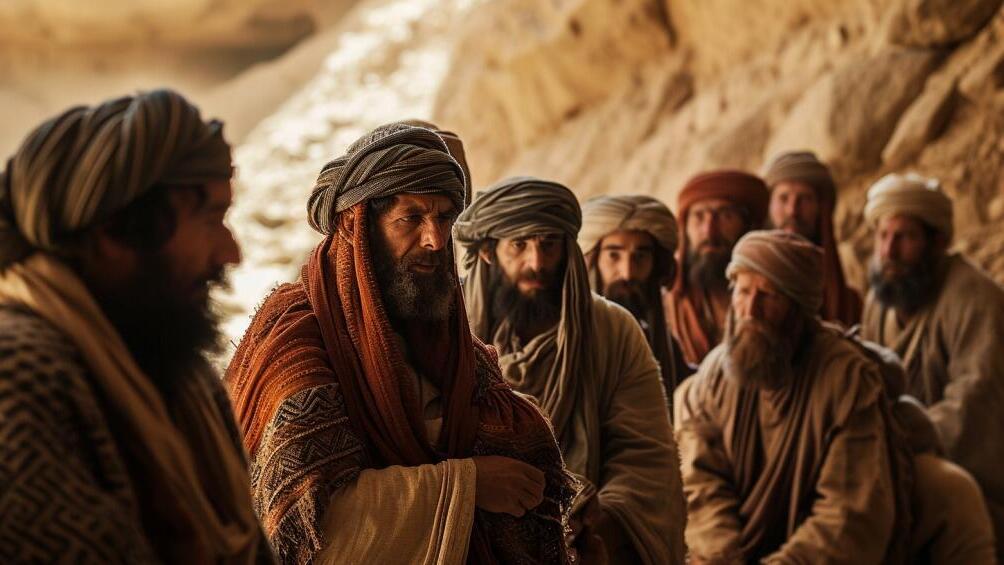
Joseph's brothers confer
(Image creator: Amitai Cohen - creator of educational content using AI technology)
If we follow this line of thought in a careful reading of Vayigash, it becomes clear that the encounter between the brothers is not an “emotional closure,” but a slow repair of a relationship that has fallen apart. Joseph does not rush to reveal himself. The brothers do not immediately confess. Only when Judah is willing to forfeit his personal freedom for Benjamin does revelation become possible. Not out of love, but out of responsibility.
Classical philosophical readings of the relationship between the individual and society point in the same direction. For Aristotle, a community is not built on shared feelings but on mutual obligation. Not “we feel the same,” but “we are responsible for one another.” Love may come later. Sometimes that love is the result of mutual responsibility and shared existence—and it certainly need not be a precondition for them.
This is not always a pleasant or comfortable message, but it is painfully accurate for Israeli society today. We are preoccupied with the question of whether love is possible—between right and left, religious and secular, center and periphery. But Vayigash offers a prior question: is responsibility possible? Are we willing to protect those with whom we disagree? Are we willing to give up something of our own so that the “younger brother”—the one without power, voice or political backing, and sometimes without proper representation—will not be harmed?
The brothers did not suddenly become identical people. The gaps remained. But something else was born: a willingness to be a family even when it is uncomfortable.
In organizations, as in Vayigash, crises are not resolved through speeches about values, vision or “togetherness.” They are resolved when a manager is willing to place themselves between the system and the most vulnerable person within it. The junior employee, the team that failed, the department without backing—this is not easy, but it is the true test of leadership.
Judah did not come to Joseph with a clever argument. He came with a commitment: I am responsible.
This is not charisma. It is not strategy. It is personal responsibility that allows the entire system to break free from paralysis.
In managerial terms:
Not “who is right,” but “whom am I protecting.”
Not “how does it look,” but “who will be hurt if I do nothing.”
Not “why did they fail,” but “how do I prevent the collapse of those who depend on me.”
Many managers search for a solution that balances interests. At times, specifically the unbalanced choice—the one that protects the weaker side—is what creates trust, commitment and organizational recovery. Yes, it rarely produces broad consensus, and it is certainly not “cheap popularity.” But that is precisely the difference between a manager and a true leader: one who is not afraid of “losing votes,” but is focused on values and fairness.
As a manager, I have often found myself in similar situations. I did not always act perfectly or as hindsight might suggest, but one of the strongest examples for me of what managerial responsibility truly means revolved around a decision regarding an office with sales activity in Asia. In the short term, it was clear this was primarily an investment: rebuilding a department, a small team operating remotely, without a real “protective envelope,” and during a period of cost-cutting—exactly the kind of unit likely to be the first to be cut.
And yet, the company’s leadership chose to preserve the activity, to trust the team, and to give them time and conditions to succeed. That trust, combined with consistent, hard work by the people on the ground, ultimately led to excellent results.
This week it was reported that Israel’s NewMed has begun exploration drilling in two potential gas reservoirs in Bulgaria—a move that, if successful, could be worth tens of billions of dollars. Beyond the dramatic economic impact on the company—which could become a significant player in the European energy market—it is important to remember that the chances of success are estimated at only 22%–32%.
And still, part of a CEO’s responsibility is to make precisely such decisions: to embark on a major move when not everything is certain, when not all indicators are green, knowing that if it succeeds it will be against the odds, and if it fails he is the one who will bear the consequences.
An organization does not fall apart because of a mistake. It falls apart when people realize that no one is taking responsibility for them. That is exactly the turning point of the Torah portion of Vayigash: the moment when responsibility precedes cold calculation, making revelation possible—of truth, of trust, and of leadership.
Parashat Vayigash is not a story of great love. It is a story of maturity—of taking responsibility, and of leadership.
Management, ultimately, is not the luxury of waiting for 100% certainty. It is the ability to choose, to act and to be accountable for the outcome—for better or for worse.
Leadership is tested at the moment when we stop asking who is right and begin asking who is responsible. Perhaps from there—and only from there—can love, too, be rebuilt.