

Iran’s announcement that it is prepared to reopen the Strait of Hormuz, despite its earlier refusal to do so in exchange for a temporary ceasefire, gave the White House press secretary sufficient grounds to declare victory and announce that President Donald Trump had succeeded in reopening the waterway.
It is difficult to assess how the expected talks between the sides will conclude, whether the wide gaps between them can be bridged, and whether they will in fact lead to an end to the war. However, even setting aside the dramatic statement by Iran’s Supreme National Security Council, which declared a “great victory” and a “severe historic defeat” for its enemies, a review of Iran’s 10-point plan — described by the U.S. president as a “good basis” for negotiations — raises a series of questions and concerns that cast significant doubt on the achievements of the current campaign.
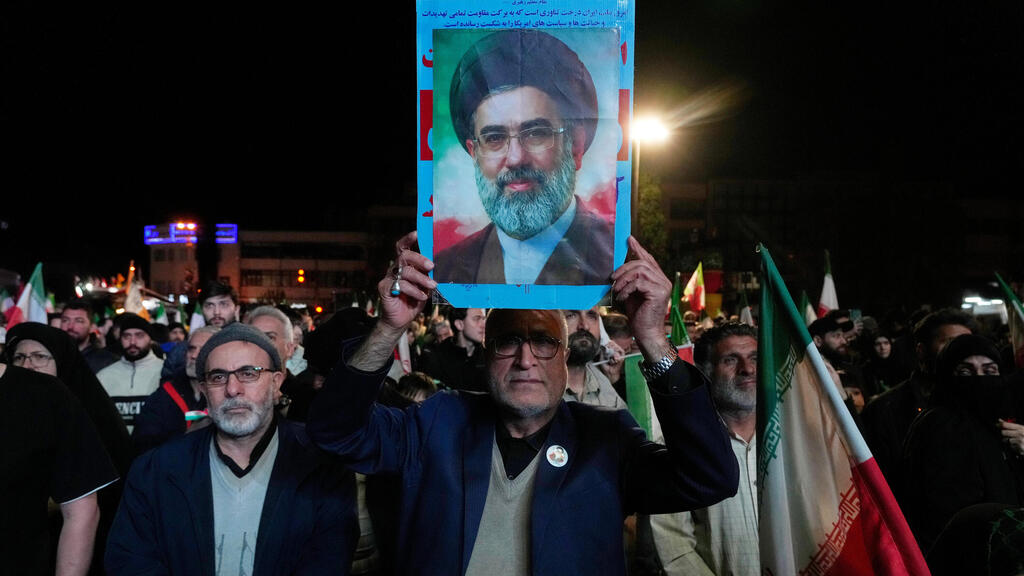
Supporters of the Iranian regime wave a portrait of Mojtaba Khamenei following the ceasefire announcement
(Photo: Vahid Salemi/AP)
First, the Iranian proposal calls on the United States to recognize Iran’s right to enrich uranium. As a reminder, this issue was one of the core disputes in the failed negotiations that led to the war. While senior U.S. officials insisted that Iran would not be able to continue enrichment under any future agreement, Tehran maintained it had no intention of relinquishing this right, at most agreeing to suspend its implementation for a limited period.
It is to be hoped that in the negotiations, the United States will insist on dismantling the underground facilities of Iran’s nuclear program, removing at least the uranium enriched to 60% that remains in Iran from the June 2025 war, diluting uranium enriched to 20%, and suspending enrichment for an extended period.
This would minimize, as much as possible, Iran’s ability to break out toward nuclear weapons in the future, drawing on lessons learned from the current campaign. At this stage, however, it cannot be ruled out that in an effort to prevent renewed fighting, the United States will agree to recognize Iran’s right to enrich uranium on its soil, even if it insists on removing the remaining fissile material.
Second, the Iranian proposal makes no reference to the issue of ballistic missiles. There is no doubt that Iran’s ability to rebuild its missile array has been significantly damaged in recent weeks, mainly due to sustained strikes not only on missiles and launchers but also on production capabilities and military industries. However, past experience, along with the fact that Iran still retains at least many hundreds of missiles and launchers stored in underground tunnels, reinforces the assessment that rebuilding these capabilities is largely a matter of time.
Third, there is still no indication that the Iranian regime is close to collapse, despite the significant internal challenges it faces, which have intensified considerably in recent weeks. On the contrary, despite the blows it has sustained, the regime — under even more hardline leadership — has managed to preserve its command and control capabilities up to the ceasefire.
Regime change was not presented as one of the war’s objectives, but the conditions that could enable the Iranian public to bring about the desired change do not yet appear to have matured. Even if Iranian citizens take to the streets at some stage to protest their worsening conditions, there is considerable doubt as to whether the regime has lost its ability to suppress demonstrators with brutal efficiency.
Moreover, if the United States agrees to ease sanctions on Iran, this would provide a lifeline to a regime at its weakest point. The removal of sanctions and the unfreezing of Iranian assets are unlikely to dramatically improve Iran’s dire economic situation, which also stems from structural problems, including mismanagement and corruption. However, they could improve the regime’s ability to cope more effectively with postwar reconstruction.
Fourth, on the issue of Hormuz as well, Iran appears to have achieved one of its central objectives. Tehran’s decision to close the strait selectively allowed it not only to influence the global energy market but also to use the war as an opportunity to turn its control over Hormuz into a significant political and economic asset. It appears that at least during the temporary ceasefire, Iran and the Sultanate of Oman — with which Tehran has negotiated in recent weeks over a protocol for supervising maritime passage through the strait — will be able to collect fees from vessels passing through it.
If this arrangement becomes permanent, it would not only generate substantial economic benefit for Iran but also fulfill its ambition to establish a new order in the strait that recognizes its status and its capacity to harm regional states and the global economy.
In any case, the very fact that the issue of Hormuz — rather than Iran’s nuclear and missile capabilities — has become the central issue for President Trump in issuing his ultimatum to Iran and agreeing to a ceasefire should be a cause for concern in Israel.
In addition, the details of the Iranian proposal include other problematic provisions, including demands for a withdrawal of U.S. forces from the region, the cancellation of resolutions by the Board of Governors of the International Atomic Energy Agency and a cessation of fighting on all fronts, including in Lebanon. Even if it is highly doubtful that these demands will ultimately be met, their very inclusion by Iran at this stage as a basis for negotiations provides further evidence of a sense of victory in Tehran, even after 40 days of fighting.
 Dr. Raz Zimmt
At the same time, attention should already be drawn to growing criticism in the United States toward Israel, which, according to an emerging American narrative, dragged the United States into an unnecessary campaign based on false promises of bringing down the regime in Tehran. This development in itself should be deeply troubling for Israel, as it not only jeopardizes its public standing in the United States — already at a historic low — but also poses a significant challenge to its ability to mobilize support in any future campaign against Iran, which is expected to continue for the foreseeable future.
Dr. Raz Zimmt is director of the Iran and the Shiite Axis Program at the Institute for National Security Studies (INSS).