


King Abdullah II of Jordan conducted an official state visit to China from August 18 to 24, culminating in summit talks with President Xi Jinping at the Great Hall of the People on August 24. The bilateral proceedings yielded signed intergovernmental documents spanning foreign affairs, trade, supply chains and judicial cooperation. Additionally, the leaderships issued a joint statement on deepening the China-Jordan Strategic Partnership established in 2015, expanding into the digital economy, artificial intelligence and green energy.
Amman's engagement in Beijing does not indicate a geopolitical rupture nor a realignment away from Western partnerships. It represents an intentional policy of measured diversification and strategic hedging. China became Jordan's largest trading partner in 2025, with trade volume reaching $6.7 billion to $6.72 billion. However, this economic footprint coexists with Jordan's reliance on the United States, which committed through a Memorandum of Understanding (FY2023 to FY2029) to provide $1.45 billion annually in military and economic aid, with actual obligations between $1.45 billion and $1.65 billion. This commercial pivot functions alongside Jordan's quiet security coordination with Israel.
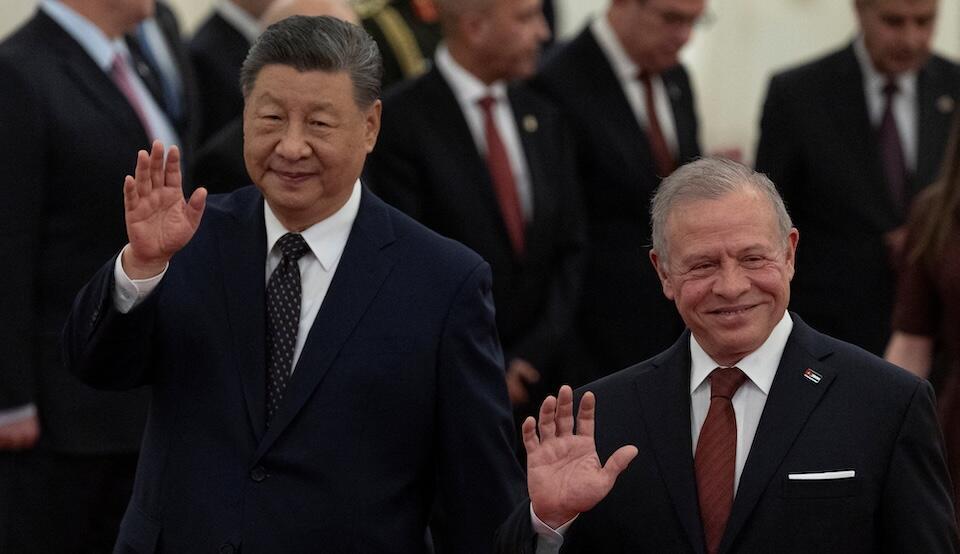
China’s President Xi Jinping (L) and King Abdullah II of Jordan (R) gesture after attending a welcoming ceremony at the Great Hall of the People in Beijing, China
(Photo: Reuters)
Amman’s strategic logic: domestic strain and multipolar hedging
The structural imperatives driving the Hashemite monarchy toward deeper economic cooperation with Beijing stem from severe domestic economic pressures and sovereign statecraft. Jordan continues to manage persistent economic challenges, including youth unemployment, constrained public revenue, water scarcity and national energy transition targets. The Royal Court in Amman recognizes that long-term social stability depends on delivering tangible economic performance to a population sensitive to regional instability.
Expanding commercial and technological partnerships with China provides Jordan with investment, equipment and technological expertise without political governance conditions associated with Western financing. The documents executed during the August visit target Jordan's growth imperatives. By inviting Chinese enterprises into solar power, wind infrastructure, electrical grid modernization and digital platforms, Amman seeks to fortify its internal economic resilience.
This approach reflects rational statecraft within a multipolar global system. Jordan is not attempting to replace its primary security alignment with Washington, which remains the guarantor of its external security and fiscal baseline. Instead, Amman is constructing a broader diplomatic safety net. By cultivating robust commercial links with major non-Western powers, the Hashemite leadership enhances economic flexibility and preserves strategic maneuverability, insulating the kingdom against global shifts.
The Palestinian file: diplomatic alignment and global leverage
The political dimension of the August summit in Beijing centered on strong diplomatic alignment between King Abdullah and President Xi regarding the Palestinian issue. Official readouts from the Royal Hashemite Court, Petra News Agency and China's Ministry of Foreign Affairs confirmed that both leaders endorsed a two-state solution based on 1967 lines. Both sides reaffirmed the necessity of establishing an independent, viable, sovereign Palestinian state with East Jerusalem as its capital. Furthermore, the joint statement emphasized the principle of "Palestinians governing Palestine" across the West Bank and post-war Gaza, while Beijing reiterated support for Hashemite custodianship of Jerusalem's holy sites.
For the Hashemite Monarchy, coordinating its diplomatic posture with a permanent UN Security Council member yields strategic leverage. Amman views Beijing's international standing as a mechanism to reinforce international law and counter unilateral measures in the West Bank that the monarchy views as threats to internal stability. The Royal Court recognizes that China's regional diplomatic profile has expanded, demonstrated by its hosting and mediation of the 2023 Saudi-Iranian reconciliation.
By anchoring vital security concerns to Chinese global diplomatic initiatives, Jordan aims to ensure that its historical custodianship over Jerusalem's holy sites retains international backing. Additionally, Amman seeks Chinese diplomatic weight to ensure post-war regional arrangements accommodate Hashemite priorities. For Israel, this alignment requires recognition that Jordan will utilize its partnership with Beijing to build broad international consensus around its preferred Palestinian framework.
The dual security reality: ring-fencing the operational core
Assessing strategic consequences for Israeli security requires separating high-level diplomatic positioning from fundamental operational border defense. The primary security pillar along Israel's eastern frontier remains intact. The quiet operational relationship connecting the Israel Defense Forces (IDF), Shin Bet and Jordan's General Intelligence Directorate (GID) continues to function as an indispensable strategic buffer along the 480-kilometer border.
Continuous operational collaboration among the IDF, Shin Bet and GID represents Israel's frontline defense against eastern destabilization. Joint security efforts remain focused on dismantling arms smuggling cartels, intercepting drone traffic, neutralizing violent extremist networks and preserving stability throughout the Jordan Valley corridor. Nothing in the bilateral agreements signed in Beijing indicates any intent within the Jordanian defense establishment to undermine this operational relationship. The Hashemite leadership understands that its security depends on maintaining an impermeable border.
Technological exposure: managing intelligence and cyber vulnerabilities
While the operational security core remains resilient, the expanded presence of Chinese physical and digital infrastructure inside Jordan introduces legitimate long-term intelligence and cybersecurity considerations for Israel. The strategic commitments made in Beijing place explicit emphasis on joint initiatives in artificial intelligence, digital economy infrastructure, telecommunications expansion and smart industrial supply networks.
Documented global patterns regarding state-linked technology vendors underscore potential vulnerabilities associated with deep digital integration. The deployment of advanced cellular infrastructure, smart surveillance camera systems, cloud data storage centers and automated logistics platforms near sensitive border areas creates potential exposure for signals intelligence (SIGINT) and electronic warfare operations.
As Chinese state-backed entities participate in Jordan's energy grids, transport hubs and telecommunications networks, the physical proximity of these systems to IDF positions along the Jordan Valley naturally increases. The key security concern for Israel is not intentional espionage by Jordanian institutions, but potential third-party intelligence gathering, cyber vulnerabilities and covert collection embedded within dual-use commercial technologies.
These realities do not warrant public opposition or diplomatic pressure on Amman. Instead, they require methodically executed technical risk mitigation. Israel must anticipate foreign technology near its eastern border and adapt its signals security protocols, operational cyber defenses and border monitoring infrastructure to preserve operational security.
Strategic recommendations and concluding vision
To address Amman's measured diversification effectively, Israel should implement a calibrated, three-pronged strategy reinforcing bilateral economic foundations while establishing clear technical security boundaries.
First, Israel must actively expand its bilateral economic ballast with the Hashemite Kingdom. Deepening economic interdependence represents the most practical tool to reinforce shared security objectives. Jerusalem should expand existing bilateral initiatives, particularly in desalinated water supply allocations, joint solar-for-water energy exchanges and cross-border commercial transit corridors. Serving as Jordan's reliable supplier of vital resources like water reinforces Israel's standing as an indispensable partner, ensuring Chinese investment complements regional cooperation.
 Amine Ayoub
Second, Israel should establish quiet bilateral technical security consultations with Jordanian counterparts concerning foreign digital infrastructure deployed near sensitive border corridors. Rather than demanding exclusions, Israeli technical experts can work alongside Jordanian officials to define technical standards, baseline encryption protocols and physical hardware buffer zones for telecommunications and surveillance equipment operating near the Jordan River corridor. Setting clear technical standards protects joint security while respecting Jordanian sovereignty.
Third, regarding the Palestinian file, Israel should maintain a pragmatic approach to Chinese commercial participation. Where Beijing offers to finance civilian infrastructure projects in the West Bank or post-war Gaza, Israel can utilize Jordan's administrative role to filter these initiatives, ensuring focus on economic stabilization. Any Chinese involvement must remain subject to an absolute Israeli security veto, eliminating dual-use risks while allowing limited external capital under Jordanian filtering.
King Abdullah II's August 2026 state visit to Beijing reflects the evolving dynamics of modern regional statecraft. Amman is responding to internal economic pressures through sovereign multipolar balancing, expanding trade options while maintaining core security relationships with Washington and Jerusalem. Israel's defense establishment possesses the strategic sophistication required to navigate this landscape without panic. Navigating Amman’s expanding ties with Beijing ultimately demands that Israel protect the operational security core, manage the technological periphery and convert diplomatic diversification into an additional stabilizing channel.
- Amine Ayoub, a fellow at the Middle East Forum, is a policy analyst and writer based in Morocco. Follow him on X: @amineayoubx