


As a desperate move, faced with the sense that the Israeli public doesn’t truly care about the suffering of Gazans, the Israeli left has once again pulled its so-called doomsday weapon — or more accurately, its most overused card: comparisons to the Holocaust. This trend is a textbook example of Holocaust trivialization — diminishing its scope and historical weight by likening it to far smaller, unrelated events.
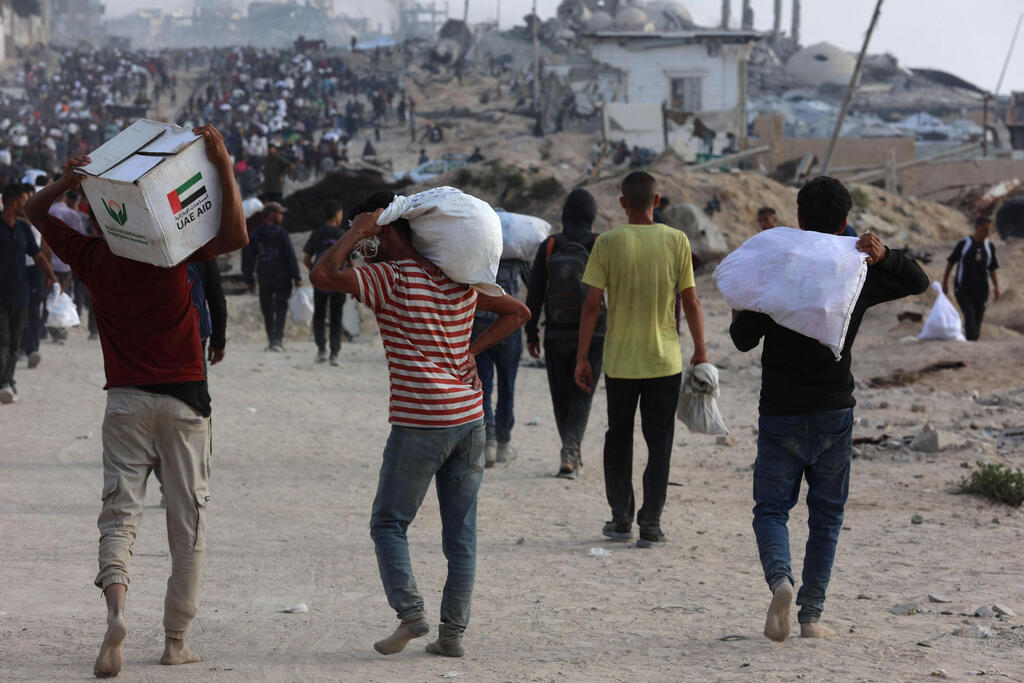
Unfortunately, these comparisons are spreading like wildfire in August, even within Israel. The poet Agi Mishol, for example, wrote that “a ‘humanitarian city’ sounds like a ghetto, and the ‘final victory’ is starting to sound more and more like the ‘Final Solution.’” An editorial in Ha'aretz, a well-known left-leaning publication, claimed the plan to build a "humanitarian city" in Rafah was in fact a plan to establish a “concentration camp.” Similar claims were echoed by Channel 12’s foreign news editor Arad Nir and other media figures.
Former Prime Minister Ehud Olmert joined in during an interview with British media. Radical protest activist Dr. Yolanda Yavor compared Netanyahu to Nazi war criminal Josef Mengele and warned on Facebook: “The concentration camp now being built in Gaza is only the pilot. We’re next. Let’s not go like sheep to slaughter! Only a siege will bring down the tyrant” (she later deleted the post). These are just a few selected examples of the new trend.
Rules of the comparison game are simple: to maximize shock value, one must compare everything to the Holocaust. Even though countless atrocities have taken place since — in Rwanda, Darfur, or even in the unprovoked war Russia launched against Ukraine in 2022 — only the Holocaust is deemed worthy of comparison. The reason: the public lacks deep knowledge or emotional connection to other genocides or war crimes. Facts don’t matter in this game. The goal is singular — to pressure Israel to halt its war against the terror groups in Gaza. Those who dare to make these comparisons are praised for their “courage,” even when everyone around them shares the same view.

Former Prime Minister Ehud Olmert
(Photo: AP Photo/Ariel Schalit)
What can one say to people who can’t tell the difference between a refugee camp and a concentration camp? How is a serious discussion even possible when facts and context hold no value? Is it worth pointing out IDF’s significant efforts to minimize civilian harm, in stark contrast to the Nazis’ obsessive push to kill as many Jews as possible? Is it worth noting that there was no prior military confrontation between Jews and Germans before the Holocaust, whereas the war in Gaza followed a horrific massacre by hundreds of Palestinian terrorists — a massacre that was publicly celebrated in the streets of Gaza and during which Israeli hostages remain in captivity?
Get the Ynetnews app on your smartphone: Google Play: https://bit.ly/4eJ37pE | Apple App Store: https://bit.ly/3ZL7iNv
Does it help to remind people of the broader context — a complex urban battlefield where the enemy, which rejects all compromise and seeks the eradication of Jewish presence in the land, uses civilians as human shields? How is any of this remotely comparable to the Nazi extermination campaign against a non-threatening population whose only “crime” existed in the fevered imaginations of Hitler, Goebbels, and their ilk?
It appears there’s no point in arguing facts here. The knee-jerk backlash against the academic work of Professor Danny Orbach, Dr. Jonathan Boxman, Dr. Yagil Henkin, and attorney Jonatan Braverman — who critically examined the genocide accusations against Israel during the Gaza war — is telling. When people fall in love with propaganda, they become addicted to the “genocide” lie that the enemy began amplifying at the very start of the war. Critics will label Orbach and his colleagues as Israeli government mouthpieces, but they’ll never admit their own enlistment in Palestinian propaganda or their deep-seated hatred of the Israeli government.
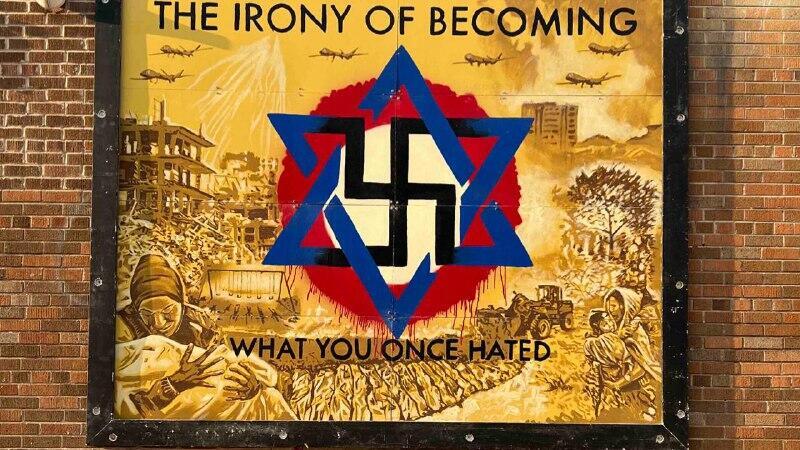
A Milwaukee painting comparing Nazism and Zionism
Some of the chronic comparers will claim their Holocaust references are merely “metaphorical” — a moral wake-up call meant to warn Israel of the abyss it might tumble into. But anti-Israel activists around the world often take these statements literally. Besides, opinion columns, Facebook posts and interviews aren’t poems; people read them as they are.
The call to stop trivializing the Holocaust applies across the political spectrum. Hamas operatives are Islamists, jihadists, fundamentalists — there are more than enough descriptors available without invoking “Nazis.” Duty to uphold historical accuracy rests on all of us. Otherwise, we lose our moral standing to demand others refrain from warped comparisons that minimize the Holocaust. Even metaphorically, such analogies are baseless and harmful.
The memory of the Holocaust should never be a political plaything. Absurd comparisons laced with demagoguery and provocation distort the truth and diminish the Holocaust as a singular event in human history.