

Many in Israel believed that after the war in Gaza concluded, international animosity toward Israel might fade and conditions might revert to those prevailing before October 7. Then came a tweet by Nalin Haley, the son of Nikki Haley — the former U.S. Ambassador to the United Nations, a candidate in the U.S. presidential race and a prominent supporter of Israel: “Israel is just another country. You should stop interfering in American politics if you really want to keep our relationship.”
When the son of one of Israel’s strongest U.S. allies uses rhetoric reminiscent of the chants heard on U.S. campuses in recent years — chants such as “from the river to the sea” and “free Palestine” — it becomes clear this is not a marginal phenomenon. This is a long‑term campaign aimed at shaping the consciousness of young Americans. A Harvard Harris poll in August found that only 40% of Gen Z respondents supported Israel, while 60% backed Hamas.
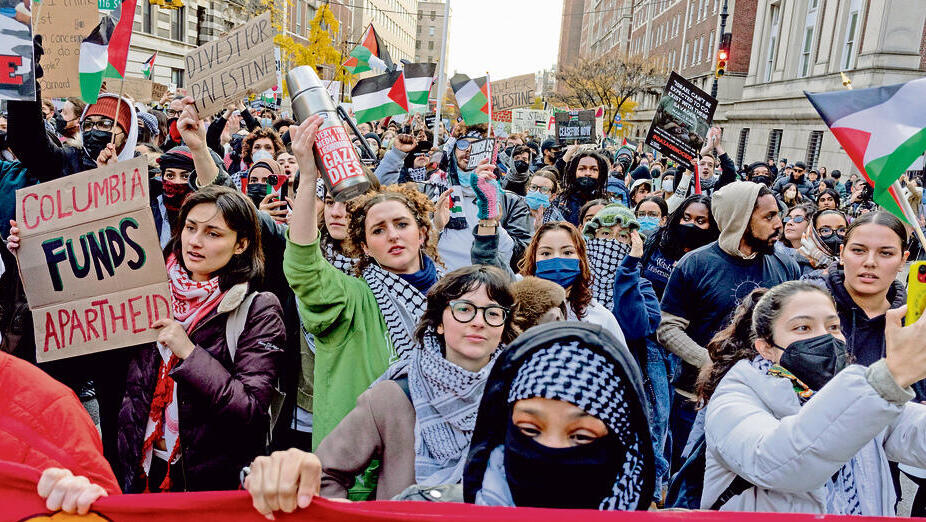
Anti-Israel protests at Columbia University; Green-Red Alliance
(Photo: Andrew Lichtenstein, Getty)
This is not support for the Palestinian Authority but for an organization designated a terrorist group by the U.S. government. These figures are not a reaction to the images coming out of Gaza. They reflect a synthetic system active for more than a decade, which seeks to engineer a generation’s consciousness. To understand how this happened, one must examine the deeper process that began long before the current war. The foundation lies in the ideological language of neo‑Marxist campus movements which merged with Islamist movements aligned with the Muslim Brotherhood in the U.S. This “green‑red alliance” identified a common goal: weakening the West from within. Its most effective tool: antisemitism, used as a divisive force to stoke internal social conflict. Enter the social‑justice narrative. For at least a decade the narrative has been spread that white people bear original sin because they are heirs to those who stole Indigenous lands or enslaved Africans, and benefit from systemic privilege over people of color. This process produced a generation that internalizes: “I must atone for what the white man did.” And where is the supposed enduring colonial‑oppression system? Israel.
This guilt‑through‑“whiteness” perception became a concept awarding intrinsic guilt to anyone born white. To escape this guilt the only way is to side with the oppressed — rendering Israel the ideal target. This wasn’t spontaneous hatred but engineered hatred.
Here we see the four stages identified in our forthcoming scientific article in the Journal for the Study of Antisemitism, co‑written with my colleagues Prof. Golan Shahar of Ben‑Gurion University, a psychologist specializing in youth in loss contexts, and Prof. Jennifer Brick Murtazashvili of University of Pittsburgh. Prof. Shahar coined the term “self‑critical malignancy,” a deep guilt the youth carry for the deeds of previous generations, which becomes a mechanism for self‑atonement. A young white person feeling “white guilt” needs to atone — and Israel becomes the ultimate target. This is not spontaneous hatred; this is engineered hatred.
The four stages of the process:
Mobilization — Begins in middle and high schools where pro‑Palestinian demos are framed as part of social justice and moral awakening.
Breaking the rules of engagement — Students arrive on campus and receive legitimacy to chant harmful slogans such as “from the river to the sea” even when Jewish students request they stop.
Breaking the ethical code — The young person commits infractions against the university code: blockades, harassment, shaming and isolating Jewish and Israeli students.
Breaking the law — In the final stage the student is willing to be arrested, as happened during the takeover of the library at Columbia University, which ended in arrests, expulsions and criminal records.
This phenomenon is not limited to the American left. Young people on the right are going through similar processes. The influx of Qatari money into academic institutions is influencing both sides. Recently, it emerged that the communications school at Northwestern University, acquired by Qatari donors, even forbade faculty criticism of Qatar. Meanwhile, Israel itself was absent from this arena. Its Foreign Ministry had been starved of resources for years, unable to contend with the cognitive campaign. The state commission of inquiry must examine this failure. One cannot understand Israel’s international position without understanding the campaign for the consciousness of young Americans.
 Dr. Kobby Barda Photo: Tal Givony
Yet there is hope. Private parties such as Ella Kenan, founder of Bright Mind, and Rotem Oreg-Kalisky, founder of Librael, are already active on the ground. The state must partner with them, set clear objectives, fund them and monitor outcomes to return Israel to the critical arena in which it never engaged.
Dr. Kobby Barda is an expert in American political history and geostrategy, at Holon Institute of Technology (HIT).