


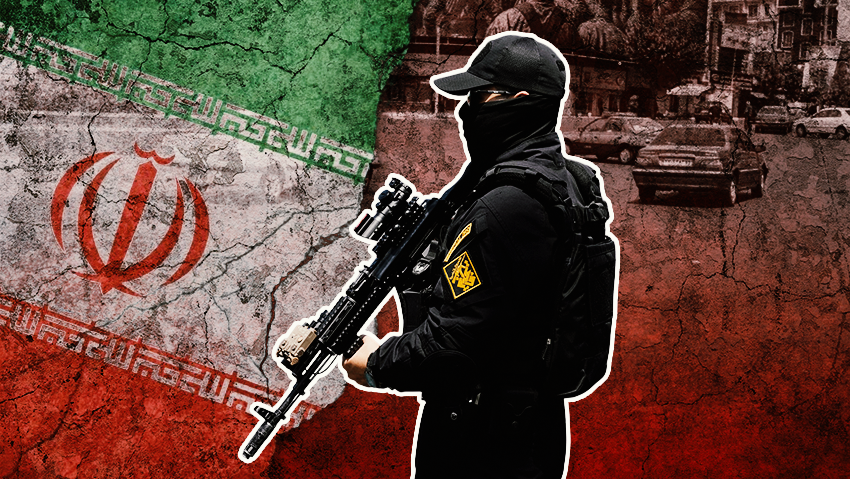
The European Union finally did what many in Israel and the US have demanded for years: it unanimously designated the Islamic Revolutionary Guard Corps (IRGC) as a terrorist organization. Tehran’s reaction was as swift as it was predictable, with the Iranian Foreign Ministry calling it a "major strategic mistake" and accusing Europe of "fanning the flames." While we should welcome this long-overdue political signal, we must also ask the hard question: Is this genuine statecraft, or is it mere symbolism?
The timing of the EU’s move is directly tied to the "catastrophe" currently unfolding inside Iran. Documents reviewed by human rights groups suggest that over 36,500 Iranians—many of them youth and children—have been executed or killed in the streets by the IRGC’s elite units since the current uprising began. This is the "dumbification" of the regime in its most lethal form: a state that has replaced meritocracy and governance with "medieval raids" against its own people.
(Photo: AP Photo/Vahid Salemi, Shutterstock)
For Israel, the EU designation is a tactical win. It provides a legal framework to disrupt the IRGC’s "Shadow Empire" in Syria and Lebanon, and it complicates the group’s ability to use European financial systems to fund its "Ring of Fire." But a label is not a strategy. The Islamic Republic is now weaker than it has been at any point since 1979. Its military was humiliated in the direct clashes of 2025, its proxies are decimated, and its economy has reached a point of hyper-inflationary collapse where the currency has plummeted and basic food prices have soared beyond the reach of ordinary citizens.
The real "strategic mistake" would be for the West to believe that a terrorist designation is a substitute for real action. The EU designation must be followed by concrete steps if it is to have any impact on the ground. First, Western powers must explicitly recognize the right of the Iranian people—specifically the youth—to "legitimate self-defense" against a designated terrorist entity. If the IRGC is a terrorist group, then the Iranians fighting them are not "rioters"; they are a resistance movement. We must move from "expressing solidarity" to providing the logistical tools, including more satellite communication terminals, that allow this resistance to coordinate despite the internet blackout.
Second, the West should utilize the "Solidarity" model of the 1980s. The liberation of Eastern Europe was achieved by focusing on supporting internal movements rather than just external pressure. The current uprising in Iran, spread across 100 cities, is the "opportunity of a lifetime" to collapse the Khomeinist era from within. The regime's image of invincibility has been destroyed, and even its staunch loyalists are beginning to look for an exit. The internal cracks are widening as the "dumbification" of the state apparatus renders it unable to solve the very economic crises it created.
Third, we must address the "Governance Vacuum." The fall of the former regime in Syria has shown the danger of state collapse without a managed transition. If the IRGC structure collapses tomorrow, the world must be prepared for what comes next. This requires working with the diverse Iranian opposition and the legitimate representatives of the Iranian people to ensure that the vacuum is not filled by another radical or chaotic variant.
 Amine Ayoub
Israel’s primary "strategic anxiety" is that the U.S. and Europe will use this EU designation as a way to "check the box" and avoid the necessary measures against Iran’s remaining nuclear infrastructure. The arrival of massive naval strike groups in the region and the threat of "far worse" attacks if a deal is not reached is the only language the regime truly understands. The EU has finally called the IRGC what it is: a transnational engine of repression. Now, Israel and the West must treat it like what it is: an existential threat that must be dismantled, not just labeled.
The "bittersweet" victory of a legal designation must not become a strategic delusion. The IRGC is the regime's backbone—weakening it weakens the regime's capacity to repress at home and export terror abroad. The time for diplomatic pragmatism has passed; the era of ideological alignment and decisive action has arrived. The survival of regional stability depends on ensuring that the Ayatollahs do not survive their final crisis. The label is only the beginning; the objective must be victory.