


Syrian parliamentarians in Damascus have begun gathering signatures for a legislative motion to repeal Law No. 49, the July 1980 statute enacted under Hafez al-Assad that made membership in the Syrian Muslim Brotherhood a capital offense punishable by death. As of October 13, the proposal had not yet been formally submitted, still requiring the support of 17 assembly members before the drafting process could begin. The immediate question is therefore not whether the law will be repealed, but whether the transitional authorities will permit the proposal to advance. A parliamentary proposal in a shattered post-Assad Syria might easily be dismissed as minor administrative noise or distant legal housekeeping. It is anything but that. While repealing an autocratic decree does not automatically legalize the organization or grant it a party charter, the Muslim Brotherhood has already signaled its explicit intention to return from exile, re-enter public life, and seek a role in shaping Syria's political architecture.
For Israel, this moment represents a significant development along its northern frontier. The essential question is not simply whether Islamists exist in Syria, but rather: Is post-Assad Syria moving toward genuine political pluralism, or will disciplined Islamist networks manipulate new democratic mechanics to rebuild state-backed influence on Israel's doorstep?
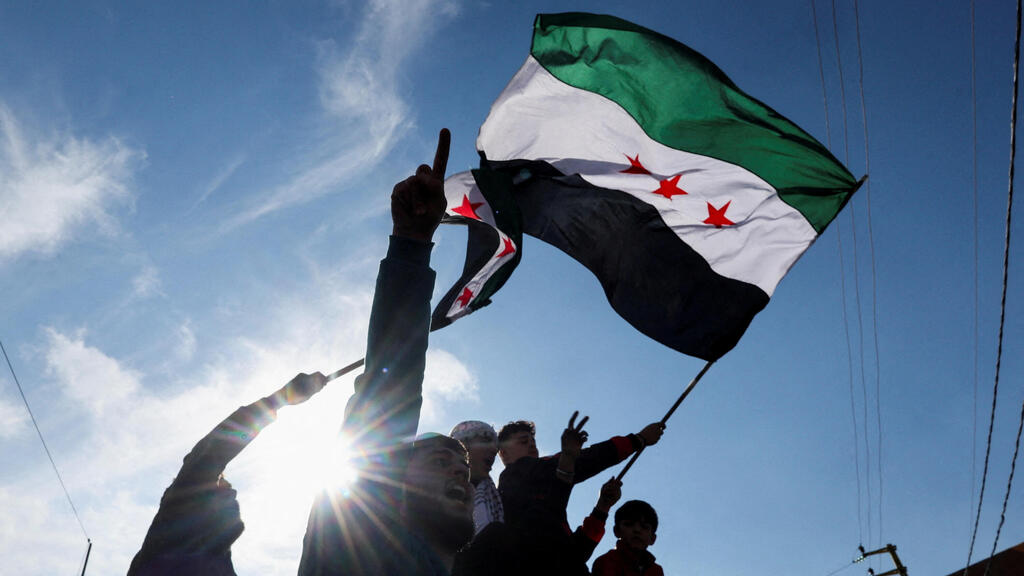
A man waves the Syrian opposition flag following Assad's fall
(Photo: REUTERS/Amr Abdallah Dalsh)
Repealing Law No. 49 is fundamentally about removing a notorious symbol of the Assad dynasty's terror state. Passed during a violent crackdown on political opposition, the law specifically criminalized membership in the Brotherhood with capital punishment, serving alongside the regime's broader apparatus of mass arrests, disappearances, and extrajudicial executions to eliminate political dissent. Removing a law that prescribed execution for political affiliation is a basic, necessary threshold for any country attempting to transition away from totalitarian rule. Following the collapse of the former regime, the January 2025 Victory Conference declaration explicitly suspended exceptional laws and dissolved Baath Party structures; the unresolved issue today is whether that action already legally covered this particular statute or whether formal legislative repeal is required. The current proposal in the People's Assembly reflects an effort to resolve that statutory uncertainty. Supporting the abolition of an abusive law, however, is radically different from endorsing or legitimizing the Muslim Brotherhood as a political actor.
The Syrian Muslim Brotherhood is an organized ideological movement with a complex, turbulent history. Originating historically as an offshoot of the Egyptian Islamist movement, the Syrian branch developed its own distinct operational path, separate from other regional actors like Hamas, which emerged directly from the Palestinian branch of the wider Muslim Brotherhood movement. Having spent decades operating in exile or underground, the organization portrays itself in its official platforms as a moderate, constitutional force committed to civil norms, political pluralism, and democratic competition. On September 27, 2026, the Shura Council of the Syrian Muslim Brotherhood issued a sixteen-point declaration explicitly calling for party pluralism, organized political activity, and a permanent constitution. Yet repeal would not guarantee a mass political revival. The Brotherhood faces internal divisions, pressure to dissolve and a diminished support base after years of exile and the Syrian civil war. Sympathy for those persecuted under Assad does not necessarily translate into support for the organization today. The organization is not returning to an open political arena. Syria has yet to enact the law governing political parties, while figures close to the transitional presidency have called on the Brotherhood to dissolve. Its leadership has rejected that demand. The dispute is therefore also a test of whether the new authorities will establish a workable framework for organized political competition beyond their own preferred structures. Skeptics point out that the organization's stated commitment to pluralism must be assessed against its actual political program and conduct, particularly given its historical emphasis on expanding religious influence within state institutions. The true test for post-Assad Syria, and the primary strategic concern for Israel, lies in how the emerging Syrian constitutional framework manages this tension. If Syria legalizes political parties, does it establish rigorous guardrails to prevent anti-democratic or foreign-backed movements from using open elections to subvert democratic principles? Or does it allow disciplined ideological networks to secure levers of state authority?
Whatever political rules take root in Damascus directly influence the long-term operational environment along Israel's northern frontier. The primary security risk for Israel is not merely the individual presence of Muslim Brotherhood parliamentarians in a future assembly. Rather, the concern is whether formal recognition could create potential avenues of influence within executive institutions, ministry budgets, judicial appointments, or educational policy—outcomes that would depend entirely on future electoral results, institutional arrangements, and the distribution of power. Historically, exiled leaders of the Syrian Brotherhood found safe havens and political backing in Turkey and Qatar. If an organized Islamist movement achieves formal political status in Damascus, there is a distinct risk that external actors could leverage these political channels to project strategic influence into Syria, creating new security variables along Israel's northern border.
Furthermore, Israel must evaluate the risk scenario in which political factions in Syria form ideological or operational alignments with hostile regional networks, including militant groups in the broader Middle East. Israel does not need another armed or ideological adversary establishing a foothold within the sovereign structure of an adjacent state. While Hamas in Gaza emerged directly from the Palestinian branch of the Muslim Brotherhood and Hezbollah in Lebanon operates as an Iranian-backed Shiite militia, both examples demonstrate the fundamental danger posed to regional stability when armed movements operate outside effective state control. Whenever political systems permit non-state factions or foreign-backed movements to build institutional power while maintaining independent capabilities, the result is state weakness and heightened conflict risk.
The political struggle surrounding Law No. 49 represents the first major structural stress test for post-Assad Syrian governance. To assess whether this transition poses a genuine security threat, specific, measurable indicators should be tracked rather than relying on broad assumptions. Key developments to watch include: the financial transparency and funding sources of political parties; whether the existing constitutional prohibition on private military and paramilitary formations is enforced equally against every political faction, regardless of its relationship with the transitional authorities; explicit legal protections for religious and ethnic minorities; proposed reforms to national education curricula and the judiciary; and a binding commitment from all participating factions to adhere to democratic electoral rules.
 Amine Ayoub
If repeal is accompanied by a legal framework that guarantees individual liberties, protects minorities and enforces the state's existing prohibition on independent armed formations, Syria may indeed be charting a path toward long-term stability. Such an outcome would serve core Israeli security interests by fostering a predictable, sovereign neighbor focused on domestic reconstruction rather than regional confrontation. Conversely, if the repeal acts as an uncritical opening for disciplined networks operating without institutional checks or counterweights, Syria risks swapping one form of instability for another, potentially allowing domestic political mechanisms to become a platform for hostile regional pressure aimed at the Jewish state.
While immediate operational threats require constant military vigilance, long-term national security demands that Israel anticipates the political structures emerging along its borders before they harden into permanent realities. Israel has no vote in the Syrian parliament, nor should it attempt to meddle in the domestic legal reforms of its neighbor. However, Israeli decision-makers must look past surface-level rhetoric. What matters is whether Damascus applies the same political rules to every faction, prevents foreign patrons from exercising influence through unaccountable networks, and enforces the state's monopoly on armed force. That is what will determine whether Syria's political transition produces a more predictable neighbor or creates new security risks along Israel's northern frontier.
- Amine Ayoub, a fellow at the Middle East Forum, is a policy analyst and writer based in Morocco. Follow him on X: @amineayoubx