


While Israel's air force was dismantling Iran's nuclear infrastructure and the IDF was fighting on multiple fronts, Turkish President Recep Tayyip Erdogan spent the same months doing what he does best: turning regional catastrophe into personal strategic gain.
On Tuesday in Riyadh, Saudi Transport Minister Saleh Al-Jasser and his Turkish counterpart signed comprehensive memoranda of understanding for a new overland rail corridor. The stated goal is practical: bypass the nearly shut Strait of Hormuz, slash cargo transit time from thirty-plus days by sea to under two weeks by land, and rescue Gulf supply chains strangled since the U.S.-Iran war began in late February.
The corridor runs from Istanbul through post-Assad Syria, down through Jordan and into Saudi Arabia's existing rail network at the Haditha border crossing, with ambitions to eventually reach Oman and the Indian Ocean. Estimated investment costs sit at around five and a half billion dollars, with the Asian Infrastructure Investment Bank already committing $750 million toward Turkish rail infrastructure along the route.
Every city on that map is deliberate, and not one of them is Israeli
Back in September 2023, then-U.S. president Joe Biden announced the India-Middle East-Europe Economic Corridor, known as IMEC, at the G20 in New Delhi. That corridor was designed to run freight from Indian ports through the UAE, Saudi Arabia, Jordan and Israel, then onward to Europe. It was, among other things, an implicit wager that Israel's Abraham Accords connections were turning the Jewish state into the indispensable commercial node of Middle Eastern trade.
Erdogan was furious. Turkey, the geographic bridge between Asia and Europe for centuries, had been bypassed entirely. He said so loudly and repeatedly.
IMEC died in October 2023 with the Hamas attack on Israel. It has not recovered. The Saudi-Turkish corridor announced this week is its direct replacement, and Erdogan made certain this time that Turkey is not the country being skipped. He is not merely back on the map. He is the map.
The geopolitical architecture Erdogan has assembled deserves careful attention from Jerusalem, because it has been constructed almost entirely during the period when Israel has been consumed by war.
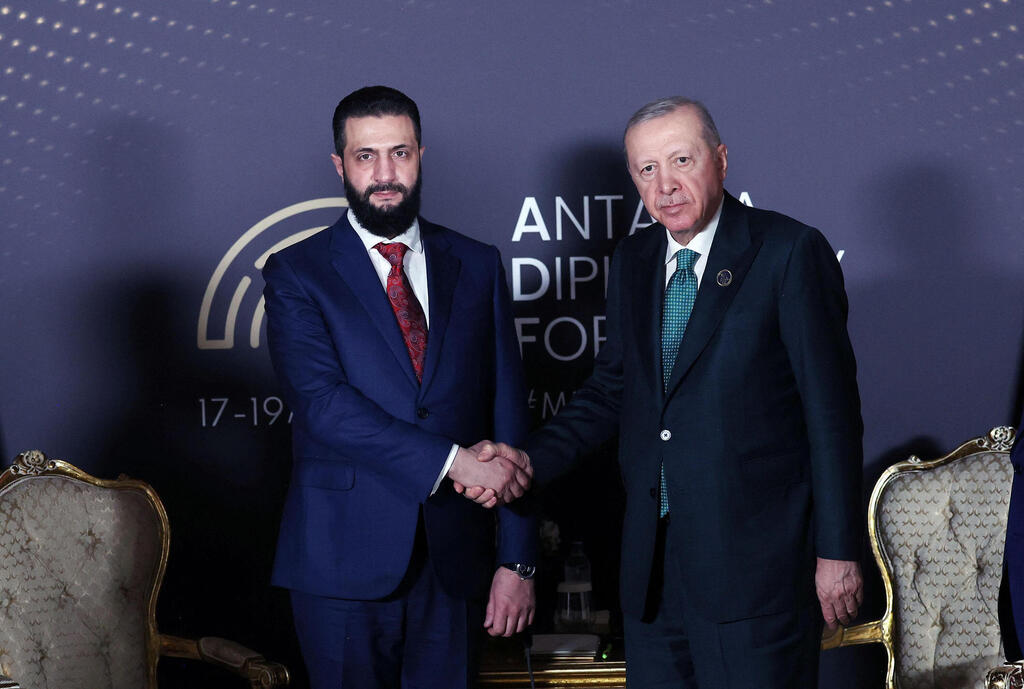
Syrian President Ahmed al-Sharaa and Erdogan
(Photo: AFP PHOTO / TURKISH PRESIDENTIAL PRESS SERVICE / HANDOUT)
Start with Syria, which is now the corridor's operational spine. The government Erdogan backs in Damascus emerged from Hayat Tahrir al-Sham, an organization the European Union and the United States continue to designate as a terrorist group. Erdogan calls them liberators. He has spent the months since Assad's fall positioning Turkey as Damascus's irreplaceable economic patron, with Turkish companies already operating in Aleppo, Turkish banks preparing to open branches across Syrian territory and a bilateral trade target of ten billion dollars by 2030.
At this week's Anatolian City Economies Summit in Gaziantep, just across the border from northern Syria, Turkish Trade Minister Omer Bolat announced the imminent opening of the Islahiye rail crossing between Turkey and Syria, while Syria's economy minister invited Turkish investors to treat his country not as a market to exploit but as a partner to build.
The corridor encodes this dependency permanently. Every freight train making the Istanbul-to-Saudi-Arabia journey will cross through Aleppo and Damascus, meaning the entire Eurasian land bridge passes through territory that is effectively an economic protectorate of Ankara. Erdogan has secured a sphere of influence stretching from the Bosphorus to the Red Sea, with an Islamist-governed Syria as its operational backbone.
For Israel, the strategic implications compound rapidly.
The new corridor is explicitly designed as an alternative to maritime routes disrupted by the U.S.-Iran conflict. But it is also explicitly designed as an alternative to the IMEC architecture that would have tied Gulf trade to Israeli transit infrastructure. Saudi Arabia had been edging slowly toward its own potential deal with Jerusalem, has now signed a landmark logistics agreement with Erdogan's Turkey instead. The message from Riyadh is not hostile to Israel. But it is not reassuring either.
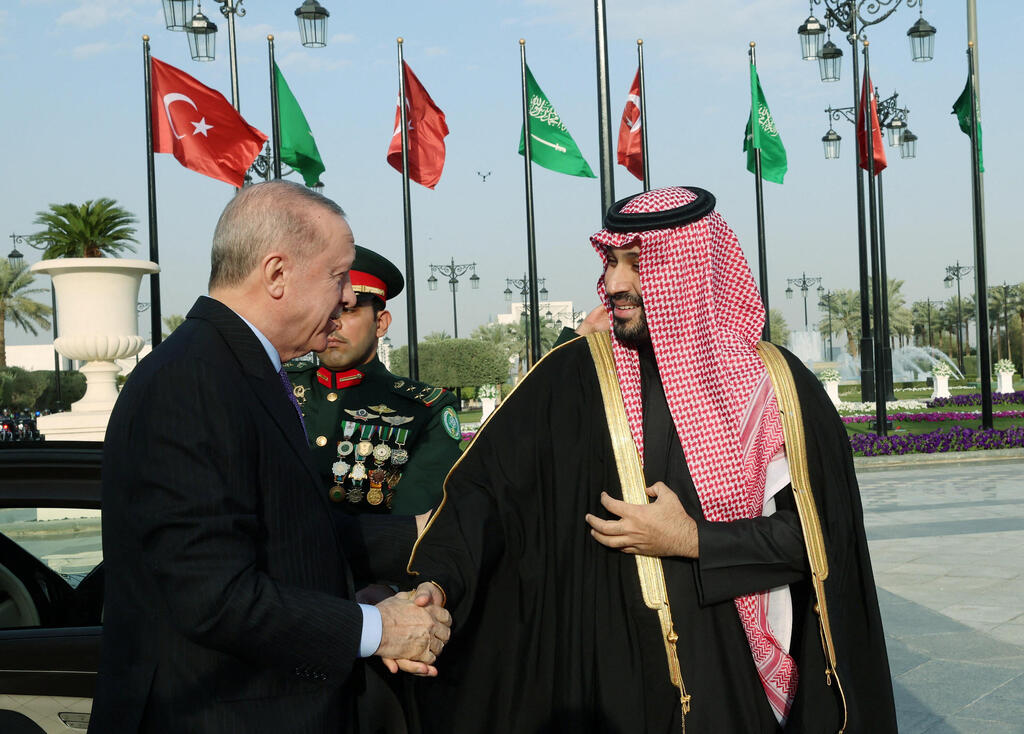
Erdogan and Saudi Crown Prince Mohammed bin Salman
(Photo: Murat Cetinmuhurdar/Turkish Presidential Press Office/Handout via REUTERS)
Saudi Arabia is hedging. The kingdom has two coastlines, on the Red Sea and the Arabian Gulf, making it a natural logistics hub regardless of which corridor it backs. With Israel at war and American attention stretched across multiple theaters, Riyadh has made a pragmatic choice to build the infrastructure that is available and functional today.
Pragmatic choices in the Middle East have a way of hardening into permanent strategic alignments. The billions that will flow through Turkey's rail network, the Turkish banks that will operate in Damascus and the Saudi freight that will transit Erdogan's sphere of influence are not neutral economic transactions. They are the foundations of the next decade's regional order.
There is a layer of deliberate historical theater in all this that Erdogan is consciously staging. The new corridor is framed by its promoters as a revival of the Hejaz Railway, the Ottoman-era line that ran from Istanbul to Medina and Mecca from 1908 onward, connecting the imperial capital to the holy cities of Islam when Constantinople still governed the Arab world. It was destroyed during the First World War, partly by the Arab revolt and partly by British sabotage.
For Erdogan, who has spent two decades reconstructing Ottoman symbolism at every available opportunity, the framing is not incidental marketing.
 Amine Ayoub
Jerusalem should understand what that staging means in concrete terms. A Turkey that presents itself as the natural custodian of the logistics connecting the Gulf to Europe, that governs the land bridge through Aleppo and Damascus, that commands both the Bosphorus crossing and the Saudi border junction, possesses leverage over regional affairs that goes well beyond freight tonnage and transit fees.
Erdogan is constructing the infrastructure of Ottoman-era centrality in a post-Iran-war Middle East, and he is doing it with Saudi commercial weight, Syrian land and the vacuum created by Israel's necessary but consuming wars.
None of this is finished. Technical studies for the full corridor remain incomplete. Financing is only partially secured. The Iraqi junction that would make the corridor truly transcontinental is still theoretical. And running freight reliably through post-conflict Syria will require stability that Islamist governance in Damascus has not yet demonstrated it can sustain.
But the direction is unmistakable and the pace is accelerating. While Israel was rightly focused on destroying the centrifuges at Fordow and degrading the IRGC, Erdogan was laying the economic foundations of the region's next strategic era. Saudi Arabia and Syria are now the twin pillars of his ambition: one providing commercial destination and financial weight, the other providing land and transit.
Erdogan did not defeat Israel. He simply waited for Israel to be busy, and then built his empire while no one was watching.
- Amine Ayoub, a fellow at the Middle East Forum, is a policy analyst and writer based in Morocco.