

The US Supreme Court on Friday dramatically blocked one of President Donald Trump’s central initiatives — the sweeping tariff plan he imposed on countries around the world. In doing so, it delivered a principled message: even a strong and popular president is not above the law. In a functioning democracy, the executive branch does not define the limits of its own authority; binding interpretation rests with the judiciary. The ruling carries significant constitutional weight and is particularly relevant to the ongoing debate in Israel over the relationship between the government and the Supreme Court and the proper boundaries of governmental power.
The US Constitution explicitly grants Congress the authority to levy taxes and tariffs. The International Emergency Economic Powers Act grants the president authority to “investigate, block, regulate, direct, compel, nullify, void, prevent or prohibit” certain transactions related to imports and exports. Trump sought to give a broad interpretation to one word in the law — “regulate” — arguing that it includes the authority to impose sweeping tariffs at high rates, without limits of amount or duration, on numerous countries.
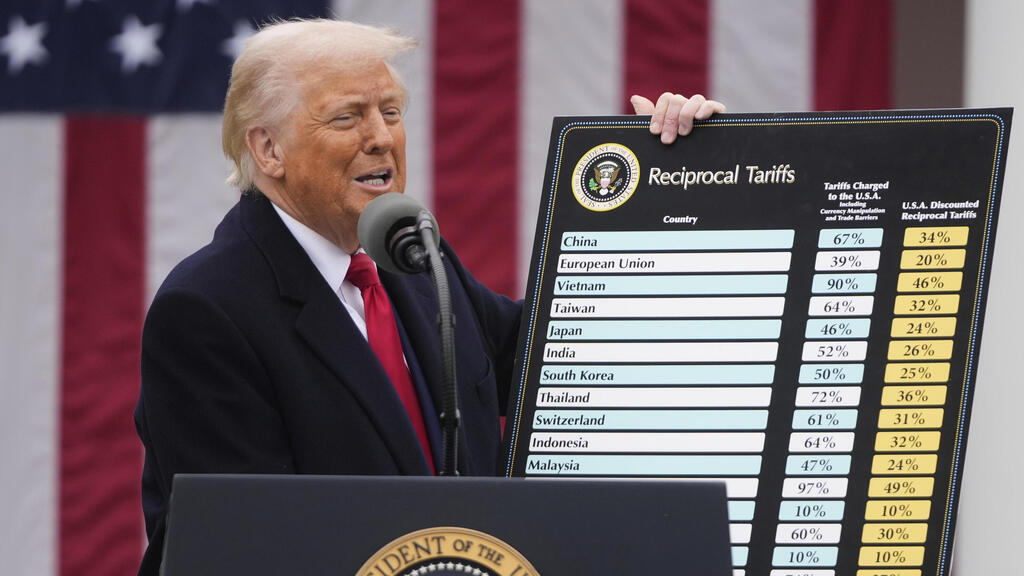
Trump unveils his tariff plan, April 2025
(Photo: AP Photo/Mark Schiefelbein)
The court rejected that interpretation. It ruled that the word “regulate” does not encompass the power to tax or impose tariffs. While the term is broad, the court said, it does not include, under ordinary meaning and certainly not under legal interpretation, the authority to levy taxes.
The court further held that when a president claims Congress has granted him authority of vast economic and political significance, ambiguous statutory language cannot be read as conferring such power. Clear and explicit congressional authorization is required. Imposing broad tariffs on all trading partners constitutes a dramatic structural shift in US trade policy, a matter reserved for the legislative branch.
The court did not rule that tariffs are improper as a matter of policy. The substance of policy decisions remains within the political arena. Rather, the court determined that the authority to change tariff policy was not granted to the president under the specific statute at issue.
Here lies the lesson for the Israeli public. The United States has a written and entrenched Constitution, a bicameral legislature, complex institutional checks and balances and a long constitutional tradition. Even within that system, the court was required to stand against an executive branch seeking to interpret the law in a way that expanded its power.
In Israel, the democratic institutional framework is more fragile. There is no complete constitution. The government rests on a coalition majority that controls the Knesset. In practice, the executive and legislative branches operate as a single political bloc, and nearly any law the prime minister seeks to advance can pass.
In such a system, internal checks are limited. In Israel’s structure, the court remains the primary institution capable of examining whether the government is acting within its legal authority. Efforts to weaken judicial independence, curtail judicial review, dismantle internal legal oversight mechanisms or concentrate interpretive authority in the hands of ministers or the prime minister amount to consolidating unchecked power in the hands of the governing majority.
Friday’s US ruling, which dramatically halted Trump’s plan, serves as a reminder that democracy is not unlimited majority rule but majority rule subject to rules. Separation of powers is not a slogan but a mechanism to prevent those who hold power from defining its own limits. A judiciary capable of standing up to a strong executive is not a weakness of democracy but a clear expression of it.
 Dr. Matan GutmanPhoto: Shlomi Yosef
Ultimately, in both the United States and Israel, the court does not replace the government, manage the economy or determine the preferred policy. It does not decide whether tariffs are wise or how the country should be run. Its role is narrow but critical: to determine whether government actions comply with the law and to remind every branch that its actions, whether popular or controversial, must remain within the bounds the law permits. That is the difference between rule by will and rule by law. When a court draws that line, it does not undermine democracy — it protects it.
Dr. Matan Gutman is a doctor of law, an attorney and an expert in public law at Reichman University.