


The Arab League was founded in 1945 with the stated purpose of advancing Arab unity. What it actually did, for most of its eight decades, was advance Arab opposition to Jewish statehood. That was its animating logic, its political center of gravity, and ultimately its undoing.
Now, as Egyptian diplomat Nabil Fahmy prepares to assume the secretary-generalship on July 1, succeeding Ahmed Aboul Gheit after a decade in the role, he inherits an organization that cannot collect dues from its own members, cannot produce decisions that anyone is obligated to follow, and cannot prevent Iran from constructing a parallel regional architecture in the space the Arab League has vacated. The League has never been more irrelevant. That irrelevance is not incidental. It is the direct consequence of seventy years of institutional malpractice dressed as solidarity.
Gallery
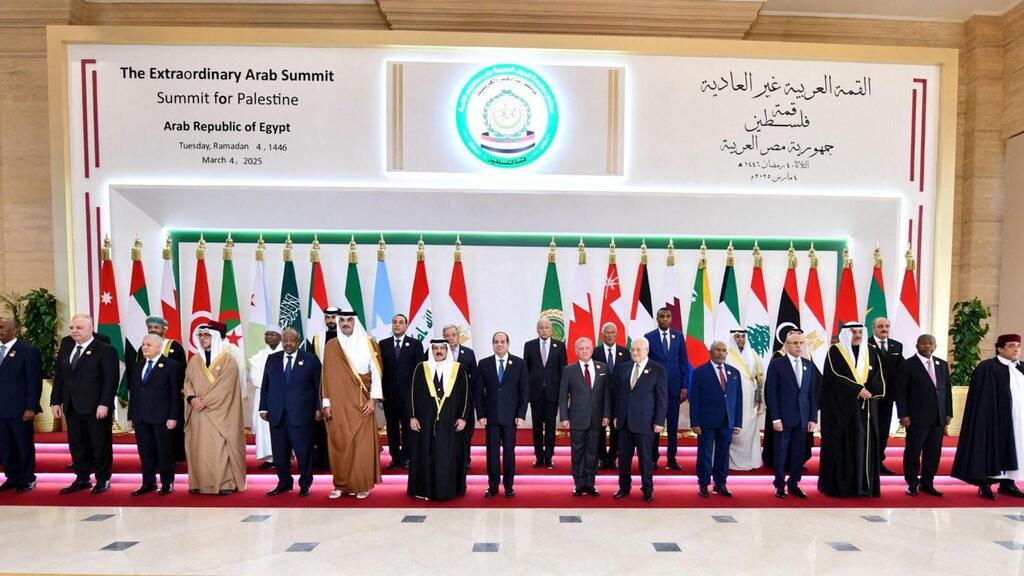
Emergency Arab League meeting in Cairo, dubbed the ‘Palestine Summit’
(Photo: Egyptian Presidency, Reuters)
The finances make the verdict plain. The Arab League operates on an annual budget of roughly sixty million dollars, with nearly ninety percent consumed by salaries and administrative overhead. Most of the twenty-two member states are delinquent on their assessed contributions. The secretariat has been drawing on cash reserves simply to pay staff and keep the institution minimally functional, a condition Aboul Gheit warned about repeatedly and publicly. For a body purporting to represent a combined Arab population approaching five hundred million people, this is not a funding gap. It is an institutional judgment by the Arab states themselves on the League's utility.
But the crisis runs deeper than liquidity. Institutions lose funding when their members stop believing in them, and Arab governments have quietly stopped believing the League is a mechanism for advancing their national interests. The evidence is everywhere and undeniable. When the UAE normalized relations with Israel through the Abraham Accords in 2020, it did not seek Arab League endorsement. It did not need it. When Saudi Arabia has coordinated on security matters with Israel, the conversations happened bilaterally, far outside any pan-Arab framework. When Gulf states needed defense architecture against Iran, they turned to Washington and Jerusalem, not to Cairo. The League was not consulted because consulting it produces nothing actionable.
This is the fundamental structural failure, and it has a specific cause that Arab diplomatic culture still refuses to name honestly. The League was designed for collective mobilization against an external enemy, primarily Israel. When that mobilization failed repeatedly across three quarters of a century, in 1948, in 1967, in 1973, and in the long decades of diplomatic warfare that followed, the organization was left with its institutional habits and none of its purpose. It became a machine engineered to fight a war it had already lost, issuing communiqués about a political reality it could no longer reshape.
Iran understood this vulnerability before any Arab capital did. While the Arab League convened emergency sessions and produced unanimous condemnations that changed nothing on the ground, Tehran built a different kind of regional architecture. The Islamic Revolutionary Guard Corps, Hezbollah, the Houthis, the Iraqi Popular Mobilization Forces, Hamas: these are the effective instruments of regional power in today's Middle East. They are non-state actors that are disciplined, funded, and operationally coherent. They answer to Tehran, not to any Arab capital, and they have been more consequential in determining the shape of the region than anything the Arab League has done in the last thirty years. Iran did not defeat the Arab League in a confrontation. It bypassed the Arab League entirely, occupying the political and security space that pan-Arab dysfunction left vacant.
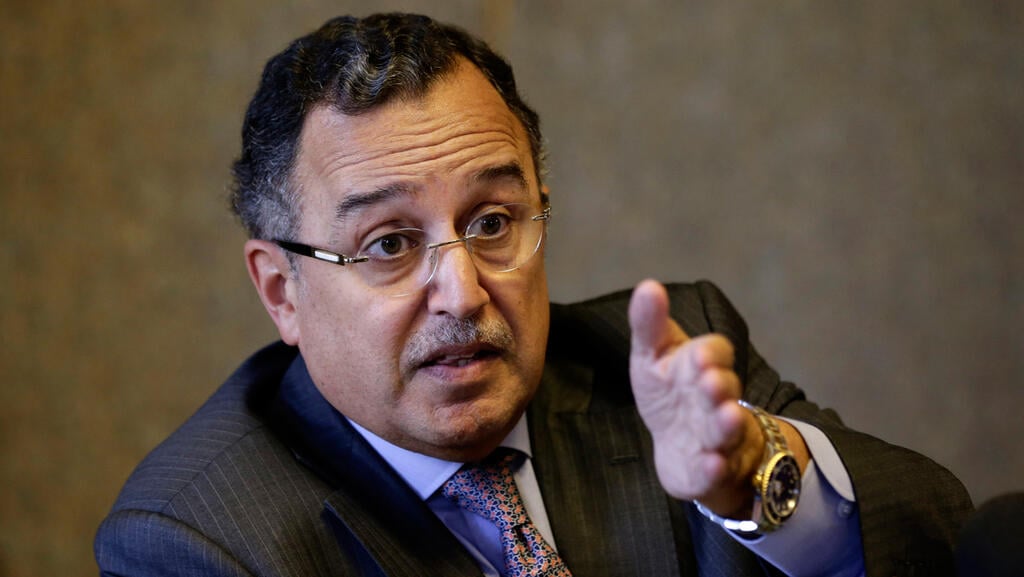
Nabil Fahmy
(Photo: AP)
The consequences for Arab populations have been catastrophic in direct proportion to the League's absence of effective agency. Sudan is in the middle of a civil war of staggering human cost, and the League convenes. Yemen has been destroyed by a conflict in which one party is an Iranian proxy, and the League convenes. Libya has become a weapons bazaar supplying jihadist networks across the Sahel, and the League convenes. Gaza has experienced destruction without precedent in the modern history of the region, and the League convenes. Convening without consequence is the Arab League's core institutional competency, and it explains precisely why Fahmy's widely celebrated "historic opportunity" is more accurately understood as an impossible assignment.
The real regional architecture emerging from the wreckage of pan-Arab ideology is bilateral, transactional, and increasingly anchored to Israel. The Abraham Accords proved that Arab governments can pursue their genuine strategic interests, including security cooperation, technology partnerships, normalized commerce, and intelligence sharing, without waiting for pan-Arab consensus that never comes. The UAE, Bahrain, Morocco, and Sudan made individual calculations that normalized relations with Israel served their national interests better than continued participation in a symbolic confrontation they could not win and, increasingly, did not want to fight. What the Accords revealed was not betrayal of a cause. It was Arab recognition that the cause had betrayed them.
Washington has been slow to absorb the implications of this shift, and that slowness carries a real cost. American policy still treats the Arab League as a functioning institutional partner, directing diplomatic energy toward League processes and treating its endorsements as meaningful signals of regional consensus. They are not. They are procedural artifacts of a multilateral architecture that the Arab states themselves have abandoned in practice. More critically, continuing to elevate the League signals to Arab governments that their bilateral realignment with Israel and the United States must operate within a pan-Arab framework that nobody in the Arab world actually respects.
 Amine Ayoub
The prescription for Washington is direct: invest in the Abraham Accords architecture, not the Arab League framework. Expand the normalization network, deepen the security and economic relationships that underpin it, and stop channeling diplomatic legitimacy toward an institution whose primary members are actively routing around it. The Accords have produced tangible integration: defense cooperation, intelligence sharing, commercial partnerships, and academic exchange. The Arab League has produced a financial crisis and a rotating cast of emergency sessions resolving nothing.
Nabil Fahmy is an accomplished diplomat who will pursue institutional reform with genuine seriousness. The problems confronting him are structural, not personal. An organization whose identity was built around political failure cannot be fixed by better management. It requires an honest reckoning with what it was built to do, why that project failed, and what, if anything, can replace it. That reckoning has not yet happened, and Fahmy's optimistic public statements suggest it will not happen on his watch either.
The Arab League spent seventy years trying to eliminate Israel. It eliminated itself instead.
- Amine Ayoub, a fellow at the Middle East Forum, is a policy analyst and writer based in Morocco. Follow him on X: @amineayoubx