

The Lebanese tragedy continues to bleed. On the morning of February 14, 2005, hundreds of kilograms of explosives detonated in the heart of Beirut, destroying not only the convoy of Prime Minister and Western ally Rafik Hariri, but also shattering Lebanon’s old political order and reopening the era of political assassinations in the fractured country.
A decade later, the Special International Tribunal for Lebanon at The Hague convicted senior Hezbollah figures for the murder, foremost among them Mustafa Badreddine, a close associate of Hassan Nasrallah. Yet Badreddine himself had been assassinated three years before the verdict was handed down.
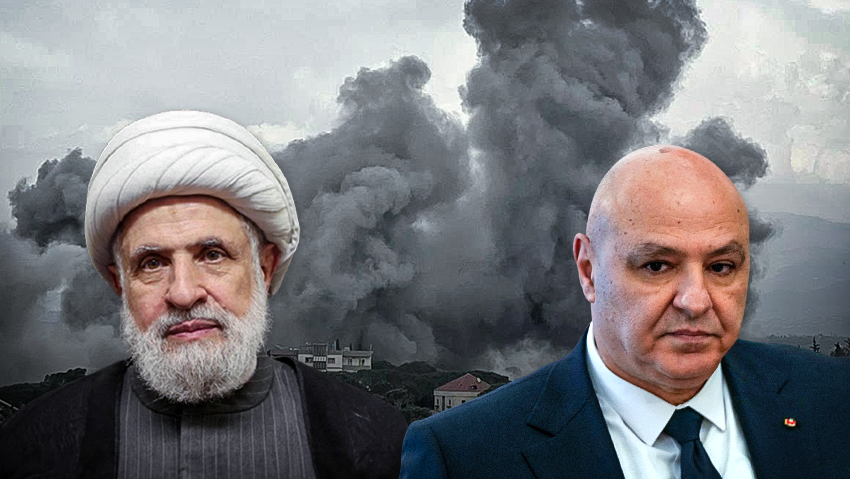
(Photo: Petros Karadjias/Pool via REUTERS, REUTERS/Mohammad Yassine)
Twenty years after Hariri’s assassination, the same refrain is returning. According to a series of reports, the level of threats against Lebanon’s 14th president and former commander of the Lebanese Armed Forces, Joseph Aoun, is breaking records because of his uncompromising opposition to Iranian influence in the country, alongside his calls to strip Hezbollah of its weapons and leave it as a purely political movement.
In Aoun’s view, Tehran is using Lebanon as a bargaining chip in negotiations with the U.S. aimed at ending the war. Under current circumstances, Hezbollah and the ayatollahs’ regime, more extreme than ever, are the immediate suspects in any attempt to plunge Lebanon into renewed chaos. Both the regime and the terrorist organization seek to regain their grip on the country, encouraged by what appears to be an Israeli-American systemic failure reflected in the waning stages of the Iran war.
The consequences of harm to Lebanon’s sitting president could be far more severe than many assume. Among other things, it could lead to the collapse of a government in which Hezbollah is not a member, derail the faltering security dialogue being conducted in Washington with Israel, and further worsen the security situation along the border.
For these reasons, the international community would be wise to act before disaster strikes and draw lessons that have yet to be learned from Hariri’s assassination.
For example, President Emmanuel Macron, who appears more focused on boycotts of Israel than on safeguarding France’s interests in the Middle East - should work with the U.S to move Aoun’s security arrangements, the West’s last major asset in Lebanon, onto a more proactive footing. This could include supplying countermeasures against drones and explosive devices and establishing a direct intelligence channel capable of providing real-time warnings about movements by Hezbollah’s special forces and operational units of the IRGC operating in Lebanon.
Second, Washington and the Gulf states must deliver an unequivocal message to Iran’s new leadership: the price of an assassination will be extraordinarily high. Any harm to a single hair on Aoun’s head should trigger an additional sanctions regime targeting critical sectors in both Iran and Lebanon. Signalling a willingness to use force in response to such an act would also help convey the seriousness with which the West would view any attempt on the Lebanese leader’s life.
The Aoun era in Lebanon requires Israel to accelerate the faltering dialogue in Washington, a process in which every step forward seems to cause political discomfort for members of Netanyahu’s far-right coalition government. Advancing that dialogue now is an Israeli interest, particularly in light of Iran’s “unity of arenas” strategy, which has been strengthened by failures in the campaign in the Persian Gulf.
In practical terms, this means moving beyond ceremonial diplomacy in Washington and toward a professional working-level military dialogue. Within such a framework, it would be possible to formulate a joint roadmap that improves the security reality along Israel’s northern border while also enabling residents of southern Lebanon to return to their homes through the advancement of security arrangements.
Ultimately, if Lebanon can free itself, with the support of the West, from the grip of the Iranian octopus, conditions may emerge that allow progress toward a historic bilateral security agreement between Jerusalem and Beirut.
First published: 13:42, 06.18.26