

When Prof. Ada Yonath won the Nobel Prize, I was in third grade. Perhaps I saw a news report about it at the time. I no longer remember. What I certainly did not understand was the scale of the achievement.
I did not know what it meant to decipher the structure of the ribosome. I did not even know what a ribosome was.
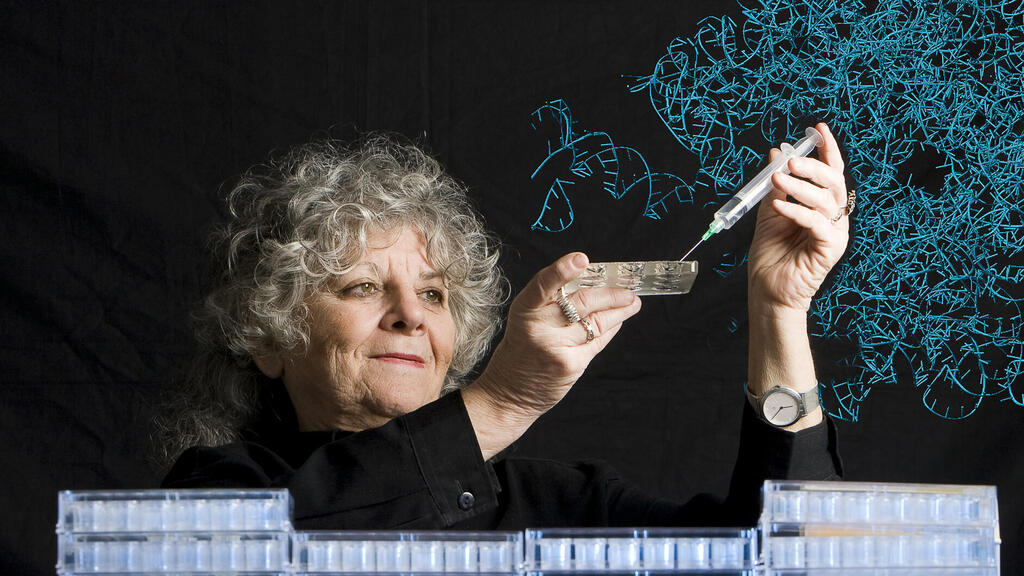
Prof. Ada Yonath
(Photo: Micheline Pelletier/Corbis)
And yet something about Yonath lodged itself in my consciousness, and probably in that of an entire generation.
By the time I reached middle school, she had already become a figure in her own right, a symbol of intelligence. “How should I know, am I Ada Yonath?” people would sometimes say, as her name became a kind of Israeli shorthand for genius, much like Einstein.
In high school biology, we learned about the structure of the ribosome and about Yonath’s work. A year after I graduated, my school named its laboratory after her.
In that sense, Yonath occupied a particularly unusual place in Israeli science. Alongside her extraordinary scientific achievements, and without seeming to seek it, she became a popular icon.
Not an icon in the cheapened sense of the word. Quite the opposite.
She was the kind of figure who made science accessible to young people, and especially to young women. Her discovery was fundamental to understanding how cells work, yet at the same time brilliantly complex. She became someone students encountered early in their first attempts to understand the living world.
Yonath understood the value of that role.
She used the influence she had gained to promote science in Israel whenever she could, while never abandoning her own research at the Weizmann Institute of Science and continuing to run her laboratory long after the conventional retirement age.
But she hardly needed to lecture about the importance of women entering science, or about the need to challenge the boundaries of human knowledge.
She demonstrated both simply by being herself, through the sharpness of her thinking, her persistence and her unmistakable warmth.
Having grown up with that public image of Yonath, I was surprised when I interviewed her for the first time to discover how modest and meticulous she was.
Even after countless interviews, she was careful not to comment on anything that strayed even slightly beyond her expertise or beyond what she knew with certainty.
At the same time, she was curious. She asked questions about what it was like for young people to study science in high school and university. And above all, despite being a senior professor and Nobel laureate, she remained strikingly human.
If decoding the structure of the ribosome was Yonath’s contribution to humanity, then her contribution to Israeli society was no less profound: she gave people permission to dream.
It hardly needs explaining why Yonath embodied a certain version of the Zionist dream. From a childhood of limited means in Jerusalem to the Nobel ceremony in Stockholm, her life demonstrated it step by step.
Looking back, however, what strikes me most is how unusual it was for someone from the distant world of academic science to enter the consciousness of children and teenagers so completely.
Her scientific willingness to take risks and pursue research despite criticism became something broader: an invitation to dare.
But it was not merely an invitation. Yonath was proof that daring could work, and a reminder of what Israeli society might aspire to be.
On another occasion, I asked her what advice she would give someone choosing a field of study. She agreed to offer only one piece of advice.
It may capture Yonath, and what she leaves behind for future generations in Israel, better than anything else:
“Follow your curiosity.”