

The International Criminal Court (ICC) was presented to the world as a court of law. Increasingly, however, it has delivered politics—dirty politics carried out by officials now facing allegations serious enough to cast doubt over decisions they made.
If the ICC’s Gaza-and-Israel narrative was not already in question, along with the troubling issue of its claimed jurisdiction over non-member Israel, the latest reporting makes it even harder to believe the case against Netanyahu and Gallant is rooted in impartial evidence rather than political pressure and Qatar’s campaign to delegitimize the Jewish state.
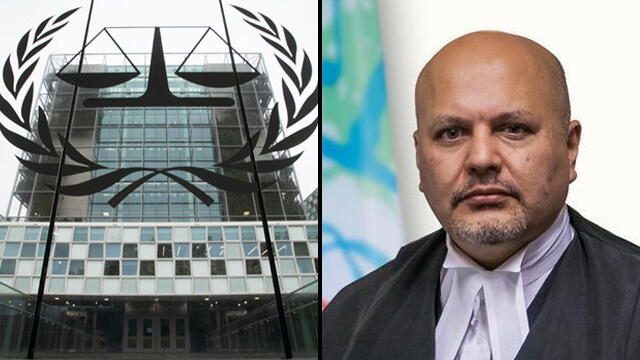
Karim Khan and the Hague
(Photo: AP)
A recent Wall Street Journal editorial reported that while former Chief Prosecutor Karim Khan was seeking arrest warrants against Israeli leaders in 2024, a witness statement alleged that Qatar promised to “look after” him if he proceeded. The same report said investigators discussed Qatar as the “client country,” while private intelligence contractors allegedly referred to “wrapping” their “arms” around Khan in connection with the warrants. Whether every allegation is ultimately proven is not the only issue. The immediate question is whether an international institution can be trusted to prosecute Israeli officials when the process itself is clouded by claims of compromise and improper influence.
This is not merely about personalities or misconduct allegations. It is about the integrity of the process. Prosecutorial independence is the foundation of legitimacy. If there is credible reason to believe a prosecutor was offered protection or support by a foreign state while handling a politically explosive case, then justice risks becoming leverage.
The report also described efforts to scrutinize Khan’s accuser through speculative claims tied to Jewish heritage and Israeli connections, while examining personal details and travel. According to the Journal, those efforts “led nowhere,” and no evidence was found that the accuser was part of any Israeli plot. Khan denies wrongdoing. But the larger lesson remains: when suspicion is weaponized, confidence in the institution suffers.
Then there is the core question for Israel: what do these allegations mean for the case against Netanyahu and Gallant, already built on contested evidence and disputed jurisdiction? Even before these revelations, the ICC’s actions raised serious legal and political concerns. An institution accused of selective enforcement does not gain credibility when scandals surrounding its own leadership emerge.
The Journal further reported that Khan took leave in May 2025 and that the court’s governors advanced disciplinary proceedings after allegations of sexual assault. Khan denies misconduct. Yet the fact that such internal proceedings are moving forward is not a footnote—it is a legitimacy crisis.
 Nitsana Darshan-LeitnerPhoto: Shurat Hadin
This is why confidence in the ICC prosecution has been further eroded, not strengthened. When the court’s top prosecutor is alleged to be compromised, Israel is entitled to question whether the case against its leaders can be trusted as a neutral legal process.
Israel does not need perfection to demand fairness. It needs only the standard expected in any courtroom: independent decision-makers applying evidence without fear, favor, or political orchestration. The recent reporting suggests the opposite.
The ICC has failed that legitimacy test. The tainted case against Israel’s leaders should be dismissed in the interest of justice.
The author is an Israeli civil rights lawyer and president of the Shurat HaDin Law Center.