

The last time Israel found itself in a major confrontation with Turkey, 10 Turkish citizens were killed when Israeli naval commandos boarded a ship attempting to break the blockade of Gaza. Israel was eventually forced to pay $20 million in compensation to the victims’ families, and Benjamin Netanyahu apologized to Recep Tayyip Erdoğan in a phone call joined by Barack Obama.
Now our side is once again picking a fight with Erdoğan, who is threatening to strike back after Israeli aircraft attacked a Syrian air force base near the Turkish border.
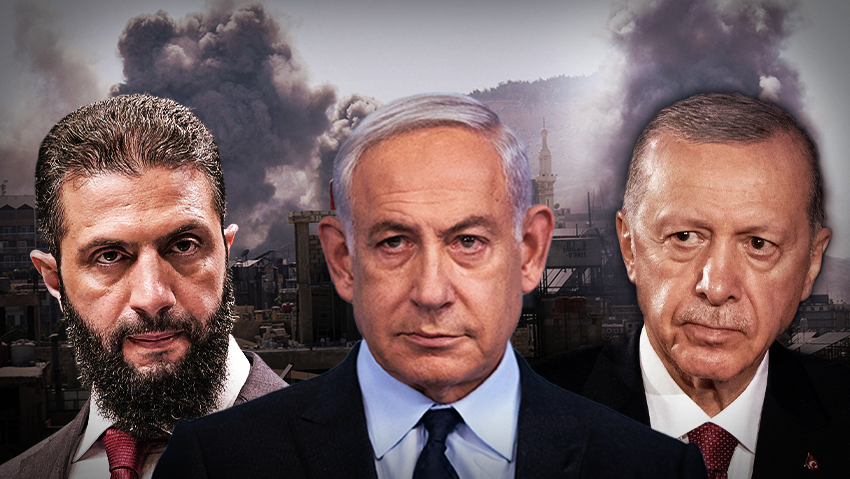
Ahmed al-Sharaa, Benjamin Netanyahu, Recep Tayyip Erdoğan
(Photo: Alex Kolomoisky, Mehmet Ali Ozcan/Anadolu via AFP, Andrew Harnik/Getty Images North America/AFP, Reuters/Khalil Ashawi)
The rhetoric between Israel and Turkey is heating up, and judging by the big mouths of Netanyahu and Defense Minister Israel Katz, it is already possible to imagine where this could lead: IDF soldiers being called on to join an eighth front in the endless war Netanyahu is imposing on us, until once again an American president forces him to apologize to Erdoğan.
This is an insane reality.
I do not buy the argument that the approaching election has raised the blood pressure of Netanyahu and his circle, who smell defeat at the ballot box and are therefore deliberately provoking Turkey. What we are seeing is dangerous management of Israel’s foreign relations: public exchanges of blows instead of quiet diplomacy.
If this continues, prepare yourselves for an eighth front and another round of reserve duty, this time on the Turkish border.
Meanwhile, in the corridors of the parties that make up Israel’s anti-Netanyahu bloc, one question keeps being asked: Who will be prime minister?
Self-appointed commentators, and others working on behalf of those who may well lose, are inflating the argument to dimensions intended to confuse undecided voters.
My advice to all of you is simple: Vote according to what you believe, not according to supposed “strategic voting” calculations and all the rest of that nonsense. Only after the polls close will negotiations begin over who goes first and who goes second.
And remember this too: Everyone abandons promises afterward. Under Israel’s political system, the final dish is ready only for whoever can produce at least 61 supporters in the Knesset.
Netanyahu, for his part, is still looking for candidates to fill the reserved spots he controls on the Likud slate. So far, there do not appear to be volunteers eager to carry the rotten stretcher he is bringing into the race toward Election Day.
In other words, he may have to eat what he cooked alone, or perhaps with Likud lawmaker Katy Shitrit, who could find herself promoted.
Gideon Sa’ar, meanwhile, has become one of the most vilified politicians in Israel. His place on the Likud slate is guaranteed, so he does not have to humiliate himself before the party’s vote contractors.
But one thing should not be forgotten: During his years in government, Sa’ar made consequential moves in the appointment of Supreme Court justices and judges throughout the judicial system. Nor can anyone take away from him the decision that turned Ariel College into Ariel University.
That is why it is so disappointing to hear him quarrel with virtually every country on the globe and make statements better suited to Itamar Ben-Gvir and the hardcore Netanyahu camp.
In 1969, a year before her death, the poet Leah Goldberg was asked what purpose lyrical poetry still served in the 20th century. She replied: “And what are horses to do in the 20th century / and gazelles? And the great stones / in the hills of Jerusalem?”
A separate argument has now erupted over reports of an effort to organize Israelis living abroad to return to Israel and vote in the election. The uproar stems from fears on the right that left-wing voters could tip the balance.
What hypocrisy.
The same people said nothing in previous elections when thousands of ultra-Orthodox Israelis came from around the world to ensure that their representatives could continue enjoying everything the Likud-led government lavished upon them.
The poet Natan Wasserman writes in his poem “Right of Return”:
“And the pelicans return here in autumn, from the northwest / landing hungry among the pools falling silent at evening / brave, unafraid of the cannons brought to drive them away, fishing / fishing and pushing their beaks into the mud, swallowing worms ... and then, when they are full, they look around and peck at their own breasts / I admit it: I support the Law of Return. I am prepared to sign. That is who I am.”
So am I.
Every Israeli, wherever they live, is welcome to exercise the right to take part in safeguarding the existence of our country and its security by coming here to vote.