

Less than a month has passed since Syrian President Ahmed al-Sharaa declared his desire to reach a security agreement with Israel “that will pave the way for comprehensive peace,” and not even two weeks since reports emerged of a U.S.-Syrian-Israeli agreement to remove nuclear material from the country. Yet in recent days, tensions between the sides have risen.
Last Tuesday, Israel struck the Abu al-Duhur military airfield in Syria after Damascus reversed course on the nuclear material in its possession and announced that it would remain under Syrian control for “peaceful purposes.”
Gallery
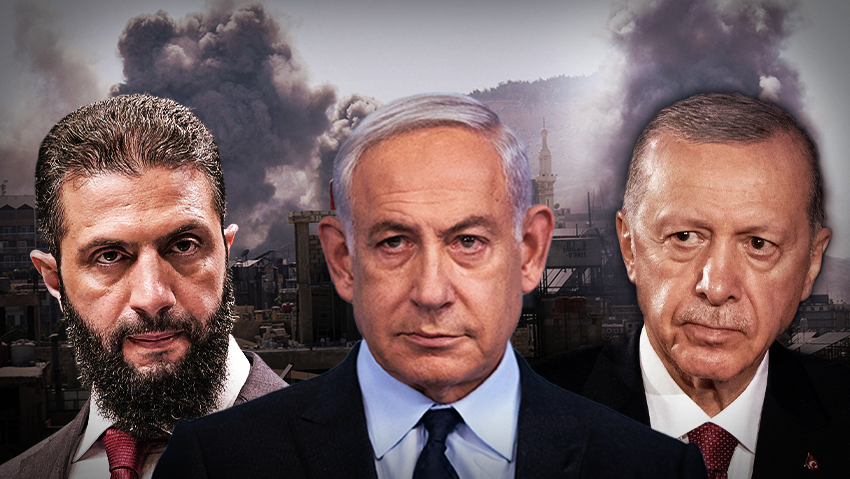
(Photo: Alex Kolomoisky, Mehmet Ali Ozcan/Anadolu via AFP, Andrew Harnik/Getty Images North America/AFP, Reuters/Khalil Ashawi)
After several tense days, the IDF struck Syria again Saturday. In the afternoon, a vehicle carrying a terrorist was targeted in Beit Jinn, in the rural Damascus area. Syrian media reported that one person was wounded.
The IDF said: “The IDF fired in southern Syria toward a terrorist who advanced terror attacks in final stages of preparation. The terrorist's activity posed an immediate threat to IDF soldiers. The IDF will continue to operate in order to remove any threat to IDF soldiers and Israeli civilians.”
Lt. Col. (res.) Eyal Dror, who headed the IDF’s “Good Neighbor” directorate responsible for humanitarian aid during the Syrian civil war, said Beit Jinn is known as a village with terrorist infrastructure. “There are pro-Hamas elements there,” he said.
He noted that the strike differed from the one at the military airfield but said “the signs indicate that things with Syria are not moving toward stabilization.”
‘Al-Sharaa says he does not want escalation. That’s nonsense’
According to Dror, “Al-Sharaa is playing the game, but in the meantime he is escalating his rhetoric. For his part, he is doing nothing to contribute to or create a calmer atmosphere. We know that Arab rulers who want to prevent something know how to prevent it, and you can see in the media an escalation in al-Sharaa’s statements and those of his military. Whether it is Nazi-style salutes at the end of an air force officers’ course or chants that they are coming to drive us Jews out, the dynamic is one of escalation.
“The fact that he tells the media he does not seek escalation is nonsense. I would like to see gestures from him on the ground, and so far he has done nothing. He has only talked.”
Dror said that, at present, neither side appears to be taking steps to calm the situation. “Israel, for its own reasons, is not taking steps, and as long as the Syrian regime does not thwart these kinds of elements, we will continue to see terrorist infrastructure trying to operate,” he said. “The Syrians are doing nothing and we will thwart it, because it has to be thwarted. In the absence of an attempt to reach some kind of arrangement, we may see these incidents occurring with greater frequency.
“As time passes, various elements may become more entrenched. That certainly will not bring us quiet.”
What preceded the strike deep inside Syria
In an unusual statement issued Saturday, Defense Minister Israel Katz addressed the strike deep inside Syria and said that “the IDF recommended several times carrying out the strike at the Abu al-Duhur airfield in Syria in light of clear intelligence received regarding Turkey’s intentions to conduct activities there that would endanger the security of the State of Israel.”
“After several discussions the prime minister and I held with the IDF and various security bodies, it was agreed that before approval was given, a direct warning would be conveyed to the Syrian regime at the highest levels in an attempt to prevent the move — and that was done,” Katz said. At the same time, he added, the information was also passed to the relevant U.S. authorities.
Katz said the Syrian regime did not respond to the request and the strike was therefore approved and “carried out successfully.” “Erdogan was caught with his hand in the cookie jar and was forced to back down,” he added.
Katz said: “We will not allow any party to endanger the security of the State of Israel and we will act against every threat — as we did again today in southern Syria. This is the central lesson from the events of October 7.”
Katz also responded to claims that the strike was politically motivated and intended to heat up fronts ahead of the election. “The attempt by elements in the opposition and parts of the media to paint the operation in Syria in political colors stems from a combination of ignorance, a lack of understanding of Israel’s security interests and a constant desire to attack the government — and deserves condemnation,” he said.
Tom Barrack hints at a political motive behind the strike
(Video: From Mario Nawfal’s X account)


Another figure who hinted that political motives may have been behind the strike was Donald Trump’s envoy to Syria and U.S. ambassador to Turkey, Tom Barrack, who did not rule out the possibility that the strike was intended to provoke a Turkish military response.
In an interview with content creator Mario Nawfal, Barrack said: “One theory is that they [Israel] were just trying to bait Turkey. It’s a very aggressive move, but one that may play well going into the election, that’s one theory.”
Barrack referred to the 2015 incident in which Turkey shot down a Russian plane and added that in an election period, “irrational judgment” could come into play.
Barrack also said that “Israel occupies the Golan Heights, despite UN resolutions saying that it is Syrian territory.” Although the Trump administration itself recognized Israeli sovereignty over the Golan Heights in 2019, Barrack said “there is an international consensus on the issue.”
In his statement Saturday, Katz attacked Barrack, saying he was contradicting U.S. President Donald Trump, whom he is supposed to represent. “Barrack’s response is full of inaccuracies and positions that contradict Trump’s own position regarding the Golan Heights,” Katz said.
Dror also addressed Barrack’s comments, saying they were problematic for Israel. “We are being portrayed as the bad kid,” he said. “We apparently are not investing enough time in tarnishing and discrediting the other side, and we are turning the world against us. Statements by senior officials like this reduce the Syrian regime’s motivation to act because it receives legitimacy while Israel is being attacked.”
IDF chief of staff visits Syria this past week
(Video: IDF Spokesperson’s Unit)
Israeli security officials said Saturday night that the strike followed intelligence indicating that Ankara was preparing to deploy radar at the Abu al-Duhur base, followed later by air defense systems and a Turkish commando force that would operate them.
Israel believes the Turks may continue trying to advance a similar move in the future.
According to the officials, Israel presented the intelligence about Turkey’s intentions to the Americans. Officials in Jerusalem said such a move could alter the regional balance of power and restrict Israel’s freedom of action in the air. It could also make a future strike on Iran more difficult.
Condemnation from Trump’s envoy
Earlier this week, Barrack warned that Israeli strikes in Syria, like the one on the military airfield, could “increase Turkish presence at that base” in the near future. He said Turkey had not been warned in advance and therefore could have attacked Israel in response.
Shortly afterward, Prime Minister Benjamin Netanyahu’s office said Syria had nearly violated the agreed security status quo “by allowing Turkish soldiers to deploy at the air force base near Aleppo.”
The statement added: “Israel has repeatedly warned Syria that such a deployment would pose a threat to Israel's security - and Syria has chosen to ignore the warnings. Israel will not tolerate threats to its security, and will welcome a return to the status quo.”
Netanyahu later stressed in his own words: “We will not tolerate a Turkish military buildup moving southward because it threatens us, and we made that clear in general terms.
“We saw that Turkey intended to establish itself at an airfield south of its line, near Aleppo, and we conveyed a message: Don’t. The message was delivered, but apparently they did not hear it. So we made sure they understood.”
IDF Chief of Staff Lt. Gen. Eyal Zamir, who visited Syrian territory, also stressed: “We will not allow hostile forces to establish themselves on our borders.”
Turkey, for its part, rejected the Prime Minister’s Office claims, saying they were “untenable and are intended to legitimise Israel’s unlawful airstrikes targeting Syria’s sovereignty and territorial integrity.”
Anger in Turkey
The strike also drew harsh reactions in Turkey. The headline in Türkiye, a newspaper supportive of President Recep Tayyip Erdogan’s government, called it “serious Israeli provocation.”
The subheadline read: “Israeli fighter jets bombed a military airfield in Idlib — only about 55 kilometers from the Turkish border. The airfield was intended for the deployment of radar and air defense systems — and in doing so, [the Israelis] carried out a provocation of war.”
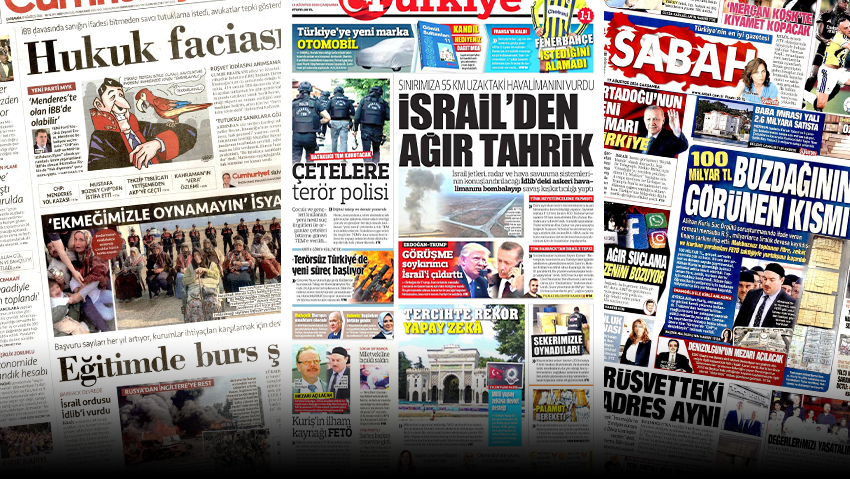
Turkish newspaper headlines after the Israeli strike in Syria
(Photo: Screenshot from Türkiye newspaper)
The newspaper linked the Israeli strike to Turkey’s growing international influence, claiming that “the Erdogan-Trump call drove genocidal Israel into a frenzy. Erdogan and Trump reached understandings on resolving the crisis in Iran and on peace in Gaza. Netanyahu, panicked by the decisions reached in the call, struck Syria shortly afterward.”
After Turkey denied Netanyahu’s claims about a presence in Syria, a Turkish Defense Ministry spokesperson also issued an official response Thursday denying the allegations.
“Our efforts to protect Syria’s sovereignty and territorial integrity will continue with determination,” he said. “It is important that the international community take more concrete and effective steps against Israel’s actions, which threaten peace and stability in the region.”
Burhanettin Duran, head of communications for the Turkish presidency, said “the threats and lies Netanyahu voiced against Türkiye and Syria in an interview are a new reflection of the Israeli prime minister’s growing international isolation, political fears and delusions.”
“As Türkiye, we will continue to combat the destabilising actions of genocidal Netanyahu and stand with all states pursuing peaceful policies in our region, particularly Syria,” he said.
Duran went on to connect the rhetoric against Ankara to Netanyahu’s domestic political considerations. He said the prime minister “views anti-Turkish sentiment as a political lifeline” amid Israel’s approaching elections and competition from political figures he described as “radical.”
He also claimed Israel was trying to “spread the taint” arising from its policies in Gaza, Syria and Lebanon, and from what he called the disregard of “settler terrorism,” onto countries in the region, foremost among them Turkey, including over Turkish activity in Syria.
Claims of political motives behind IDF activity in Syria were also emphasized by Turkey’s Anadolu news agency, which presented a critical analysis arguing that Netanyahu and his associates are intensifying anti-Turkish rhetoric against the backdrop of Likud’s weakening in polls ahead of elections and U.S. pressure that led to an end to fighting with Iran and Hezbollah.
According to the report, Netanyahu is struggling to preserve his image as a “strong leader” ahead of the election.
The agency noted that after Israel was required to stop the fighting in Iran and Lebanon following U.S. pressure, Netanyahu faced criticism from the opposition and from his right-wing partners.
The confrontation with Turkey and Syria was described by the agency as “an election campaign built on anti-Türkiye rhetoric.”
The Netanyahu-Erdogan confrontation
After a series of mutual accusations between the countries, Turkey requested an Interpol Red Notice against Netanyahu for “genocide” in connection with the Gaza flotilla affair.
Turkish Justice Minister Akin Gurlek, who announced the move, said it followed an arrest warrant issued July 14 and was part of an ongoing trial in Turkey.
An Interpol Red Notice is effectively an international request to locate a person.
An arrest warrant for Netanyahu has already been issued by the International Criminal Court in The Hague, and Turkey has also previously issued arrest warrants against him, including over the past year.
The first Sumud flotilla was intercepted in the Mediterranean Sea on Yom Kippur last year, and hundreds of activists aboard were brought to Ashdod Port.
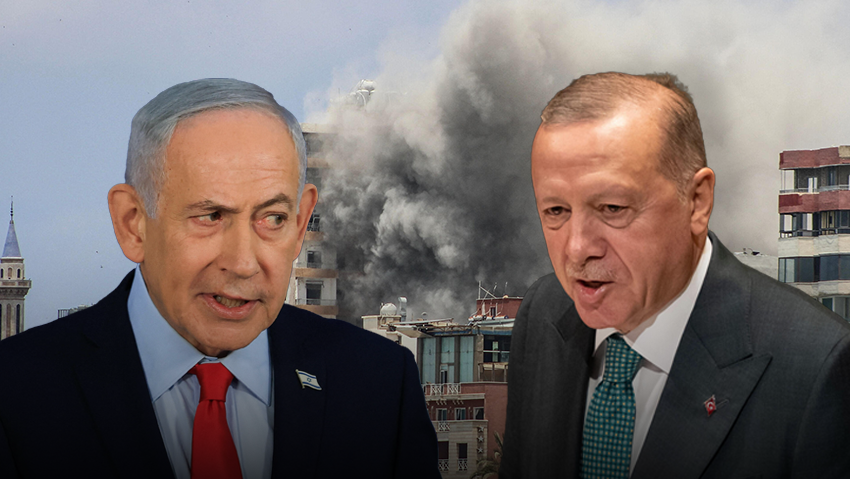
Turkey seeks a Red Notice against Netanyahu, who responds: 'Erdogan is an antisemitic dictator'
(Photo: AP/Yuki Iwamura, Kawnat Haju/AFP, Reuters/Ronen Zvulun/Pool)
Hours later, Netanyahu responded in a statement from his office. “Israel has long since ceased to be impressed by Turkey’s hypocrisy,” he said. “Erdoğan is an antisemitic dictator who has massacred Kurds, supports Hamas’ massacre and oppresses his own people. Israel will continue to act forcefully against Turkey’s attempts to undermine stability in the region and against any threat to its security.”
A statement issued in English by Netanyahu’s office added that Erdogan “occupies half of Cyprus, and jails record numbers of journalists and politicians who oppose him. He now seeks to extend his aggression against Israel into Syria. Israel will not tolerate it. Erdoğan’s pathetic attempt to intimidate the leaders and soldiers of Israel, the only true democracy in the Middle East, will go nowhere.”
Mossad chief and Syrian minister spoke
Reuters reported that in the week before the strike, Mossad Director Roman Gofman and Syrian Foreign Minister Asaad al-Shaibani spoke and discussed Turkey’s military presence in Syria.
According to three sources familiar with the details who spoke with Reuters, the conversation took place Aug. 14 — four days before Israel struck the Abu al-Duhur air force base in northwestern Syria, near the Turkish border, overnight Monday into Tuesday.
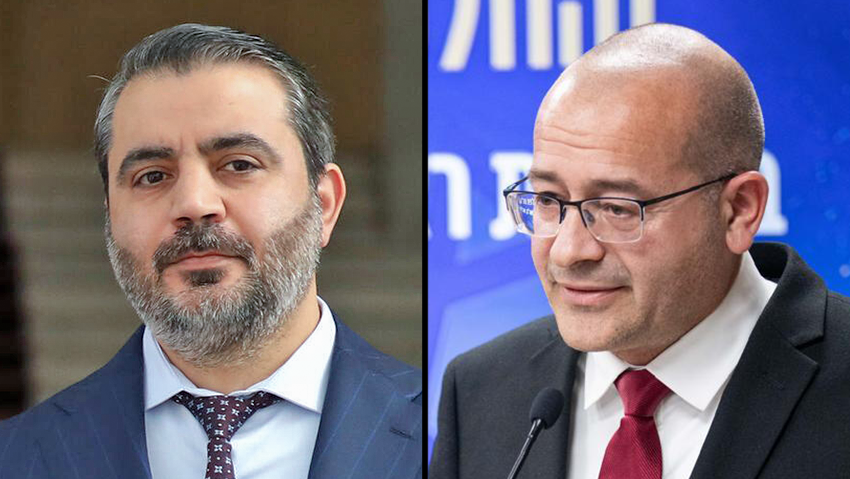
They spoke in the week before the strike: al-Shaibani and Gofman
(Photo: Ali Haj Suleiman/Getty Images, IDF Spokesperson’s Unit)
During the conversation, Reuters reported, Gofman and al-Shaibani discussed Turkey’s military presence in the country, an issue that has recently become a focal point of tensions between Jerusalem and Ankara over Syria’s future. According to the report, it was one of the highest-level contacts between Israel and the new government in Damascus.
Three days after the unusual strike on the military airfield, Israel conveyed a message to Syria: “Don’t let the Turks take you for a ride.” According to the message delivered to Damascus, “Israel does not intend to escalate either with Syria or Turkey — but it will not accept a Turkish foothold on Syrian soil.”
On Thursday, Israel’s ambassador to the United States, Yechiel Leiter, told ynet: “Israel received clear intelligence indicating that Turkey intends to significantly expand its military presence in Syria.
“We are not seeking escalation with Turkey or Syria, but a red line was crossed. This was a blatant violation by Turkey of the understandings that the status quo in Syria would remain in effect.
“Those who needed to be exposed to the intelligence received it. We made clear that this was a violation of the understandings — and that is why Israel had to act.”
An Israeli security official also said Saturday night that “because the diplomatic message did not get through, Israel conveyed the message through a pinpoint strike, a warning strike. We have no interest in escalation with either Syria or Turkey.”
“The Mossad chief practically pleaded with the Syrian foreign minister not to allow Turkey to do this, but the Syrians did not internalize the message,” he said.
Syria, however, rejects the claim that a permanent Turkish military presence was planned at the base. The Syrian foreign minister said Damascus had made clear to Israel that there was no intention to establish a Turkish base there or deploy a permanent Turkish military presence and that reconstruction work at the site was intended to enable the Syrian air force to resume operations there.
Tensions at sea
Against the backdrop of recent developments, Israeli security officials are watching the Turks not only on land but also at sea.
According to the officials, Turkey is moving naval vessels into parts of the Middle East where it had not previously operated, in an effort to demonstrate its presence, in some cases not far from Israeli naval vessels.
Damage from the Israeli strike on the Syrian air base
(Video: From X)
Turkey has a large and significant navy, much of which it manufactures domestically. So far, there have been no unusual incidents at sea between Israeli and Turkish vessels and certainly no direct clashes. But the two militaries are also watching each other at sea.
The fact that Turkish vessels are now operating in places where they had not been before has raised the level of tension in the region. Security officials said fighting with Turkey is not currently part of Israel’s main reference scenario and that Turkey is considered a rival state, not an enemy state. But they said this is “a delicate spectrum that, as we can see, can change in an instant.”
According to the officials, the Turks would like greater access to natural resources and better control at sea and therefore Israel takes into account that Turkey may seek to expand its maritime presence in cooperation with the Syrians.
Such incidents in the Mediterranean have been occurring throughout the past year and are not necessarily limited to recent days or months. But they take on greater significance against the backdrop of rising tensions in Syria. Most incidents of friction center on displays of presence and projection of power. There is interaction and friction between the navies in the eastern Mediterranean, in exclusive economic zones and international waters, where all sides operate.
This has been reflected in several incidents in which Israeli ships encountered Turkish vessels and the ships approached one another. When that happens, both sides go on heightened alert. A show of force can also take the form of a fast, close pass by a ship, or alternatively a kind of “encirclement” of a vessel by several naval craft for a few minutes. These incidents have increased at sea but have not deteriorated into actual clashes.
Security officials said: “There is a big difference between encountering a German Navy ship and a Turkish Navy ship. The level of alert is different.”
It should be stressed that there has been no significant change in such incidents in recent days compared with the past year.
Influencing Trump — and angering Israel
Tom Barrack, the U.S. president’s envoy to Syria and ambassador to Turkey, responded relatively sharply to the Israeli strike and said it carried a “real risk” of rapid escalation and a direct confrontation between Israel, Turkey and Syria. He warned that the lack of communication among the parties could have led to a mistaken Turkish response and said the United States is now working to establish a deconfliction mechanism among Israel, Syria and Turkey.
Officials in Jerusalem are concerned about the line Barrack is taking and about his ability to influence the U.S. president. “Barrack is seen as someone who promotes the interests of Erdogan and the Syrian regime in the United States,” an Israeli official familiar with Israel-Turkey relations said last week. “He is not sensitive to Israeli concerns. He focuses on the immediate gain the United States can achieve from Syria,” the official said. “Netanyahu does not like Barrack because he thinks Barrack is behind Trump’s support for al-Sharaa and connects him to Erdogan.”
There is disagreement in Israel over how much real influence Barrack has over Trump. On one hand, he has been one of the president’s close associates for decades. On the other, officials in Jerusalem stress that personal closeness does not necessarily translate into influence over decision-making.
Senior Western diplomats, however, present a different picture and assess that Trump views Barrack as his man when it comes to Turkey and Syria.
The gap between Barrack and Jerusalem became apparent soon after Ahmed al-Sharaa rose to power in Damascus. Israel was initially deeply concerned about the new U.S. approach toward the Syrian leadership, which is backed to a large extent by Turkey. Trump himself met with al-Sharaa and promoted a dramatic shift in U.S. policy toward Damascus.
Barrack became one of the central architects of contacts among Israel, Syria and Turkey. But during those contacts, it became clear that Barrack is not merely seeking to prevent war between Israel and Syria. He is promoting a broader concept: integrating Syria into the regional system, supporting economic reconstruction, strengthening ties with Turkey and reducing the American and Israeli military presence as much as possible.
Barrack has previously described the conflict between Israel and Syria as “a problem that can be solved” and called for starting with a nonaggression agreement.
Israel, by contrast, wants to ensure that any new arrangement does not turn Syria into a Turkish client state and does not allow Ankara to build military infrastructure that could threaten Israel’s freedom of action.