

“Ceasefire” is a misleading term.
The Even-Shoshan dictionary defines it as “a pause in combat operations.” The school edition of the same dictionary goes further, calling it “a halt in fighting agreed to by both sides.” Milog, the free Hebrew online dictionary, explains it as “a halt in activity carried out against an adversary or enemy.”
Not one of these descriptions reflects the situation in the north or the south. Not in Gaza and not in Lebanon. Even a narrow interpretation that ignores the enemy’s force buildup and strengthening, and views “fighting” only as active fire, does not apply here. The fire continues in Gaza. In Lebanon, since the “ceasefire” was declared, 11 of our finest sons have already been killed.
And yet, official Israel tells itself it is in a “ceasefire.” The White House and the Board of Peace use the same terminology in their statements. On Sunday, the U.S. secretary of state condemned Hezbollah for violating the “ceasefire” in Lebanon. All this is happening as representatives of Israel and Lebanon are set to meet again Friday to discuss future arrangements as part of, well, the current “ceasefire.” Earlier this month, the Board of Peace shared a post by the UN under-secretary-general regarding the organization’s efficiency during the “ceasefire” in Gaza.
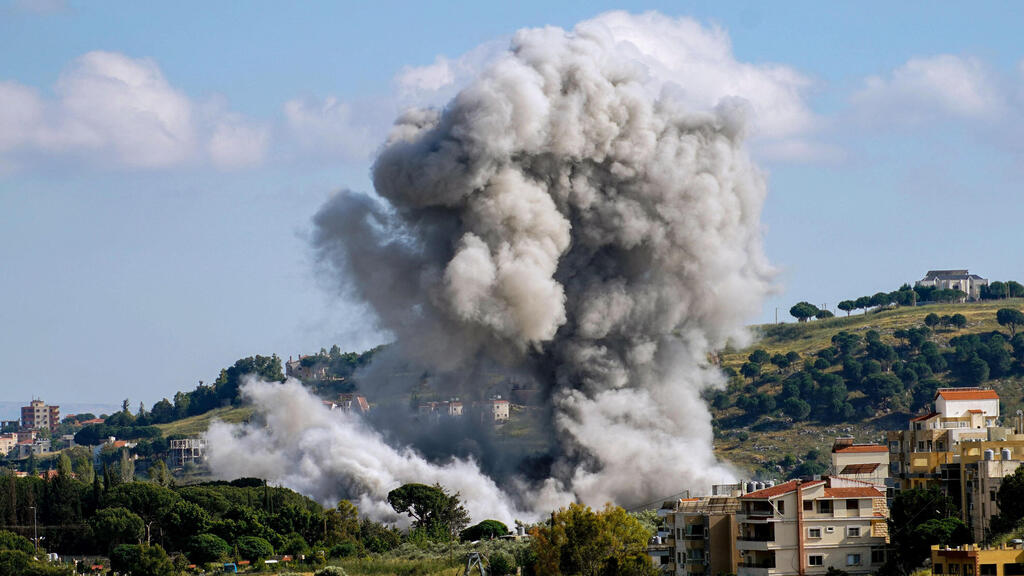
IDF attacks in Lebanon(
(Photo: Abbas Fakih/AFP)
The fixation on terminology here is not the product of grumpiness combined with linguistic pedantry. Framing reality in a certain way has a greater effect than it may seem. It is no coincidence that we say reality shapes consciousness. True, everyone understands that the fire has not really stopped. But when the default terminology is “pause,” fire on our forces is perceived as an exception to the rule. That, in turn, shapes our worldview and its consequences for us on the ground.
For example, public officials may assume that finding solutions for the emptying north or the struggling south is not so urgent. After all, we are in a cease-fire, and we need to wait and see what tomorrow brings. Negotiators at the State Department can schedule talks at intervals longer than necessary, because the urgency exists but is not burning. Their expectations of Israel follow accordingly.
Indeed, as befits a “cease-fire” in the north, the IDF is on the defensive and is not attacking. The forces are static, and for three weeks Dahiyeh has enjoyed immunity. International coverage, too, is in no hurry to obsess over every clash. Thus, the killing of our soldiers becomes “merely” a deviation from agreed calm, not full-scale war.
In February 2022, Netanyahu declared that a prime minister “must be able to say one word to the president of the United States, and that word is ‘no.’” That is true, but not entirely. Because the saga of the “cease-fire” in Lebanon and Gaza requires an update to the terminological toolbox vis-à-vis the president. Not only “no,” but also “not exactly.”
The most powerful man in the world must be made to understand that this is not exactly the pause that was agreed upon. Not exactly quiet. Not exactly a situation in which our forces can absorb fire without responding. Because Israel is not exactly in a cease-fire. It is in a fire-starter. The operational meaning is that the IDF must be given more flexibility and fewer restrictions, especially in the north. It must be allowed to respond where necessary, not in order to provoke war, but to protect our forces and to manage diplomatic processes with sensitivity, but from a position of strength.
Above all, however, the most painful consequence of clinging to incorrect terminology concerns the citizens themselves. When what is said contradicts what is actually happening, cognitive dissonance is created. The head hears “ceasefire,” but the heart knows it is not true. The result is a crisis of trust.
Much has been said during the war about resilience. Not enough has been said about what erodes resilience. A distorted reflection of reality does exactly that.