


An 11-page report submitted to the U.N. Security Council reveals a complex picture: impressive successes alongside a diplomatic deadlock that threatens the future of the Gaza Strip.
Seven months after the Gaza ceasefire took effect, the Board of Peace established by U.S. President Donald Trump submitted an interim report presenting historic achievements alongside unresolved challenges. The main difficulty: a stubborn diplomatic struggle with Hamas over disarmament.
The Board of Peace, which includes 28 countries, was established under U.N. Security Council Resolution 2803, adopted in November, which approved the “comprehensive plan to end the Gaza conflict” from Sept. 29, 2025.
“The guns have largely fallen silent across Gaza for the first time in two years,” the board wrote. But it immediately added a sharp warning: “Violations occur almost daily, some of them serious, causing civilian casualties and delaying humanitarian access.”
The report also said that “the four mediating countries — Egypt, Qatar, Turkey and the United States — are working tirelessly to preserve the ceasefire. We strongly warn that any violation, by any side, endangers everything that has been painstakingly built.”
At the heart of the report is what it calls the “road map” — a 15-point document drafted by the four guarantor states and the high representative for Gaza, former ambassador Nikolay Mladenov. The plan seeks to advance the next stage: the full and monitored disarmament of Hamas and all armed groups in Gaza as a condition for progress.
Under the road map, Hamas would be required to completely cease all military, police and administrative activity. The International Stabilization Force would be deployed as a buffer and support oversight of the weapons chain. Israel would carry out a phased withdrawal to Gaza’s periphery, but only according to the pace of verified disarmament. Reconstruction would begin only in areas where disarmament had been completed.
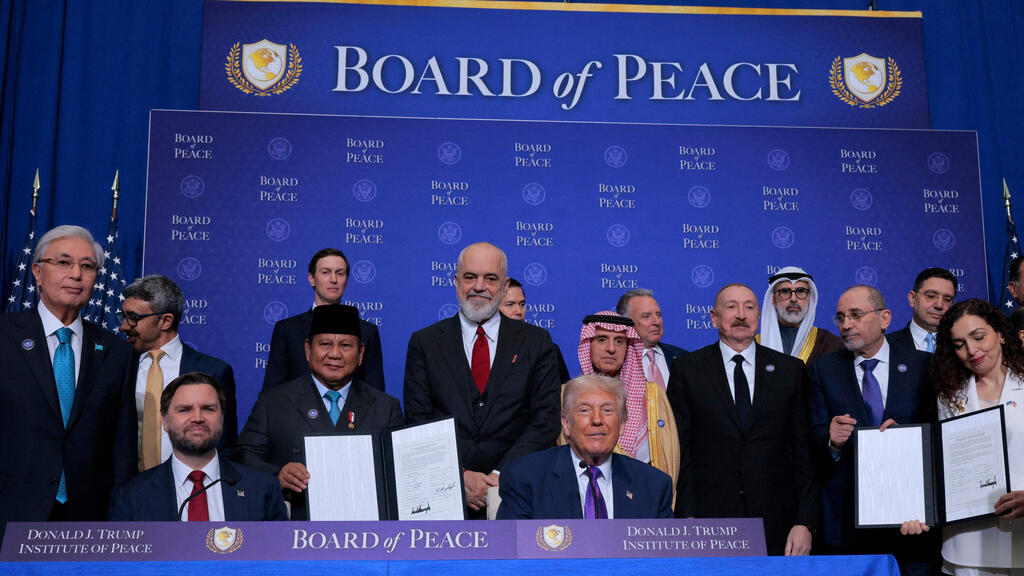
President Donald Trump launches Board of Peace
(Photo: Chip Somodevilla/ Getty Images North America / AFP)
But as of the report’s closing, negotiations on the road map had not concluded. Meetings in Cairo and Istanbul in March and April produced no breakthrough. Hamas, as the council put it sharply, “refuses to accept verified disarmament, relinquish coercive control and allow a genuine civilian transition.”
Humanitarian aid: Dramatic improvement, but needs remain vast
The humanitarian aid picture is one of the relatively bright points in the report. Since the ceasefire, the volume of aid has risen by more than 70% compared with the period before it. Nearly 300,000 tons of aid have been delivered, including drinking water, sanitation, tents and medical equipment. Most bakeries in the Strip have resumed operations, and basic food needs have stabilized for the first time since 2023. Under the agreement, 4,200 trucks are supposed to enter Gaza each week.
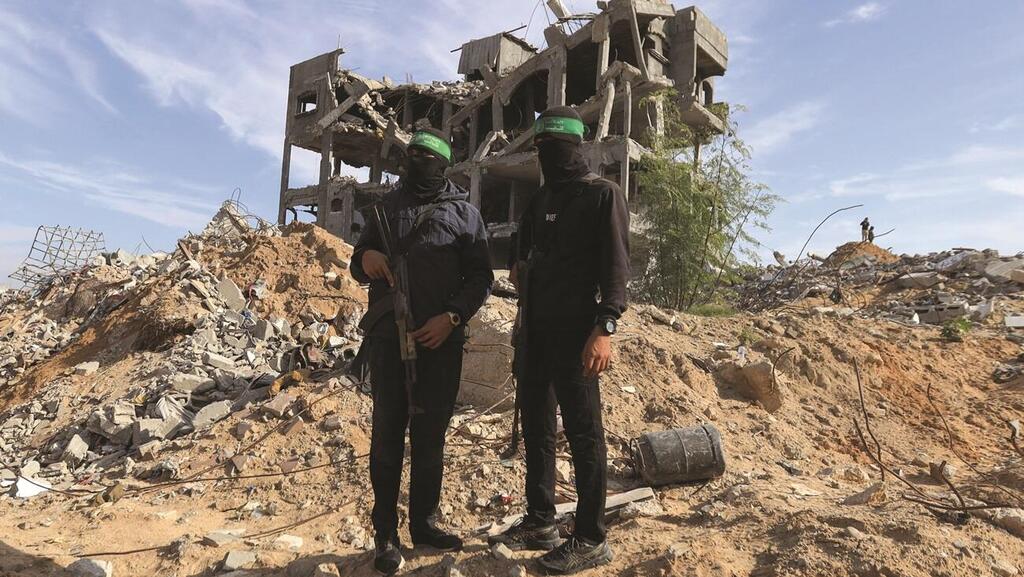
But the bleak picture has not disappeared: Most of the population still lives in tents and temporary shelters. Unemployment is estimated at about 80%. There are severe shortages of cooking gas, medicine and drinking water. The health and education systems have been “destroyed.” The U.N. Security Council estimated urgent aid needs at about $3.1 billion for the first year after the ceasefire, and OCHA, the U.N. Office for the Coordination of Humanitarian Affairs, issued an appeal for $3.72 billion.
The Palestinian technocratic committee: Ready but blocked
The Board of Peace established the NCAG, the National Committee for the Administration of Gaza, an apolitical Palestinian technocratic body from the Strip led by Dr. Ali Shaath. The committee held an inaugural meeting in Cairo on January 15, built a legal and financial framework for managing crossings and recruited thousands of candidates for a civilian police force.
The problem: The NCAG cannot enter Gaza.
“Hamas does not allow entry into areas under its armed control,” the report said. The Board of Peace called on Hamas to remove the obstacles “without further delay.”
According to the report, the International Stabilization Force is a central operational tool in the plan. It will operate under a unified U.S. command led by Maj. Gen. Jasper Jeffers. Five countries — Albania, Indonesia, Kazakhstan, Kosovo and Morocco — have already signed the “founding participants’ declaration” on February 19. A preliminary survey was completed in April 2026, and a logistical support site has been identified. But actual deployment depends on progress in disarmament, which has not yet begun.
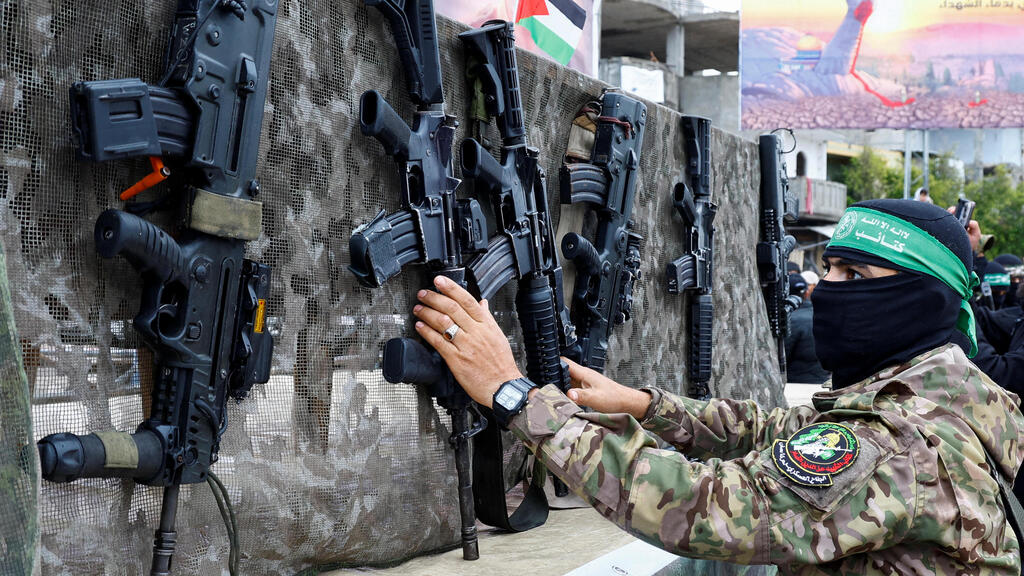
Weapons on display in Gaza
(Photo: Reuters/Hatem Khaled)
The report presents an impressive figure: $17 billion has so far been pledged for Gaza reconstruction. Eight countries, including Saudi Arabia, Qatar, Kuwait, the United Arab Emirates and Morocco, have signed the “founding donors’ declaration.” The World Bank estimated the full cost of rebuilding Gaza over a decade at $71.4 billion.
But the council warned: “The gap between commitment and actual transfer must be closed urgently. Funds pledged but not delivered are the difference between a framework that exists on paper and one that delivers results on the ground.”
In its conclusions, the Board of Peace presents four specific calls to the Security Council: “First, to state clearly and consistently that disarmament is a condition for reconstruction and Israeli withdrawal. Second, to pressure Hamas to accept the road map and the disarmament framework. Third, to require all sides to allow free entry of the NCAG into Gaza and enable the uninterrupted flow of aid. Fourth, to push member states to accelerate the transfer of pledged funds.”
The bottom line: The report sketches a picture of a new international body that managed to pull a two-year hostage crisis out of the abyss, stabilize a fragile ceasefire and build a complete institutional architecture within a few months — achievements that should not be dismissed.
But it is clear that the Board of Peace is submitting the report with one hand while the other is clenched in a fist: every cornerstone of the plan — civilian governance, reconstruction, deployment of a stabilization force and Israeli withdrawal — remains locked behind one question still awaiting an answer: Will Hamas lay down its arms?
“Every delay carries a direct and measurable human cost for the residents of Gaza, who have suffered enough,” the board wrote. “They have suffered enough.”