

The American naval blockade continues to exact a heavy economic price from Iran. Figures recently published by Iranian economist Masoud Nili point to a significant deterioration in economic indicators. Between 2018 and 2026, the exchange rate jumped nearly 50-fold, price levels rose more than 19-fold and 16 million people were added to the population living below the poverty line. About 5 million people in Iran were added to the working-age population, but the number of employed people grew by only 400,000. In recent months, the official inflation rate crossed 70%, while the number of people employed in industry fell by about 630,000.
At least for now, however, there is no evidence that the Iranian leadership intends to soften its positions in order to return to the memorandum of understanding with the United States and ease the economic distress through the removal of the naval blockade, sanctions relief and the unfreezing of frozen Iranian assets. Moreover, in recent weeks, Iranian positions appear to have hardened.
Iran is no longer content with demanding the lifting of the naval blockade in exchange for opening the Strait of Hormuz, even if understandings are reached in talks with Oman regarding future arrangements in the strait. It now demands that the American commitments under the June 2026 memorandum of understanding, including the unfreezing of funds and significant sanctions relief, be implemented as a precondition for opening the strait.
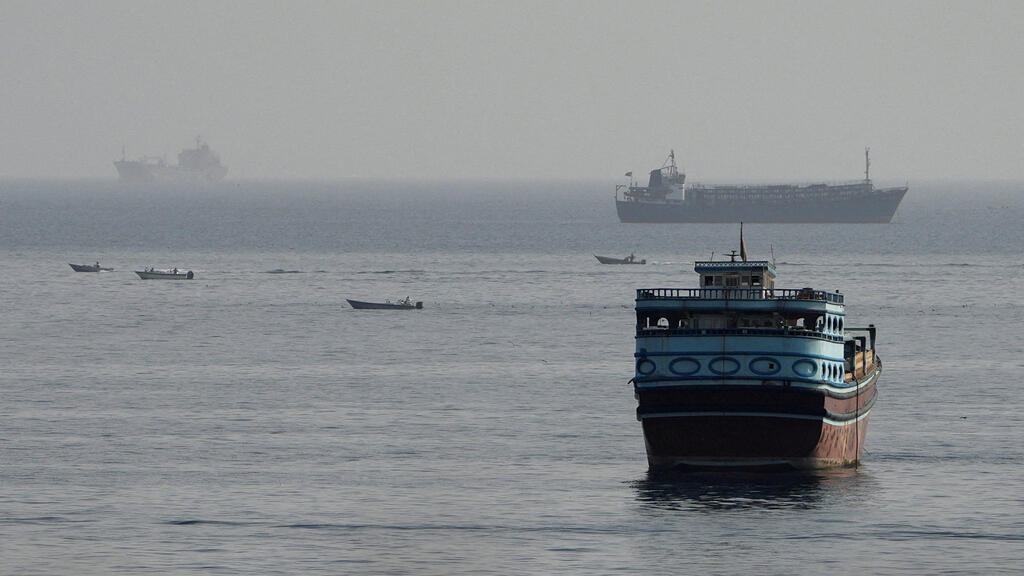
Vessels in the Strait of Hormuz
(Photo: Reuters/Stringer)
Furthermore, Iran is demanding a ceasefire on additional fronts, particularly in Lebanon and the Palestinian arena. A commentary article published by the Fars news agency, which is close to the Revolutionary Guards, presented the addition of the demand for a ceasefire in the Palestinian arena as a strategic move intended to strengthen deterrence and make clear to the enemy that every time it imposes a new war on Iran, it will face more demands and tougher conditions than those presented on the eve of the war.
A series of appointments recently decided by Iran’s leader, Mojtaba Khamenei, also signals a shift in security thinking toward preparations for a prolonged confrontation and greater offensive posture. The appointments, which come in addition to the appointment of former Revolutionary Guards commander Mohsen Rezaei as secretary of the Supreme National Security Council and the leader’s representative on the council, reflect the continued drawing of lessons from Operation Roaring Lion and convey three main messages.
First, the decision to merge the Khatam al-Anbiya emergency headquarters with the General Staff of the Armed Forces is intended to improve the decision-making process and reduce duplication caused by the existence of two parallel commands: one responsible for force buildup, strategic planning and coordination between the Revolutionary Guards and the regular army, and the other for the use of force in emergencies.
No evidence that the Iranian leadership intends to soften its positions in order to return to the memorandum of understanding with the United States and ease the economic distress through the removal of the naval blockade, sanctions relief and the unfreezing of frozen Iranian assets
Second, the appointment letters emphasize a shift to a more offensive doctrine. In Ahmad Vahidi’s letter of appointment as commander of the Revolutionary Guards, Khamenei demanded that he not settle for maximum deterrence, but maintain readiness for “powerful offensive operations against the enemy.” Mohammad Reza Naqdi, a senior adviser to the commander of the Revolutionary Guards, declared that the organization must be prepared to transfer the fighting to enemy territory whenever circumstances require it, as part of the adoption of an offensive military doctrine rather than settling for a defensive combat doctrine aimed only at protecting the country from threats. Ismail Kowsari, a member of the Majlis National Security Committee, also declared that the latest war proved the effectiveness of Iranian offensive operations in Jordan, Kuwait and Bahrain, and that Iran would continue to adopt an offensive doctrine.
Third, on the domestic front, the appointment of Hossein Taeb, the former head of the Revolutionary Guards’ intelligence organization, as commander of the Basij carries significance. Taeb’s appointment, given his extensive experience in political and civilian repression, points to an effort to improve preparations for the possibility of renewed protests, especially in light of the worsening economic situation. He was instructed to strengthen a “popular intelligence network,” expand the use of new technologies and broaden the activity of Basij networks among different sectors and in urban areas. The move could increase cooperation between the Basij and the intelligence agencies, and improve control over the public sphere following the intelligence failures exposed during the Israeli-American strikes in Iran.
 Dr. Raz Zimmt
This does not mean Iran is unwilling to return to negotiations or even reach an agreement with the United States in the future, although the chances of that appear slim in the foreseeable future. Still, it is clear that Tehran is not prepared to return to the status quo that preceded the war. It is determined to entrench its achievements, first and foremost control of the Strait of Hormuz and the ability to exact a heavy price from its Arab neighbors and American forces in the region in order to prevent another attack.
As pressure on it increases, the Iranian leadership is adopting a tougher, more defiant and more offensive line, and is prepared for a prolonged confrontation and escalation, even at a heavy cost, to ensure that if and when the campaign ends, it does so not with a temporary ceasefire, but on the basis of recognition of Iran’s deterrent capability.
Dr. Raz Zimmt is director of the Iran and Shiite Axis Program at the Institute for National Security Studies