


When Chinese President Xi Jinping touches down in Cairo for his first state visit to Egypt in a decade, Washington cannot afford to view the summit as routine diplomatic theater.
Beyond public declarations celebrating seventy years of bilateral relations and Global South cooperation, Beijing is quietly advancing a strategic initiative to erode United States financial leverage across the Middle East.
Gallery
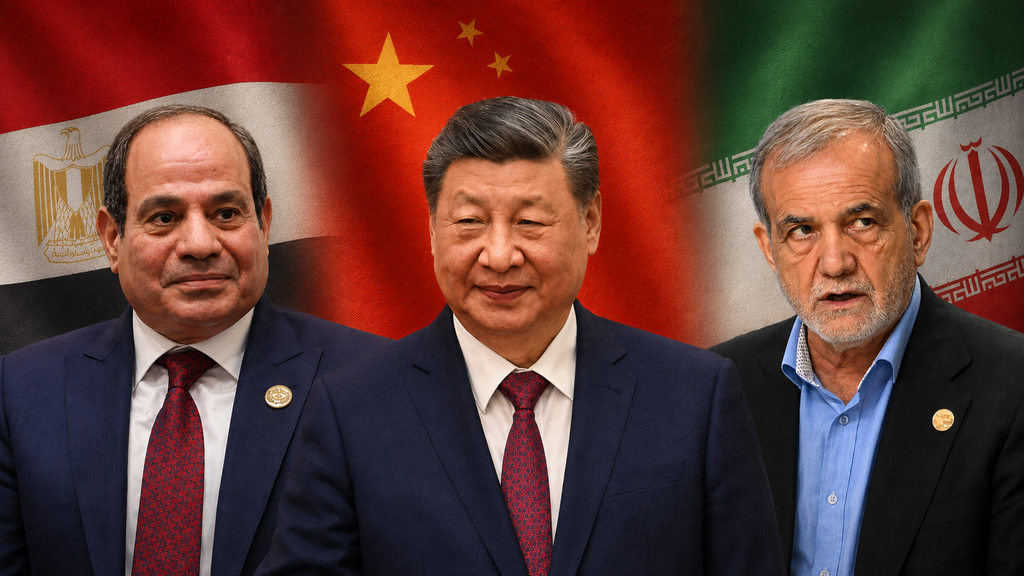
Abdel Fattah el-Sisi, Xi Jinping, Masoud Pezeshkian
(Photo: REUTERS/Evelyn Hockstein, Alexander NEMENOV / POOL / AFP)
At the center of this push is the deliberate expansion of Chinese-backed, non-dollar settlement infrastructure within Egypt. While promoted as standard commercial diversification, this non-SWIFT financial framework creates durable, opaque pathways that can be exploited to shield Iranian trade from American secondary sanctions, undermine Israeli national security and reward an Egyptian government that routinely prioritizes regime survival over its core strategic commitments to the West.
Beijing's economic engagement in North Africa focuses on building financial channels capable of operating independently of the United States dollar and Western banking oversight.
In June 2026, the People's Bank of China and the Central Bank of Egypt extended their bilateral currency swap agreement, expanding its total value from 18 billion to 30 billion yuan, equivalent to roughly 4.4 billion dollars.
This monetary expansion follows key structural agreements signed in July 2025, when Egyptian and Chinese central bank officials oversaw memoranda of understanding involving Suez Canal Bank, China-Africa TEDA Investment Company and CIPS Company Limited, the operator of China's Cross-Border Interbank Payment System.
Designed to promote yuan-denominated settlement within the China-Egypt Suez Economic and Trade Cooperation Zone, these mechanisms establish a parallel clearing architecture along the Suez Canal, embedding non-dollar financial tools into Egyptian banking.
While these non-dollar settlement networks are presented as tools for legitimate commercial trade, their technical structure creates systemic financial opacity.
By conducting cross-border clearing in local currencies and routing transactions through CIPS rather than SWIFT, these channels bypass the traditional correspondent banking networks monitored by Western regulators.
This architectural design inherently heightens the risk of sanctions evasion by creating non-transparent financial nodes that hostile actors can utilize.
Positioned at the juncture of African, Middle Eastern and European commerce, Egypt is becoming a high-risk transit hub where non-dollar liquidity can be leveraged to obfuscate illicit trade flows involving regional adversaries.
The reality of this vulnerability is not hypothetical; it is already documented in recent enforcement actions by United States authorities.
On August 28, 2026, the Financial Crimes Enforcement Network proposed a Section 311 special measure targeting the United Arab Emirates branches of Egypt's state-owned Banque Misr.
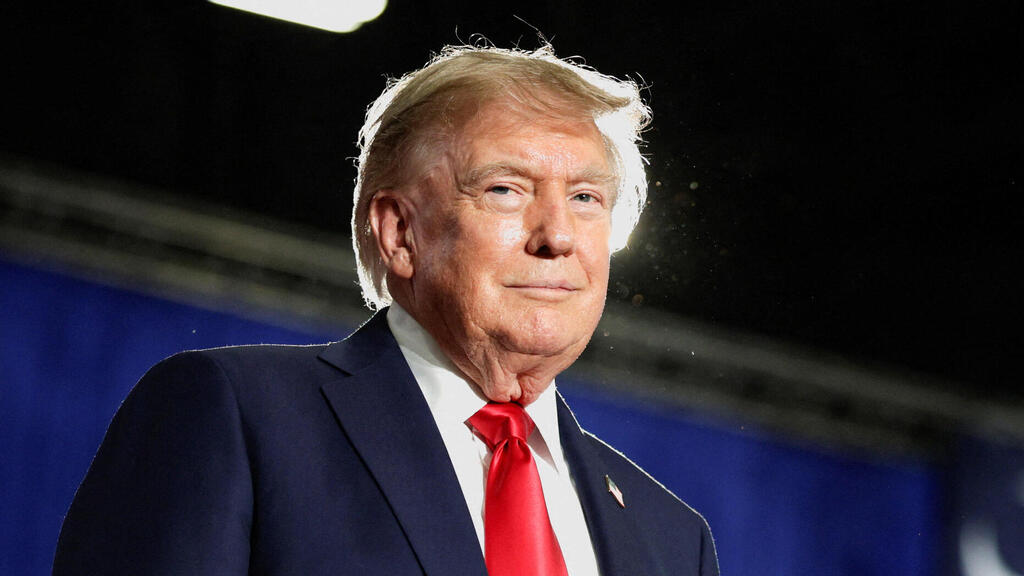
US President Donald Trump: Washington cannot afford to view the summit as routine diplomatic theater
(Photo: Evan Vucci/Reuters)
FinCEN identified 103 potential Iranian shadow-banking front companies that processed approximately 1.8 billion dollars through these branches between January 2024 and June 2026, including 520 million dollars over the most recent twelve-month period.
This documented flow of Iranian illicit funds through a premier Egyptian state financial institution illustrates how regional actors exploit banking vulnerabilities to maintain access to international commerce and dollar clearing through indirect channels.
It confirms that Egyptian financial architecture is actively being utilized as a conduit for shadow-banking operations that directly undermine American secondary sanctions enforcement.
Under President Abdel Fattah el-Sisi, Egypt continues to receive approximately 1.3 billion dollars annually in United States Foreign Military Financing.
Yet, facing severe fiscal stress and heavy external debt burdens, Cairo has consistently engaged in dual-track behavior to maintain regime liquidity.
This pattern of dual loyalty is particularly alarming given the ongoing crisis along the Red Sea and Suez corridor, where maritime security and Israeli defense face persistent threats.
For months, Iranian-backed Houthi insurgents in Yemen have launched drones and anti-ship ballistic missiles at commercial vessels, forcing major shipping lines to bypass the Bab el-Mandeb Strait and imposing an effective blockade on Israel's southern port of Eilat.
Throughout this maritime crisis, China's behavior has reflected pure realpolitik.
While Western and Israeli-linked merchant vessels remain under constant attack, Chinese-flagged and Chinese-owned ships have enjoyed a documented pattern of safer passage and individual clearances through Houthi-controlled waters.
Beijing has exploited this differential treatment to secure commercial advantages for its own state fleet while leaving international shipping exposed to hostile strikes along this vital global maritime transit choke point.
If allowed to consolidate, the expansion of non-dollar settlement mechanisms in Egypt will cause lasting damage to American power and regional stability.
An emerging framework that enables non-SWIFT, yuan-denominated clearing along the Suez Canal offers Tehran a critical structural buffer against Western economic pressure.
By creating insulated financial channels, this network heightens the risk that Iranian state entities can continue generating revenue to finance regional proxy forces, including Hamas, Hezbollah and the Houthis.
Furthermore, deeper Chinese financial and logistical entrenchment along the Suez Canal weakens Washington's capacity to enforce sanctions regimes, erodes Western influence over vital maritime choke points and directly compromises Israel's peripheral security environment.
The long-term convergence of Chinese capital, Egyptian cooperation and Iranian trade networks threatens to reshape regional Middle Eastern stability.
Washington must confront the reality that unconditional military assistance to Cairo has failed to secure strict alignment with Western national security priorities.
The United States response must be immediate, targeted and uncompromising.
First, Congress should freeze Egypt's Foreign Military Financing until Cairo subjects its banking sector to comprehensive independent audits and dismantles non-transparent, non-dollar clearing mechanisms that pose sanctions-evasion risks linked to Beijing and Tehran.
American military aid must be explicitly conditioned on absolute compliance with international financial sanctions and full operational transparency in Cairo's central banking operations.
American taxpayer dollars must not subsidize a foreign government that permits its financial sector to be used for illicit financial evasion schemes.
Second, the United States Treasury Department must aggressively deploy secondary sanctions against any Egyptian financial institution, state enterprise or government official found to be facilitating Iranian shadow-banking transactions or enabling illicit settlement schemes.
Cairo must be forced to make a definitive choice between maintaining access to the United States financial system and permitting non-transparent financial collaboration with foreign adversaries.
 Amine Ayoub
Access to Western financial markets and dollar clearing is a privilege reserved for responsible security partners, not an entitlement for regimes that play both sides.
By establishing strict enforcement penalties, Washington can effectively deter regional financial institutions from participating in shadow networks that undermine international sanctions and destabilize regional strategic stability.
Third, the United States must strengthen its core strategic commitment in the Middle East by deepening military, naval and intelligence integration with Israel.
Washington and Jerusalem should expand joint maritime interdiction operations in the Red Sea and conduct decisive kinetic strikes against Houthi launch infrastructure, weapons depots and Iranian supply vessels in the Bab el-Mandeb.
Freedom of navigation is a non-negotiable requirement for global trade and Western security. It cannot be surrendered to Iranian maritime terrorism or Chinese economic opportunism.
By pairing aggressive financial enforcement against Cairo with unyielding military power in the Red Sea, Washington can effectively reassert its strategic leadership.
Xi Jinping's state visit to Cairo marks a decisive moment for Western policy in the Middle East.
The battle for regional stability is being waged not only in maritime straits, but within central bank vaults, clearinghouses and trade zones along the Suez Canal.
The United States must act with hard power, strategic clarity and uncompromising economic coercion.
Failure to enforce accountability today will leave America weaker, Israel more exposed and an empowered autocratic axis better positioned along the world's most vital economic corridor.
Amine Ayoub, a fellow at the Middle East Forum, is a policy analyst and writer based in Morocco. Follow him on X: @amineayoubx