

Before the war that has now erupted, the Gulf states adopted a publicly neutral line and pushed for an arrangement with Iran to avert the danger of conflict, fearing it would also harm them. Once it broke out, they indeed found themselves under attack. As Iranian strikes on their territory deepen, they are gradually abandoning the image of neutrality they had embraced.
Moreover, for the first time, they are not only condemning Iranian fire on their territory but have jointly declared their right to self-defense — a necessary step before any possible response on their part.
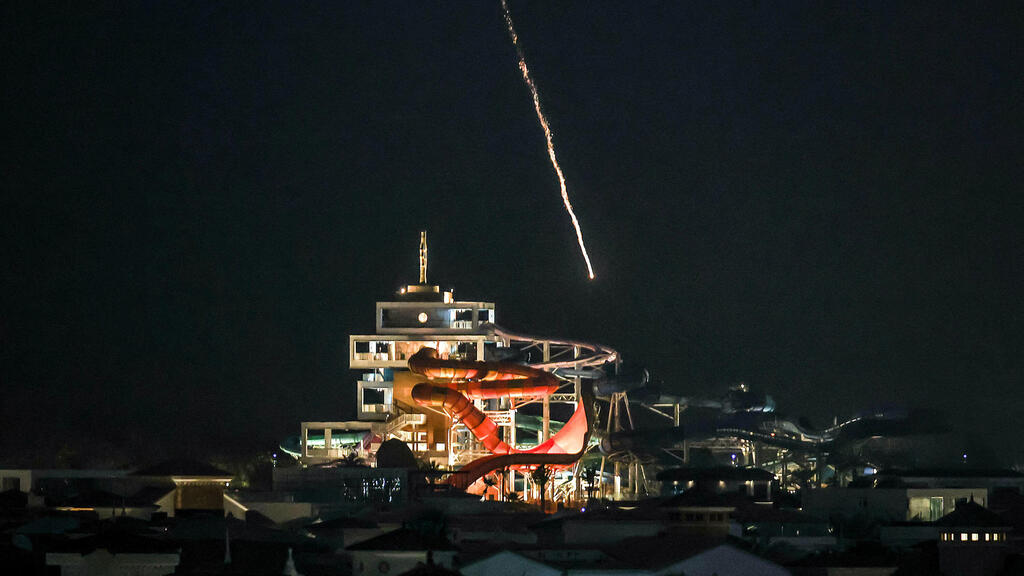
Missile in Dubai's skies
(Photo: FADEL SENNA / AFP)
Iran’s offensive move against Gulf territory is aimed primarily not at the Gulf states themselves but at the United States. It is a strategy of indirect pressure: striking countries that host American military assets on the assumption that the resulting security, economic and psychological damage will translate into pressure on Washington. Iran seeks to convince others that the cost of confronting it outweighs any expected gain and that as long as the campaign continues, the Gulf arena will not be immune.
The central question, however, is not only what Iran hopes to achieve but how its actions will be interpreted in the Gulf. This is the dilemma: whether to respond against Iran — and if so, how.
The Gulf states possess advanced military capabilities and, on paper, are able to carry out pinpoint strikes against targets in Iran. However, a direct attack on Iran would mark the crossing of a threshold and open an overt front against a regional power with a vast missile arsenal and the ability to operate through proxies across multiple arenas. Such a campaign could drag on, damage energy infrastructure and shipping routes, and threaten the economic foundations on which Gulf stability rests.
In any case, given their relative vulnerability, any military action on their part would require not only coordination with the Americans but American military backing. The test, therefore, is not solely one of military capability but also of assessing American intentions.
If Gulf leaders become convinced that Washington is determined to “go all the way” — even to the point of toppling the Iranian regime — they may be prepared to absorb damage on their own soil. The regime in Tehran is seen by them as their most serious external threat. Yet they still fear that, from the perspective of the Trump administration, this is a limited campaign, lacking a clear horizon and without a commitment to decisive victory. The conclusion, therefore, could be that they are bearing a cost without a meaningful return. In such a scenario, their response would be far more cautious, focused on risk mitigation rather than escalation.
At the same time, under fire, a new Gulf dynamic is taking shape. Messages from Riyadh expressing readiness to assist neighboring states, and intensive talks among regional leaders, reflect an understanding that the threat is shared. The Gulf Cooperation Council may once again serve as a platform for political and military coordination. However, not all states will rush to fully align with a hard line against Iran, especially if they assess that the confrontation will end in a compromise. For some, maintaining an open channel to Tehran remains a vital insurance policy.
Pressure on the leadership
Iranian strikes on civilian facilities — including oil and gas production sites — are not accidental. They are a deliberate message intended to generate pressure on Gulf leaders. Yet such messages can backfire: attacks on the civilian rear and on strategic installations in the Gulf could compel the states to abandon neutrality and clearly side with the United States.
In such a reality, it would be easier to justify deepening security cooperation — with the United States and perhaps even with Israel. Israeli-made missile defense systems are already participating in the defense of some of these countries.
 Yoel Guzansky Photo: INSS
The range of possible responses by the Gulf states includes severing diplomatic ties, canceling agreements, seeking U.N. Security Council resolutions, and tightening coordination with Washington. Before the war, they said they would not allow attacks to be launched from their territory. They now have the legitimacy to do precisely that.
A Gulf strike on Iran remains a theoretical option — but one that carries the risk of opening a front whose consequences would be difficult to control. If it were to occur, it would likely be symbolic and measured, designed to send a message while preserving their honor.
Iran is testing whether it can fracture the American front by inflicting progressively deeper damage on the Gulf states. The United States is being tested on its resolve and strategic clarity, while the Gulf states face a dual challenge: safeguarding their security and sovereignty without being drawn into a dangerous campaign that could jeopardize their economies.
The decisions made now in Riyadh, Abu Dhabi and Doha will shape not only the nature of the immediate response but also patterns of regional alignment and confrontation for years to come.
Dr. Yoel Guzansky is head of the Gulf Program at the Institute for National Security Studies and an associate fellow at the Middle East Institute in Washington.