

In recent years, the Gulf states — including Saudi Arabia, Qatar, Kuwait, Oman, Bahrain and especially the United Arab Emirates — have become arenas for cultural investments on an unprecedented scale. Behind the museums, festivals and architectural mega-projects lies a clear ambition: to forge a new national identity, elevate international standing and craft a collective narrative based not only on economic wealth but also on “soft power” — culture, education, art and tourism.
The UAE has taken the lead in this effort, with a string of landmark institutions and, soon, a striking new national museum designed to tell the story of the young federation through bold, groundbreaking architecture. The question, say its planners, is how a single building can embody a nation — and what makes this museum one of the most intriguing cultural projects of the decade.
The Zayed National Museum, set to open this December, is named for Sheikh Zayed bin Sultan Al Nahyan, the founding father and first president of the UAE, who ruled Abu Dhabi from 1966 until his death in 2004. Sheikh Zayed is revered as the unifier who brought together the seven emirates into a single federation, while driving sweeping modernization, economic development and massive infrastructure investment that transformed the country from a sparsely populated desert into a prosperous, globally connected economy. His legacy remains a central pillar of Emirati identity, and the museum seeks to commemorate both his personal role and the nation’s broader story.
A project designed to impress
The museum, with an estimated cost of $680 million, was designed by the renowned British firm Foster + Partners, founded by architect Norman Foster. It will serve both as a monument to Sheikh Zayed and as a flagship cultural center in Abu Dhabi’s Saadiyat Cultural District, a waterfront precinct that has emerged as an international hub for the arts.
The district is already home to some of the world’s most notable institutions, including the Louvre Abu Dhabi, designed by Jean Nouvel, and the future Guggenheim Abu Dhabi by Frank Gehry, expected to open later this year. It also hosts galleries, performance spaces and the Abrahamic Family House, a unique interfaith project designed by British architect David Adjaye that brings together a mosque, a church and a synagogue in one complex, symbolizing coexistence and religious tolerance.
And, as with most things in the Emirates, grandeur is the guiding principle. The Zayed National Museum is more than an architectural landmark; it is a monumental, almost ostentatious statement of presence. Spanning 44,000 square meters, the building resembles a massive vessel topped with five soaring glass “sails,” designed to dominate the skyline with both drama and symbolism.
According to the architects, the sails were inspired by the wing feathers of a falcon — a national symbol of courage, freedom and mastery. The aim, they said, was to fuse contemporary architectural language with motifs drawn from traditional Arab design. As with many projects in Abu Dhabi, the museum is an attempt to translate Emirati national identity into architectural form — with maximum visual impact.
Climate thinking no less than design
Abu Dhabi is a hot desert city, and coping with extreme climate conditions was a central consideration in the museum’s design. One of the innovative environmental solutions chosen was the integration of five aerodynamic steel towers designed to function as solar thermal chimneys. Heat accumulating at the top of each tower creates a stack effect, drawing warm air upward from the galleries. At the tower peaks, wing-shaped vents release the hot air outside, using negative pressure on their sheltered sides. At the same time, fresh air is captured at ground level, passed through underground cooling pipes and released into the museum lobby after being chilled. The result is a passive, efficient natural ventilation system that reduces the need for artificial air conditioning and demonstrates how innovative architecture can respond intelligently to extreme environmental conditions.
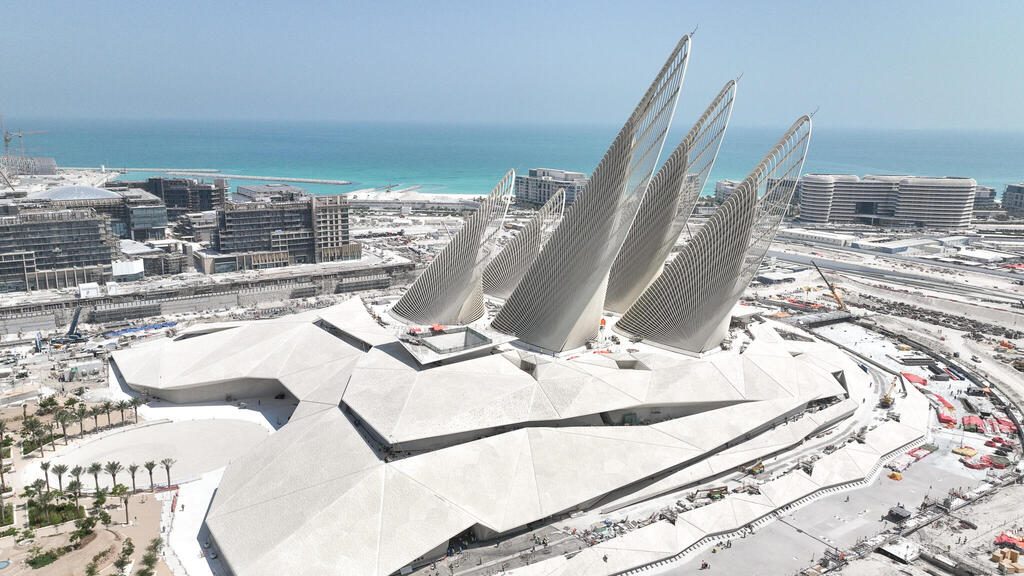
The Zayed National Museum
(Illustration: Courtesy)

The Zayed National Museum
(Illustration: Courtesy)
The museum’s galleries are designed in the shape of a raised mound — an architectural interpretation of the local desert landscape. The form balances the lightness of the soaring steel structures with a monumental, enveloping interior. Suspended above a dramatic central lobby flooded with natural light from above, the galleries create a striking spatial experience. The lobby itself, carved into the ground to take advantage of the earth’s natural thermal insulation, functions as a vibrant public space with shops, cafés, and informal areas for music and performance.
Careful attention to light and shadow is evident throughout: discreetly placed openings capture the desert’s intense sunlight and channel it gently into sculptural interiors. Color choices inside and out were made to harmonize with the warm white tones of Saadiyat Island’s sand, where the museum stands.
An ancient pearl and a rare Quran
Inside, the museum will feature galleries and exhibition halls focusing both on the life and achievements of Sheikh Zayed and on the broader story of the UAE. “The galleries focus on Sheikh Zayed’s life and legacy but also reflect the nation’s historical trajectory — from its earliest periods to more recent times,” said museum director Peter Magee. “The museum is rooted in the values of the UAE’s founding father.”
Among the highlights is the Abu Dhabi Pearl, an 8,000-year-old gem discovered on Marawah Island, which testifies to human activity in the region as far back as 300,000 years ago, including early trade links with other Gulf cultures. Another key exhibit is the Blue Quran, a rare 9th–10th century manuscript, which will be displayed in a gallery exploring the spread of Islam and the influence of new technologies and materials — developments that helped fuel the flourishing of the Arabic language.
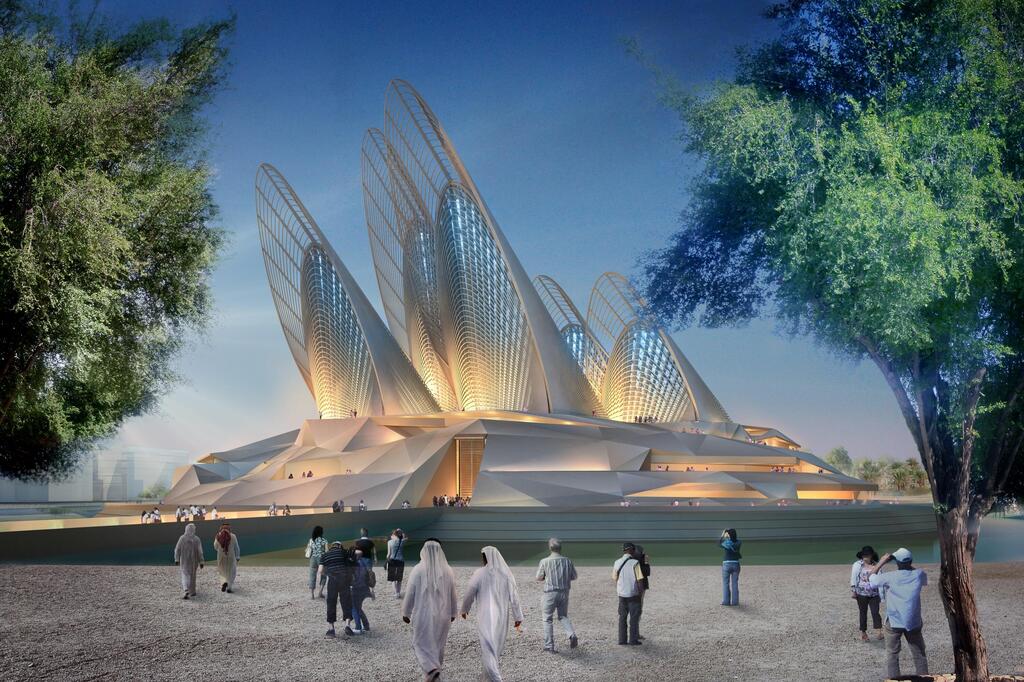
The Zayed National Museum
(Illustration: Foster + Partners)
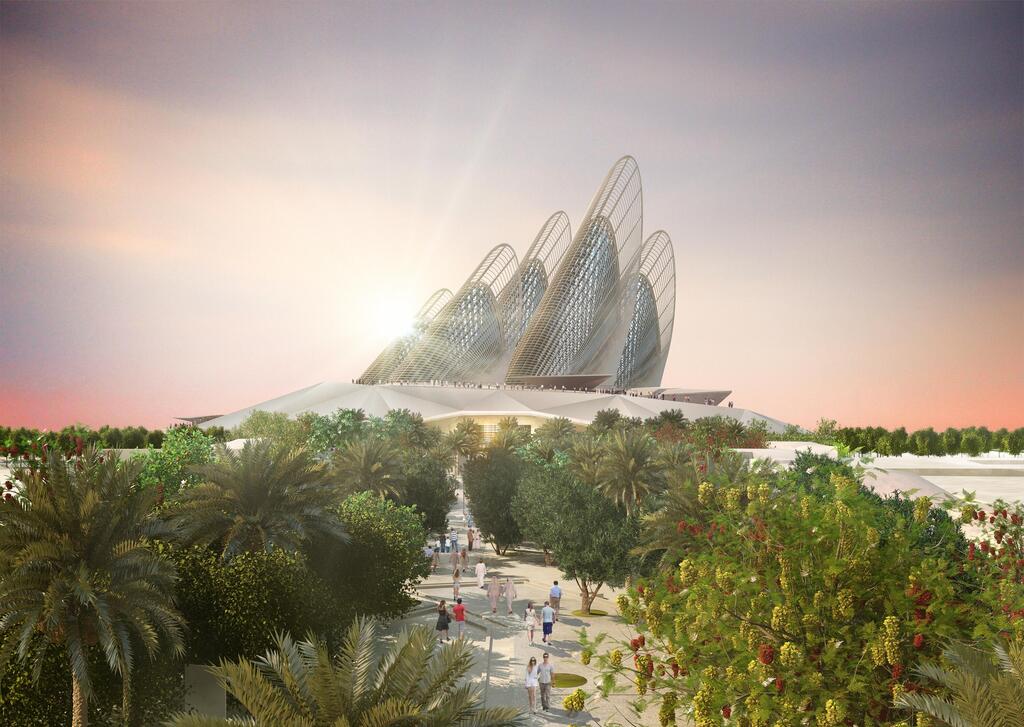
The Zayed National Museum
(Illustration: Foster + Partners)
Norman Foster, widely regarded as one of the world’s most influential architects, is known for designing distinctive, innovative projects across the globe, many of which have won international acclaim. In Israel, Foster’s firm completed the Edmond and Lily Safra Center for Brain Sciences at the Hebrew University’s Givat Ram campus in 2017, his first project in the country. The office is now involved in planning a new mixed-use tower on Kaplan Street in Tel Aviv, at the site of the former Journalists’ House, in collaboration with Bar-Orian Architects.
The Zayed National Museum is part of Abu Dhabi’s sweeping vision to rebrand the city as a global cultural hub and premier tourist destination. Enormous resources are being invested in art, heritage and architectural projects as part of efforts to diversify the local economy and shape a distinct national identity.
One particularly ambitious target has been set for 2030: attracting 39 million visitors annually. The museum’s opening marks a central step in realizing that goal, combining historical storytelling with a contemporary, international design language. Its December inauguration represents another stage in Abu Dhabi’s cultural strategy, which seeks to harness culture, tourism and design to project the nation’s image both inward and outward.
Whether this reflects a profound cultural shift or a national statement wrapped in dazzling aesthetics, the impact — and the message — is undeniable. As for whether it is also good architecture, that remains an open question.