

Syria signed investment agreements worth a reported $14 billion on Wednesday with a range of international companies, in a ceremony attended by Syrian President Ahmad al-Sharaa.
Officials said the 12 new projects, spread across several provinces, mark a new phase in the country’s reconstruction. Unlike previous rounds of deals, Qatar was at the center of the latest agreements.
Rendering of planned construction project in Damascus
(Video: from promotional video)


Talal al-Hilali, chairman of the Syrian Investment Authority, said the projects “usher in a qualitative shift in Syria’s infrastructure and economic landscape,” highlighting a $4 billion expansion of the Damascus International Airport, a $2 billion investment into the Damascus Metro system and a $2 billion high-rise residential tower complex in Damascus.
Al-Hilali told the gathering that the agreements were “a turning point” for Syria’s future. “These are not just real estate or infrastructure ventures, they are engines for job creation and bridges of trust between Syria and the global investment community.”
U.S. envoy Thomas Barrack, also present, called Syria a “new hub” in “trade and prosperity” and expressed Washington’s interest in strengthening Damascus as a center for commerce and growth.

Ayman Hamouyeh, adviser to Syria’s Higher Council for Economic Development, said all agreements have timelines, with some lasting years, and that housing remains a priority due to destruction in cities and towns during the rule of former President Bashar Assad.
Footage of the ceremony circulated on pro-government social media alongside renderings of the major projects. Rif Dimashq Governor Amer al-Sheikh described the Damascus Towers plan, to be developed with Italian firm Ubako, as “a first-of-its-kind residential project redefining modern housing.”
It will feature more than 50 residential towers of 25 stories and four towers of 45 stories, costing an estimated €2.5 billion and creating 200,000 jobs — half during construction and half once operational. Facilities will include pools, sports fields, hotels, malls and schools, health clinics and religious institutions.
Rendering of the new Damascus airport
The new Damascus airport, to be developed with Qatar’s UCC, is planned to handle 31 million passengers annually, with upgrades to the current facility and a new terminal designed in the shape of a Syrian sword. The metro system, to be built with the UAE National Investment Corporation, aims to ease traffic congestion in the capital.
The latest deals follow a July 24 Saudi-Syrian investment forum in Damascus, also attended by al-Sharaa, where 47 agreements worth $6 billion were signed. Analysts see a growing trend of Arab and Muslim countries seeking a foothold in postwar Syria, with Wednesday’s ceremony placing Qatar firmly at the forefront.
Get the Ynetnews app on your smartphone: Google Play: https://bit.ly/4eJ37pE | Apple App Store: https://bit.ly/3ZL7iNv
Dr. Ariel Admoni of the Jerusalem Institute for Strategy and Security wrote on X that the deals amounted to “whitewashing Qatari terrorism in Syria.” He said President al-Sharaa signed an agreement with a consortium of five companies to develop Damascus International Airport. The consortium, led by a Qatari firm, also includes an American company and three Turkish firms. The president and vice president of the Qatari company — brothers Ramez al-Khayyat and Moataz al-Khayyat — were accused in 2019 of financing terrorism in Syria.
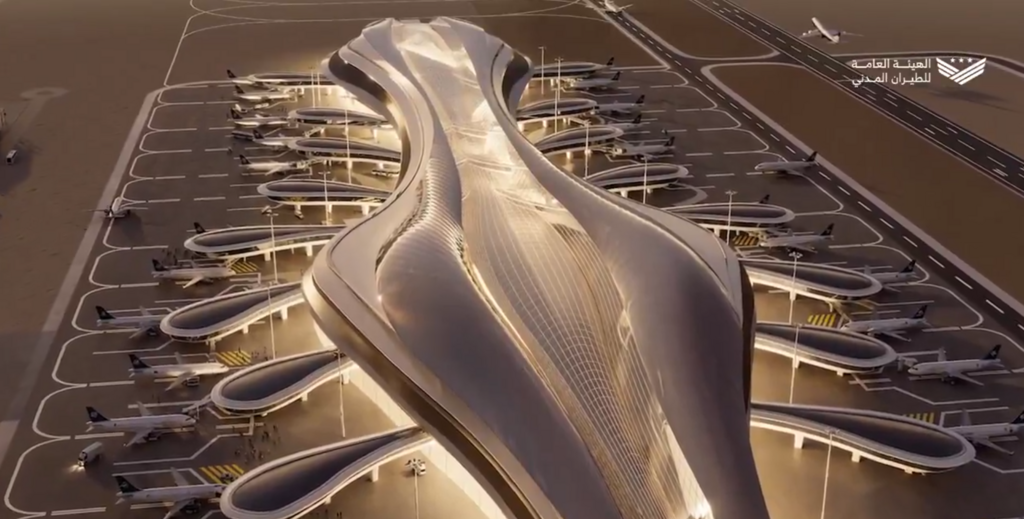
Rendering of the new Damascus airport
(Photo: from X)
Speaking to Ynet, Admoni said, “If you dig deeper into the Qatari angle, there are two layers. First, Qatar’s justification for financing terrorism. In a 2011 Al Jazeera interview, the father of Qatar’s emir, Hamad bin Khalifa al-Thani, explained that extremism would become part of civil society. There’s something deeper here — they genuinely want to engage with terrorist organizations as part of a strategic calculation to secure influence in postwar governments. In Syria’s case, it worked very well for them. They maintained ties with Assad, but also cultivated relations with [al-Sharaa], whom they’ve backed since 2012 — and today it’s paying off.
“Beyond that, we should remember that Qatar assisted the new regime immediately after Assad’s fall, especially regarding Damascus airport — and now it’s formalized in contracts.”
Asked whether the motive was jihad, geopolitics or economic interest, Admoni replied: “That’s the million-dollar question. I wouldn’t rule decisively. This is about whitewashing terrorism and strengthening terrorism.” He added that the recent violence in the Druze-majority southern Sweida province in recent weeks occurred with Qatar’s approval as part of “stabilizing the regime.”
Admoni also noted that “the Qatari financier will never be too close to the government — it’s always a middle tier, so that if there’s a need to disavow him, he can be presented as a private businessman rather than a state envoy.”