


Could the construction of the Greater Tel Aviv metro face significant delays because of logistical problems and labor shortages? The massive infrastructure project is approaching its construction phase, but it will require tens of thousands of foreign workers, with no comprehensive solution currently in place for their accommodation. Adding to the challenge are serious shortages of civil engineers and drivers for the thousands of trucks needed to remove excavated soil.
The metro project will require approximately 16,000 foreign workers at peak construction and around 23,000 throughout the implementation period. The system is scheduled to open gradually to the public beginning in 2035, with full operations expected by 2042. However, even before major international companies submit their final bids, the lack of organized solutions for recruitment, housing and the associated logistics is casting serious doubt on those deadlines.
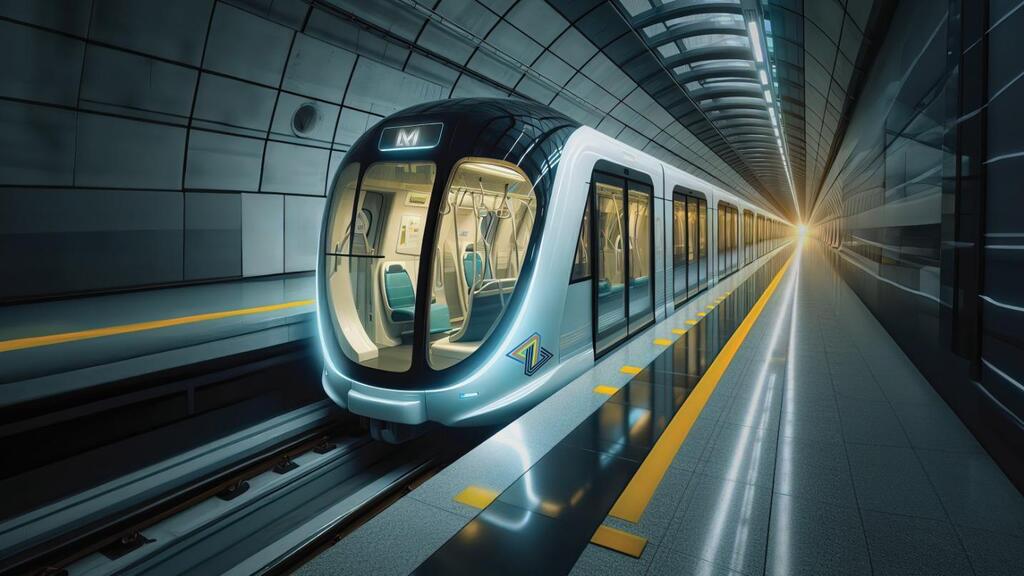
Rendering of the metro project
(Rendering: NTA)
Problems piling up
Oz Sagan, head of digital account operations at Neema, which provides payroll solutions for foreign workers, warned that a dedicated coordinator is needed to oversee the project's foreign workforce. "I don't think the workforce issue has received enough attention in the metro project. What about the 2,500 trucks that will need to remove soil every day when there's a shortage of drivers? And what about housing? Where are these people going to live? When you bring a foreign worker into the country, you have to provide a roof over their head and a bed. One committee discussed housing them in a centralized location, but then there's the question of who will transport them to the various construction sites."
NTA officials are working around the clock to address these challenges, recognizing that severe shortages of workers and raw materials could create an almost impossible bottleneck for contractors. "We're working on two fronts," explained Zohar Zoller, NTA's deputy CEO, who oversees the metro project. "One is advancing the project itself, but there's another aspect that might appear secondary, although it isn't secondary at all: examining the logistics required throughout the supply chain. Can the country provide what's needed? Is there enough cement? Are there enough trucks? Are there enough workers? The problem is that, in most parts of the chain, the answer is no."
To address the problem, NTA is seeking a fast-track regulatory process through government ministries, fearing that the existing bureaucracy could discourage major international infrastructure companies from bidding. "We want to create a green lane for these companies," Zoller said. "They have tens of thousands of workers around the world, and we want them to come here and deploy their own workforce. This is one of the biggest risk factors facing the project."
According to Zoller, international companies will not agree to wait through Israel's existing approval procedures. "Today, a foreign worker submits an application at the consulate in their home country, and most applicants don't have the patience to wait several months for an answer. That's why we need a fast track for workers arriving with their employers, and we've secured Finance Ministry backing for a dedicated quota."
Accommodating such a large workforce also presents an unprecedented planning and regulatory challenge, prompting resistance from local authorities. "Sixteen thousand workers in Gush Dan is a lot," Zoller said. "We had some interesting discussions with the directors general of local authorities. Every one of them said this was a national project, essential to the country. But when I asked who was willing to establish a neighborhood for foreign workers in their municipality, all I heard was crickets."
The Israel Planning Administration is attempting to resolve the problem by distributing foreign worker accommodation among several locations. Yael Salomon, deputy director general for infrastructure at the Planning Administration, explained: "The plan is to establish modular compounds that provide accommodation, but also leisure facilities and other services to meet the workers' needs. Together with NTA, we examined what happens around the world on projects of this scale, and it's extremely rare. In Dubai, for example, they built an entire city for foreign workers during railway construction. We realized that's not something we want to do here in Israel, nor do we want to place the entire burden on a single local authority."
Salomon emphasized the difficulty of finding available land for the compounds. "It's not a simple challenge. The accommodation needs to be located near the construction sites, and local authorities won't want such large concentrations of foreign workers. We need to divide them among several locations, with 1,000 to 1,500 workers at each site, and ensure they have water, sewage and electricity infrastructure, along with suitable environmental conditions. This is preparation on an unprecedented scale, something we haven't encountered before." The goal, she explained, is to establish approximately eight such compounds that would minimize disruption to the public while serving the project and its workers.
Israeli officials recognize that all these unresolved issues must be addressed, because a high-capacity underground mass transit system is seen as the only alternative capable of finally freeing central Israel from its chronic traffic congestion.
First published: 11:00, 10.12.26