

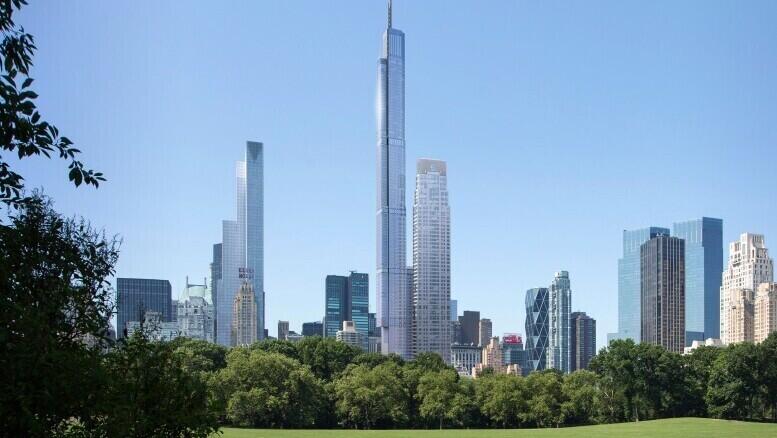
Over the past decade, it has been enough to stand at the southern edge of Central Park and look up to understand why the strip known as “Billionaires’ Row” has become a global symbol of luxury — and of a skyline that signals who is on top, even if they are rarely there. Some of the tallest residential towers in the world crowd together along the stretch, led by Central Park Tower, which rises more than 470 meters and is considered the tallest residential building in the world.
Beneath that skyline, however, lies an open secret that infuriates many New Yorkers: nearly half of the apartments in the seven tallest towers in the area sit empty. At night the picture is even starker, with dozens of darkened floors turning the glittering status symbol into a vertical “ghost neighborhood” scraping the sky.
The phenomenon is not unique to Jerusalem or Tel Aviv. For the global economic elite, these New York luxury apartments — with an average price estimated at $30 million per unit — are not homes at all. In practice, they function as high-end real estate “vaults,” designed to preserve wealth and shield it from inflation, currency fluctuations and political instability around the world. The apartments can also serve as collateral for liquidity, a kind of safe-haven asset akin to gold or fine art.
To maintain strict secrecy, most purchases are carried out through shell companies, allowing tycoons to conceal their identities and keep assets beyond the watchful eyes of tax authorities in their home countries. In reality, the apartments remain dark and vacant most of the year, since potential rental income, however high, pales in comparison to the headache of managing tenants and the risk of wear and tear. Owners prefer to employ armies of maintenance staff, private chefs and round-the-clock concierge services — all bound by discretion — to ensure the apartments remain in pristine condition, even if the residents have not visited in years.
As early as 2016, regulatory pressure began mounting to curb what critics called money laundering in the sky. The US Treasury Department started requiring identification and reporting of buyers of especially expensive apartments in all-cash transactions or purchases made through shell companies. At the same time, capital controls in China, falling oil prices that cooled demand from some Gulf buyers and uncertainty surrounding Brexit slowed the market, prompting talk of the end of the eight-figure apartment boom. At least one project in the area, 1 Park Lane, was frozen.
Still, those who managed to buy created a residents’ list that reads like a who’s who of the global economy. Ken Griffin, founder of hedge fund giant Citadel, set records when he paid $238 million for a penthouse at 220 Central Park South. Michael Dell, CEO of Dell Technologies, purchased the top two floors at One57 for just over $100 million. They are joined by figures from around the world, forming a reunion of the global elite: from Sting, Robert De Niro and Denzel Washington to Israeli billionaire Eyal Ofer, who was among the developers of 15 Central Park West and still owns apartments there. Israeli-American real estate brokers Tal and Oren Alexander, now on trial in a high-profile sexual assault case, were involved in some of the avenue’s record-breaking deals.
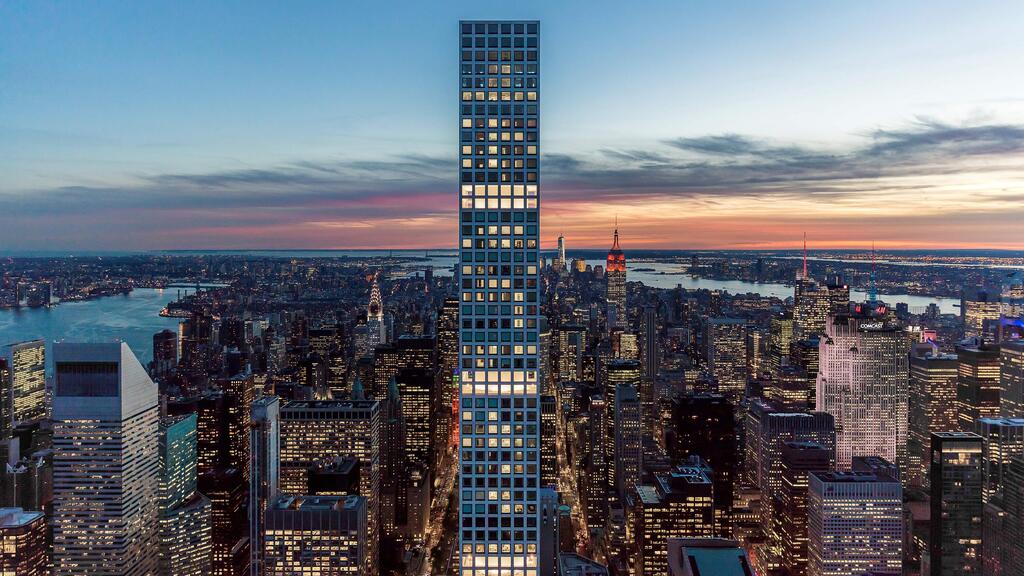
432 Park Avenue tower in Manhattan
(Photo: DBOX for CIM Group/Macklowe Properties)
Many of the names were revealed following a lawsuit by residents against CIM Group, the real estate company founded by Israelis Shaul Kuba and Avi Shemesh, the developers of 432 Park Avenue. The tower, once the third tallest building in the United States at 425 meters, is considered one of the most prominent symbols of Israeli real estate entrepreneurship in America. Kuba and Shemesh, former members of Kibbutz Sufa who once worked as gardeners in Herzliya, emigrated to the United States, founded CIM in the 1990s and built it into one of the country’s largest real estate firms, with assets valued at about $30 billion. They described 432 Park, built on the site of the historic Drake Hotel, as the “crown jewel” of their operations.
A lawsuit alleging significant defects in the luxury tower exposed its exclusive roster of residents. Jennifer Lopez and baseball player Alex Rodriguez bought an apartment on the 36th floor in 2018 and sold it a year later for $17.5 million, a profit of $2 million over the purchase price, saying they needed more space for their extended family. Saudi retail magnate Fawaz Alhokair bought the penthouse in 2016 for about $88 million, the building’s most expensive transaction. In 2021, he put it back on the market for $169 million, though the asking price has since dropped to $90 million. Other residents include the family of Jewish art dealer David Nahmad and Nautica founder David Chu. Israeli buyers are also on the list: Joey Schwebel, owner of the Gottex fashion group and Zara franchisee in Israel, purchased a 57th-floor apartment in 2016 for about $13.7 million.
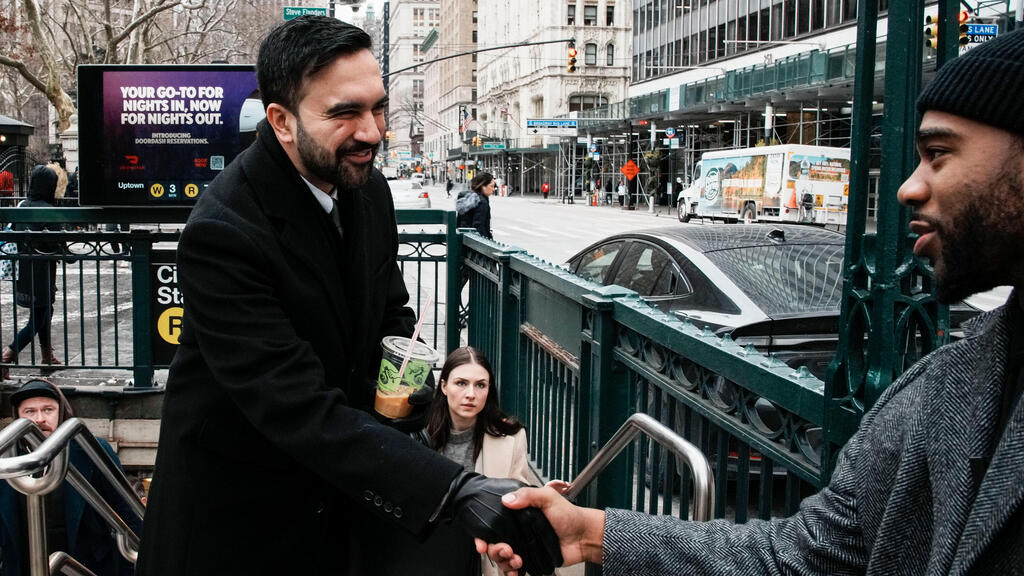
Zohran Mamdani
(Photo: AP Photo/Eduardo Munoz Alvarez)
This spectacle of headline-grabbing lawsuits, shell companies and phantom residents of luxury towers rings louder than ever against the grim economic reality facing many New Yorkers. Confronted with a looming $5.4 billion budget deficit, the new mayor, Zohran Mamdani — elected on a platform of taking on billionaires — has launched a fight. Mamdani is calling for a 2 percent income tax increase on anyone earning more than $1 million a year.
But the real threat — the one keeping the real estate industry awake at night — is what he has described as a last resort. Mamdani has stated explicitly that if New York State blocks his plan and prevents him from taxing the wealthy, he will consider raising property taxes by 9.5 percent. Such a move would directly affect more than 3 million housing units across the city and could paradoxically hurt ordinary renters if landlords pass on the added costs. For now, Mamdani is refusing to blink. He insists that billionaires — those who buy a slice of Manhattan’s sky merely to park their money — should finally start paying the bill.