

Israel’s office market, especially in Tel Aviv and the central region, has served for the past two decades as a direct barometer of the country’s high-tech industry. High-tech companies generated the strongest demand, and office towers were designed accordingly: gyms, baristas, showers, bicycle and scooter parking, and green-building standards, all meant to attract technology companies and their employees.
Large companies sometimes paid more than 150 shekels per square meter for tens of thousands of square meters of office space. But high-tech also proved to be a volatile tenant. Waves of layoffs, budget cuts and decisions made at corporate headquarters overseas quickly affected the office market. During the COVID period, companies reduced space, hybrid work became standard, and lease terms shortened from five to 10 years in the past to as little as three years in some deals.

Now, a new trend is emerging: many high-tech companies are being replaced by defense and defense-tech firms. Against the backdrop of wars around the world and growing defense budgets, companies such as Rafael, Elbit and Israel Aerospace Industries have significantly expanded their operations. Alongside them, dozens of technology companies and startups developing defense solutions have also grown.
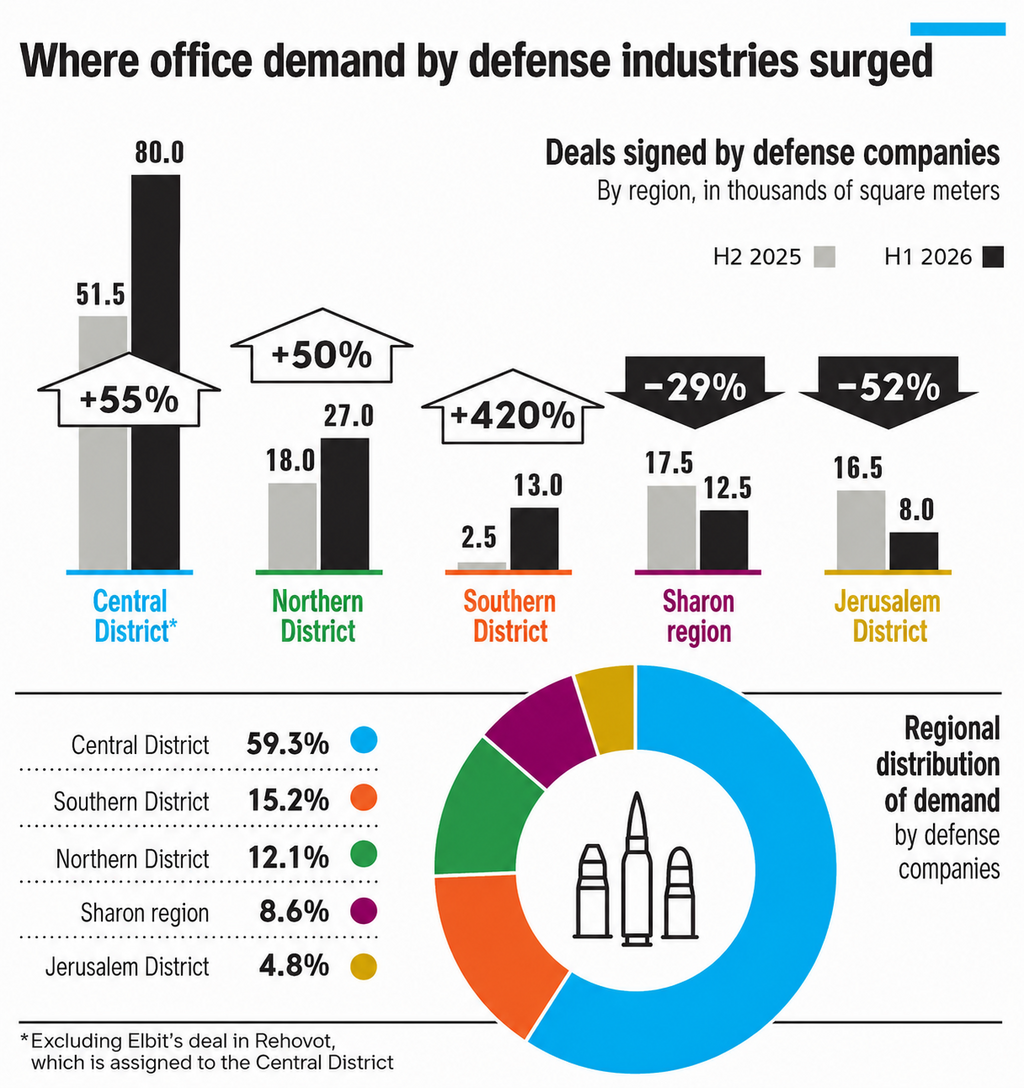
According to data from Colliers Israel, in the first half of 2026, the amount of office space leased by defense companies jumped 32%, reaching more than 140,000 square meters, compared with about 106,000 square meters in the second half of 2025. At the same time, companies in the sector are currently seeking another 145,000 square meters of office space, about 30% of all active demand in the market.
According to Sarit Yitzhakov, CEO of Colliers Israel, the defense-technology sector has become the most dominant player in Israel’s commercial real estate market over the past year.
“Unlike the waves of downsizing that high-tech went through, defense companies have consistently expanded their real estate footprint,” she says.
About 62% of the deals completed in the second half of 2025 and the first half of 2026 were concentrated in the greater Tel Aviv area, mainly in Tel Aviv, Petah Tikva, Ramat Gan, Bnei Brak and Holon. Yitzhakov says the area has become a hub for companies specializing in offensive cyber, AI-based intelligence and smart battlefield systems.
In the north, from Haifa through Mevo Carmel to Hadera, deals totaled more than 38,000 square meters, mainly due to the expansion of research and development centers and the establishment of new ones. At the same time, more small and midsize defense startups are leasing spaces of 2,000 to 4,000 square meters, mostly in Petah Tikva and the Sharon region.
Tzahi Agassi, CEO of 770 Offices, says the October 7 attack marked a turning point.
“We are seeing SaaS companies and gaming companies contract, while companies like Rafael, Elbit and Israel Aerospace Industries become the market’s major tenants,” he says. “Defense tech is not a trend but the result of geopolitical changes, and about a third of investments in Israeli high-tech are already directed to it.”
Guy Amusi, CEO of Avison Young Israel and a director in defense companies, points to the Elbit-Vitania deal in Ness Ziona, in which Elbit leased about 40,000 square meters for a long term, as an example of the change. He says there is an inverse relationship between the contraction of traditional high-tech and the growth of cyber and defense-tech companies.
A manager at a company that owns office buildings says defense companies are more stable tenants and require larger spaces. In addition, because of security sensitivity, hybrid work is almost nonexistent among them. They invest hundreds of thousands and even millions of shekels on each floor to build clean rooms, laboratories and security systems, and therefore seek longer lease terms.
“In the past, they operated mainly from campuses outside Tel Aviv, and today they are also entering the city to compete for talent,” the manager says. “In that sense, they have become the local Google and Amazon.”
Despite the rise in demand, industry officials stress that Israel’s office market remains a tenants’ market. Existing and planned office supply still significantly exceeds demand, and even in high-demand areas of Tel Aviv, many spaces are under construction and have not yet been occupied.
As a result, property owners continue to compete for every tenant, even as defense companies become the central growth engine of the office market.