


The United Arab Emirates, and Dubai in particular, are among the most prominent Gulf states affected so far by the latest wave of regional escalation with Iran.
According to data from the UAE Defense Ministry and reports by international news agencies, as of this writing, approximately 189 ballistic missiles, about 941 unmanned aerial vehicles and eight cruise missiles have been launched toward the country.
The overwhelming majority were intercepted by the UAE’s air defense systems and those of its allies. Still, the sheer scale of the launches illustrates how the country — once seen as an island of stability in the Middle East — has become an integral part of the regional confrontation arena.
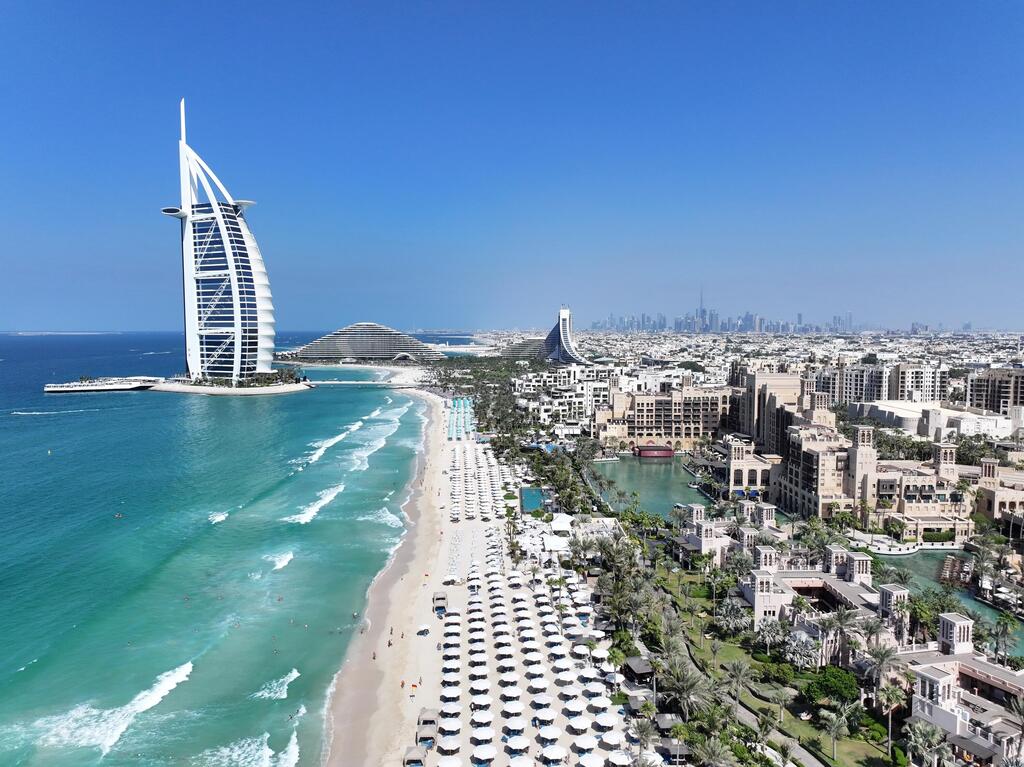
On the very first night of the Iranian attack, one of Dubai’s iconic structures was struck, a building that for years symbolized the city’s international economic and tourism standing.
The damage occurred at the Burj Al Arab hotel (Jumeirah Burj Al Arab), one of the most famous buildings in Dubai and in the world. It has long served as an icon of luxury, tourism and the high-end lifestyle associated with the city.
During the attack, most threats over Dubai were intercepted by air defense systems, but interception debris — or an unmanned aerial vehicle that exploded on the building’s lower floors — caused external damage and a localized fire on the grounds of the photogenic hotel. Fire crews dispatched to the scene brought the blaze under control within a short time, and the area was temporarily evacuated.
Following the incident, Dubai security authorities stressed that inspections found no signs of significant damage to the building’s structural systems and that the framework remained stable. The hotel resumed operations shortly afterward, although some sections were temporarily closed for repairs.
A blow to the gleaming image
Although the damage was relatively limited, the very fact that such a well-known structure was hit generated extensive media attention and underscored that even the city’s landmarks of luxury and architecture are not immune.
For decades, Dubai cultivated the image of a glittering global city: a forest of skyscrapers, futuristic architecture, an international financial center, a hub for luxury tourism and a strategic gateway between West and East. Its airport became one of the busiest in the world, and the city itself was widely perceived as a safe, stable and even indulgent enclave in the heart of a turbulent region.
Against this backdrop, the strike on the Burj Al Arab was seen not merely as a localized security incident but as damage to a central symbol of the urban and economic narrative Dubai has sought to build for itself.
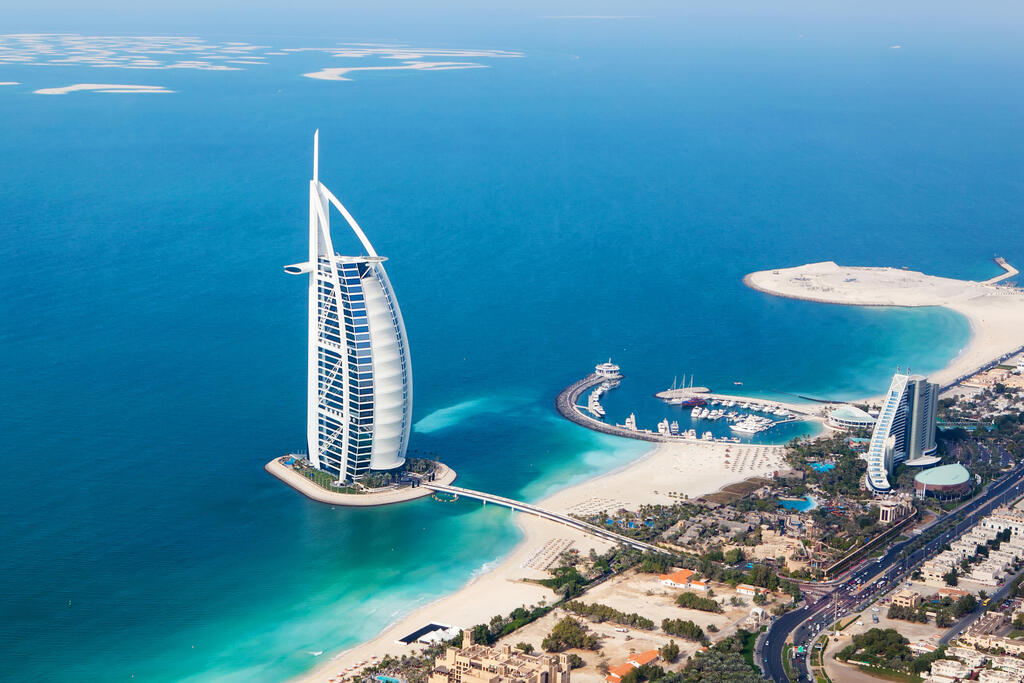
The Burj Al Arab hotel, Dubai
(Photo: Irina WS/Shutterstock)
The Burj Al Arab luxury hotel, inaugurated in 1999, was one of the first projects to signal Dubai’s transformation from a modest Gulf port city into an international financial and tourism center. Designed in the shape of a giant sail, the structure rises on an artificial island built especially for it about 280 meters (920 feet) from the shoreline and connected to the mainland by a private bridge.
Planning for the hotel lasted about a year and began in 1993. Construction itself took roughly six years, about three of them devoted to creating the artificial island on what had previously been open water.
At the time of its opening, the hotel was considered one of the tallest in the world. Today it ranks fifth after the Gevora Hotel — also in Dubai — while the world’s tallest building remains the Burj Khalifa in Dubai, completed in 2010 and rising to a height of 828 meters (2,717 feet).
By comparison, the Burj Al Arab rises “only” about 321 meters (1,053 feet), but stands out because of its distinctive shape. The building also features the world’s tallest hotel atrium, soaring to about 180 meters (590 feet), a feature that has made it one of the most dramatic and architecturally striking structures in the Gulf region.
An icon built in the shape of a traditional fishing sail
The hotel was conceived following the vision of Dubai’s ruler at the time, Sheikh Mohammed bin Rashid Al Maktoum, who sought to give the city a distinctive architectural symbol — similar to the Sydney Opera House or the Eiffel Tower in Paris — one that anyone who saw it would immediately associate with Dubai.
Accordingly, the structure was designed in the shape of a traditional Arab sailing vessel known as a dhow, a boat that for centuries was an integral part of the maritime culture of the Gulf region.
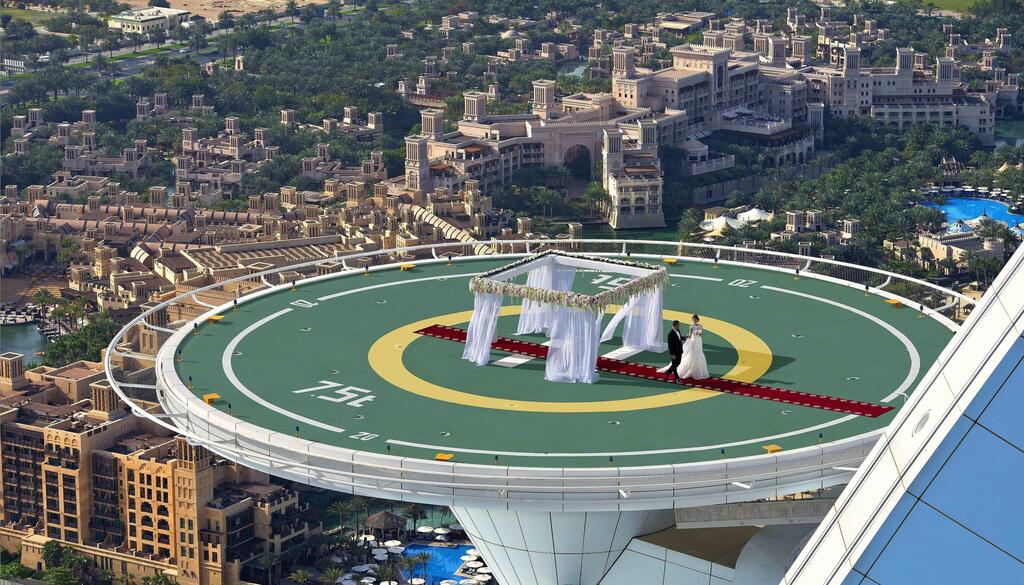
Beyond its distinctive silhouette, the building features a series of striking architectural elements, including a vast lobby with fountains and shifting colored lighting, a luxury restaurant called Al Muntaha — Arabic for “the ultimate” or “the highest” — that juts out from the side of the structure about 200 meters (656 feet) above the sea, and an exclusive helipad near the top of the tower at a height of roughly 211 meters (692 feet). The interior design is also unusual: the hotel has no standard rooms at all, containing only about 202 duplex suites, all decorated in an opulent and highly stylized Arab design.
The hotel was designed by British architect Tom Wright, who at the time worked for the international architecture firm Atkins and over the years planned a number of major projects across Gulf states. In media interviews at the time, he said one of the central goals of the design was to create a structure that would instantly become a symbol associated with the city.
“A building becomes iconic when its form is simple and unique,” Wright said. “If you can draw a building with a few sweeps of the pen and everyone recognizes not only the structure but also associates it with a place on earth, you have gone a long way towards creating something iconic.” Indeed, within just a few years, the building became one of Dubai’s most recognizable architectural symbols.
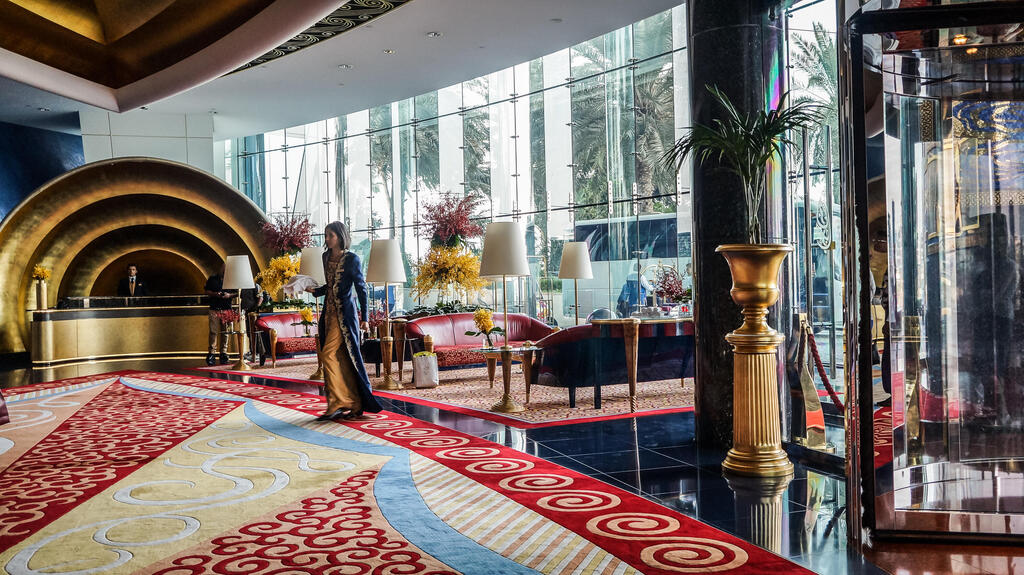
Burj al Arab hotel lobby
(Photo: Stanislav71/Shutterstock)
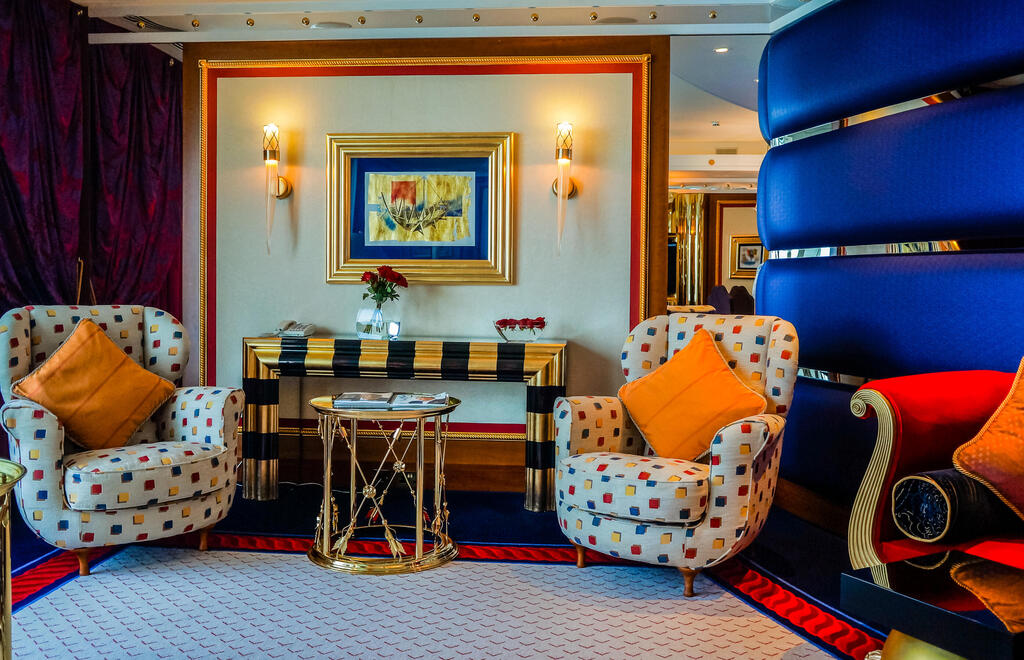
Interior of Burj al Arab hotel
(Photo: Stanislav71/Shutterstock)
The strike on the Burj Al Arab is a reminder that even architectural landmarks built to represent power, luxury and stability are not detached from the geopolitical reality around them. The hotel, constructed at a cost of about $1 billion and originally intended to serve as a global symbol instantly associated with Dubai, overnight became a symbol of another kind — one that illustrates how even the Gulf’s most global cities are no longer immune to regional turmoil.
The structure itself may have emerged largely unscathed, but the incident underscores that the iconic architecture of the 21st century is not only an expression of economic and tourism ambitions. It is also a quiet testament to the fragility of cities often viewed as moderate and closely aligned with the West in the Middle East.
Alongside the landmark building, many other structures were damaged, including hotels, residential buildings and public facilities. Flights were canceled, the airport shut down and at least 4,000 Israelis are stranded there, unable to return home.