


In the midst of one of the most ambitious construction projects the White House has undertaken in decades — the creation of a new ballroom — a dramatic twist unfolded last week. President Donald Trump fired the project’s lead architect and appointed in his place a Jewish immigrant known for fighting deportations, an unusual choice both politically and professionally.
The move revealed what had been happening beneath the surface: clashing egos, ideological disagreements and deeper questions about the future identity of the most symbolic building in the United States. Behind these decisions lies a much larger story — one that begins with a ballroom but reaches into the heart of modern architectural and political drama.
Gallery

US President Donald Trump shows off a rendering of a new ballroom
(Photo: AP Photo/Alex Brandon)
‘President Trump is a builder at heart’
The new ballroom, an initiative championed by Trump, is planned as a separate extension to the White House but will follow the architectural language that made the historic structure iconic. According to the published plans, the new building will replace the small East Wing, built in 1902 and expanded several times, including the addition of a floor in 1942. After the plan was released this summer, the White House announced that the new ballroom would span roughly 8,400 square meters and offer seating for about 650 guests. Announcing the project, Trump’s chief of staff, Susie Wiles, said, “President Trump is a builder at heart with an extraordinary eye for detail. The president and the White House are fully committed to working with the appropriate bodies to preserve the unique history of the White House while building a stunning ballroom for future administrations and generations of Americans to enjoy.”
The project is estimated to cost around $200 million, with most of the funding, surprisingly, expected to come from Trump’s personal fortune and private donors described as “patriots.” Among the dozens of donors whose names have already been released are leading U.S. companies and business figures, including Apple, the Adelson Family Foundation, Amazon, Google, Meta, Coinbase, Palantir and Lockheed Martin. “The ballroom is being funded privately by many generous patriots, great American companies and yours truly,” Trump declared in October, “and this hall will bring joy for generations to come!”
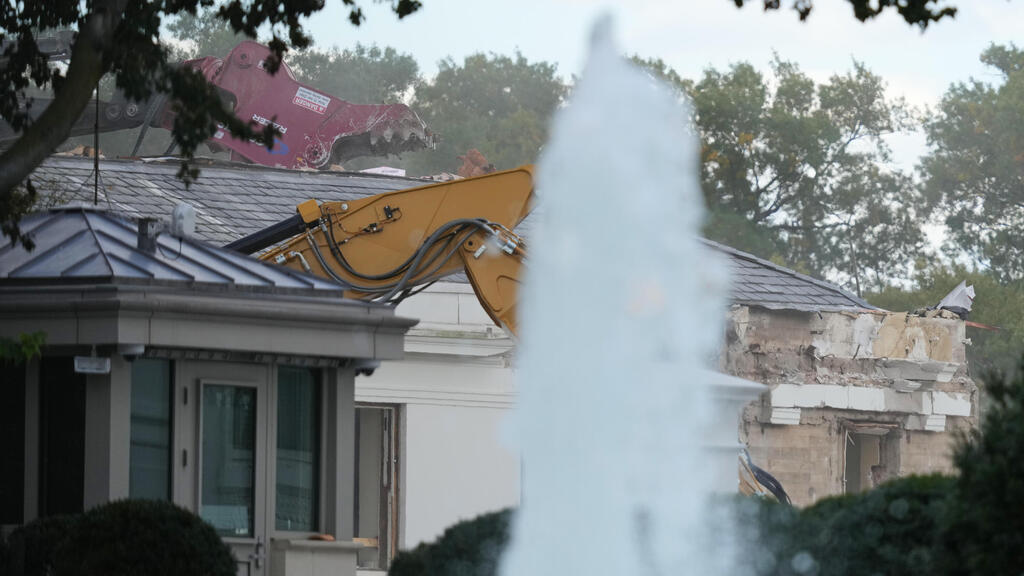
Demolition work on the East Wing of the White House to build a ballroom
(Photo: AP Photo/Jacquelyn Martin)
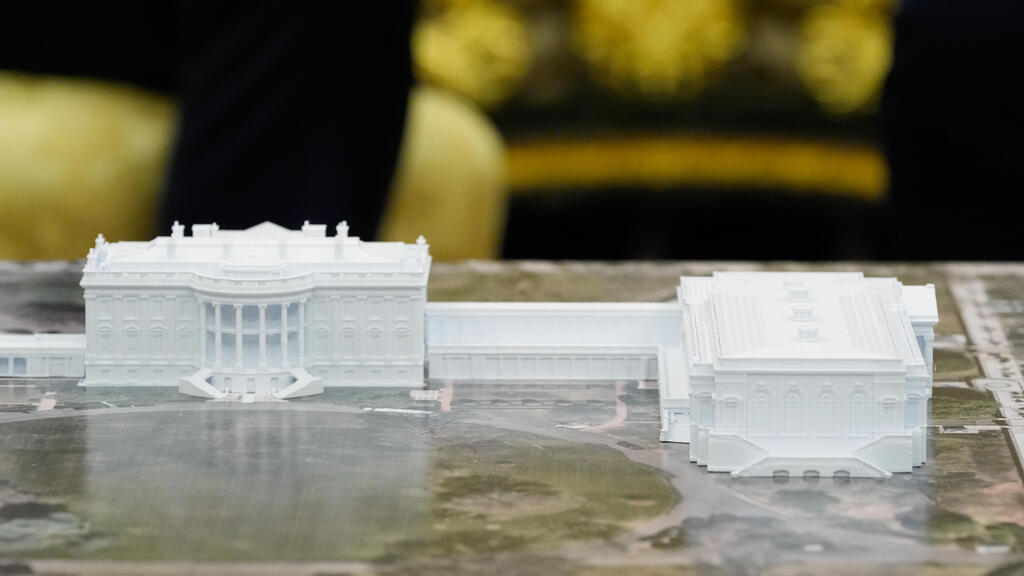
Model of the White House and new ballroom that Trump is building
(Photo: AP Photo/Alex Brandon)
The heavy reliance on private donations has sparked sharp public debate, since the structure is a presidential federal building that is supposed to be funded and maintained by the state — not by private entities with political interests. Critics argue that funneling private wealth into such a central project sets a troubling precedent, potentially undermining the basic principle of separation of powers and neutral governance. As an analogy, it would be difficult to imagine Israel’s prime minister, Benjamin Netanyahu, personally funding the construction of the official residence — a scenario widely viewed as implausible in most Western democracies.
The chosen architect was dismissed abruptly
Trump initially selected McCrery Architects, a firm specializing in neoclassical design, to lead the project. Work had already begun, but three months later, in early December, architect James McCrery was abruptly dismissed. According to reports, Trump directly clashed with him over the size of the ballroom: McCrery sought to scale down the structure for planning and execution reasons, while Trump insisted it remain large — and even expand. The dispute led to the termination of the firm’s role.
The White House, however, quickly reassured that “the project is progressing rapidly and without significant delays.” Immediately after ending its partnership with the previous firm, Trump appointed a replacement: Shalom Baranes Associates, led by Shalom Baranes, one of Washington’s most prominent architects. “Shalom is a talented architect whose work has shaped the architectural identity of our nation’s capital for decades, and his experience will be a tremendous asset in completing this project,” White House spokesperson Davis Ingle said in an official statement.

A rendering of a new ballroom to be built at the White House
The replacement: a Jewish immigrant who criticized the administration
Baranes’ appointment is surprising not only professionally but politically. Over the years, Baranes has donated to Democratic candidates and publicly opposed Trump’s immigration policy. Notably, in 2017, two months into Trump’s first term, he published an opinion piece in the Washington Post criticizing the president’s travel ban on immigrants from seven Muslim-majority countries — a move that prompted widespread public opposition, including from Jewish organizations. “When my Jewish parents arrived in the United States just a few years after fleeing persecution under an Arab regime, it was difficult for them to be accepted here — just as it is for Muslims today,” Baranes wrote, recalling his parents’ challenges.
Beyond politics, the choice is surprising from an architectural standpoint. Baranes is typically associated with a modern, understated style — far removed from the column-heavy, gold-accented neoclassical aesthetic preferred by Trump. Baranes has also said in the past that he prefers to thoroughly evaluate any architectural project before accepting responsibility, a mindset that stands at odds with the project’s tight timeline, with construction already well underway. Douglas Fruehling, editor-in-chief of the Washington Business Journal, expressed skepticism: “You have to wonder why Baranes would risk a stellar career and an almost perfect reputation for a project that could end in disaster. He could be publicly fired or become an outcast among colleagues and clients,” he wrote.
He helped rebuild the Pentagon after 9/11
Shalom Baranes was born in Libya in 1951 and fled with his parents to the United States amid rising antisemitism. The family was smuggled out with the help of the Hebrew Immigrant Aid Society and settled in Washington, where he grew up and forged his personal and professional identity. Baranes built his reputation as one of the capital’s most influential architects, with extensive experience in designing and restoring public and federal buildings as well as large-scale private projects. Among his notable work is the reconstruction of the Pentagon after the Sept. 11 attacks, the design and renovation of the city’s Jewish Community Center and numerous additional projects that shaped Washington’s urban landscape. His trajectory — from forced migration to becoming one of the architects most closely associated with U.S. federal institutions — adds to the uniqueness of his selection for the White House ballroom project, a choice that continues to draw attention in both professional and political circles.
Ultimately, the ballroom project extends far beyond questions of design, budget or schedules. It highlights the ongoing tension between tradition and political power, between architectural vision and personal interests and, above all, the way a physical structure becomes a tangible expression of American identity struggles. Construction is expected to conclude within a year or two, and Trump is ensuring the work is completed during his current term — he will undoubtedly not miss the unveiling of the new hall. Until then, the project will continue to serve as an arena where politics, architecture, loyalty and personal ambition intertwine, revealing much about the White House and even more about the person shaping its future.