


As antisemitic incidents surge worldwide amid the war in the Gaza Strip, growing numbers of Jews are immigrating to Israel, and many foreign residents are moving ahead with property deals.
In recent days, one real estate developer told Ynet that “many projects are already sold out to Americans,” and new Finance Ministry figures show that since the start of the year, purchases of homes by foreign residents in Israel have risen.
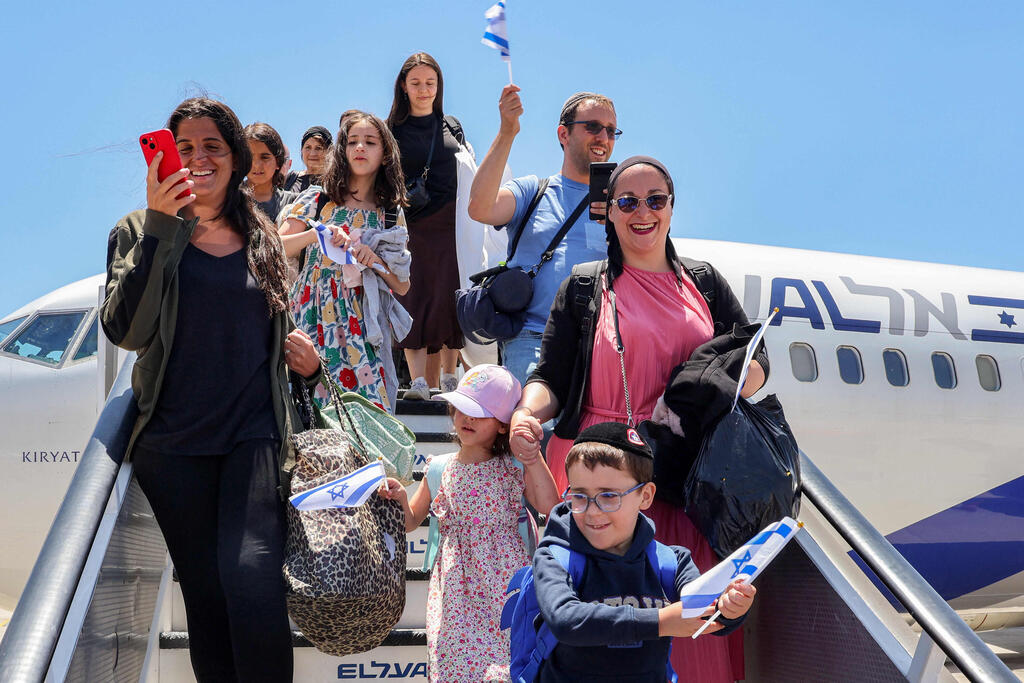
New arrivals landing at Ben Gurion Airport
(Photo: Jack GUEZ / AFP)
According to updated data from the Aliyah and Integration Ministry for January–July this year, analyzed by real estate marketing agency Ari Group, 11,612 new immigrants arrived in Israel during this period. Roughly half (6,576) came from countries of the former Soviet Union. Another 1,620 Jews arrived from France, 1,498 from North America (the United States and Canada), 379 from the United Kingdom, 384 from Latin America, 103 from Ethiopia and 1,052 from other countries around the world.
When looking at the cities chosen by new immigrants since the start of the year, Netanya overtook Tel Aviv as the top destination, with 1,688 newcomers, just ahead of Tel Aviv’s 1,667. They were followed by Haifa (1,201), Jerusalem (1,057) and Bat Yam (604). Other cities in the top ten include Ashdod, Rishon Lezion, Ra’anana, Be’er Sheva- which entered the list for the first time - and Beit Shemesh, which rounded it out.
Of the 1,688 immigrants who settled in Netanya this year, 1,042 came from the former Soviet Union, 436 from France and 48 from North America.
According to Uri Fleischman, vice president of marketing and sales at Levinstein Group, which together with Magil Construction is building a project in the city’s Park HaYam neighborhood, “Netanya enjoys an international image as a comfortable seaside city, which explains its strong appeal. We’re seeing clear interest and home purchases from Jewish immigrants from Europe and North America.”
 Uri FleischmanPhoto: Levinstein Group
Fleischman added that “in the past year, several deals in our project have been made mainly by immigrants from North America. We’re seeing two main segments among these buyers: some purchase homes for residence, while others buy what they call a ‘safe home,’ a property they can turn to if antisemitism in their home countries worsens. I believe that in the coming years we’ll see even more immigrants from these regions choosing to settle in the city.”
North American immigrants buy homes in groups, and developers are taking notice
Data show that 1,667 new immigrants settled in Tel Aviv this year, most from the former Soviet Union (981), but with significant numbers also arriving from the United States (215) and France (173). The city continues to attract younger immigrants thanks to its job market, universities and cultural scene, especially those seeking modern, Western-style urban life.
Jerusalem absorbed 1,057 newcomers, including 390 from North America - the highest number in the country - and 218 from France, many drawn by the city’s religious institutions and Jewish educational centers.
According to Lee Rom Oknin, head of marketing and sales at Sarfati Group, which is building the Luria project in the city’s new Arnona neighborhood, “Jerusalem attracts Zionist families and communities from North America, and we’ve encountered an interesting trend - groups forming abroad whose members buy apartments together, close to one another. During our project’s presale, six apartments were sold to a group of American Jewish friends for about 30 million shekels ($9 million).”
Lee Rom Oknin: "Jerusalem attracts Zionist families and communities from North America, and we’ve encountered an interesting trend - groups forming abroad whose members buy apartments together, close to one another."
She noted that one of the key attractions for this community is the planned U.S. Embassy complex to be built in the neighborhood, on the site of the old Diplomat Hotel. “The complex will include offices and security facilities for the embassy, staff residences and a designated area for the ambassador’s official residence,” she said. “Apartments located near embassies tend to be considered prestigious and command higher values than others in the area.”
According to Nefesh B’Nefesh, which assists immigration from North America to Israel, the top destinations chosen by North American olim are Jerusalem (798), Beit Shemesh (457), Tel Aviv-Jaffa (304), Ra’anana (208) and Modiin-Maccabim-Reut (133). Other popular cities include Netanya, Herzliya, Haifa, Efrat and Rehovot. Even Kiryat Gat has become a sought-after destination: while only three people moved there in 2020, by 2025 the number had risen to 57 — an increase of about 1,800% in five years.
Shiran Ahvan, vice president of sales and marketing at Kardan Real Estate, also reports growing interest among new immigrants and foreign residents in the company’s Holyland Park project in Jerusalem. “It’s a well-established neighborhood centered around a luxurious synagogue that will serve the community,” she explained. “Investing here means becoming part of Israel’s most meaningful city - culturally, religiously and symbolically. Living in Jerusalem allows people to join a thriving community and experience life in a city with unmatched historic and spiritual depth.”
Anna Fogel, VP of sales and marketing at Ram Aderet Group, said that most of the company’s current demand comes from foreign residents, focused on new projects in Havatzelet HaSharon in Netanya and HaMatos in Jerusalem. “These neighborhoods are designed as mini-cities that include everything residents need - synagogues, public and cultural buildings, schools and community infrastructure,” she said.
 Anna FogelPhoto: Naveh Aviani
Fogel added: “We’re seeing strong interest from American buyers in the Jerusalem project — just recently we closed a deal with a U.S. couple for a four-room garden apartment worth five million shekels. In Netanya, demand is coming mainly from French Jews. We’ve signed two deals there with French residents purchasing a duplex and a penthouse, each around seven million shekels. Most buyers tell us they’re purchasing for aliyah or as a ‘potential aliyah’ option if antisemitism worsens.”
The analysis further shows that coastal cities remain the top choice among new immigrants: Bat Yam absorbed 604 newcomers, Ashdod 468 and Rishon Lezion 349. Beit Shemesh saw 260 new residents, including 160 from North America, a large proportion for a city its size, continuing a trend of religious and ultra-Orthodox families moving there for affordable housing and established communities. Ra’anana absorbed 314 immigrants, including 135 from France and 69 from North America, while even Be’er Sheva in the southern periphery drew 283 newcomers.
Orit Gabay Tirer, VP of marketing and sales at Gabay Group, said she recently returned from a real estate fair in France, where she met over 40 Jewish families interested in buying homes in Israel. “Alongside the aspiration to make aliyah, we’re meeting families who want to create a safety net for themselves, understanding that Israel is home; living here is not just a real estate transaction,” she said. “For example, we’ve seen strong interest in The Lux project on Ashdod’s Lido Beach, which combines residential and hotel components in partnership with Prima Hotels. This suggests that buyers are now looking beyond the central region and Tel Aviv area.”
 Orit Gabay Tirer
Ohad Asraf, CEO of Ari Group, which conducted the analysis, confirmed the trend: “Developers increasingly see foreign residents as a key target audience, especially for coastal-city projects. Our assessment is that once the war ends, demand will rise even further, so developers are expanding marketing efforts - taking part in overseas real estate fairs, running targeted social media campaigns, advertising in Jewish media and offering remote apartment tours and sign-ups.”
From Sydney, New York and Los Angeles to Katzrin
Hanna Schwartz, VP of marketing and sales at Avney Derech Group, says that her company has seen surprising interest from overseas residents in the northern town of Katzrin, which did not appear on the official list of top destinations.
“We’re seeing unexpected demand from buyers in London, Sydney, New York and Los Angeles for HaRama, a project we’re building together with Y.D. Barazani Group,” she said. “To me, this reflects how deep their connection to Israel remains and their belief in the vision of developing the north. The October 7 attacks, the ongoing war and rising antisemitism worldwide have led many Jews to seek a safe and meaningful home in Israel. Choosing to settle in the north reflects values of Zionism, belonging and security.”
Attorney Liat Keisary Yahalomi, partner and head of the Private Clients Department at Barnea Jaffa Lande Law Offices, also notes increased demand from foreign residents.
Hanna Schwartz: "We’re seeing unexpected demand from buyers in London, Sydney, New York and Los Angeles for Katzrin. Choosing to settle in the north reflects values of Zionism, belonging and security."
“We’ve seen clear trends this past year,” she said. “Luxury properties remain in demand in Tel Aviv, sharp price increases in Netanya are drawing foreign buyers, and in Jerusalem, demand focuses on new projects tailored for the religious community. Many foreign residents prefer buying directly from developers, who offer favorable payment terms, such as full exemption from index linkage, generous credit toward the purchase and very flexible payment schedules.”
Keisary Yahalomi added that recent tax incentives for new immigrants, including reduced purchase tax rates that took effect last summer, have joined a range of advanced international tax-planning options.
“Through the use of tax treaties, trusts and foreign holding structures, wealthy Jewish families can efficiently manage their tax exposure in both Israel and abroad. Combined with personal security concerns and growing antisemitism, these financial considerations make buying a home in Israel not just a profitable investment, but also a strategic anchor for the family,” she explained.
Attorney Aharon Abuhatzira, a real estate specialist focusing on foreign buyers and new immigrants, added that “over the past two years, there’s been a sharp rise in property purchases by foreign residents.”
“Jerusalem continues to lead as the top destination, especially in luxury neighborhoods such as Baka, the German Colony, Talbiya and Old Katamon, where apartment prices sometimes reach 80,000 shekels per square meter or more,” he said.
“Most buyers come from Anglo-Saxon communities in the U.S., Canada and the U.K., alongside significant demand from French Jews, the majority being traditional or observant families. Next are Tel Aviv, which attracts buyers from France, Britain and the U.S., as well as Netanya and Ashdod, home to large French-speaking communities. This trend is expected to grow, particularly among French Jewry, given recent social and political developments.”
Attorney and CPA Yakir Ben-Harush, partner at Meir Mizrahi with A. Rafael & Co., which specializes in Israeli and international taxation, explained the legal and tax implications of property purchases by foreign residents and Jews planning to immigrate.
“When a foreign resident purchases a home in Israel, they are not entitled to the reduced purchase-tax benefits granted to Israeli residents buying their sole home,” he said. “This means that even if it’s the buyer’s only residence, they must pay 8% purchase tax from the first shekel up to about 6 million shekels, and 10% on the remainder.”
He illustrated, “For an apartment worth six million shekels, a foreign buyer would pay 480,000 shekels in purchase tax; roughly double what an Israeli resident would owe. However, a foreign resident who plans to immigrate to Israel within a year may qualify for significant tax relief. On the sale side, the situation differs: Israeli law allows foreign residents to benefit from capital gains tax exemptions when selling a single residential apartment, except in cases involving inherited property.”