


Artist and sculptor Yaacov Agam, one of the pioneers of kinetic art and one of the best-known and most influential Israeli artists in the world, died Sunday. For more than seven decades, Agam, an Israel Prize laureate, developed a unique artistic language based on movement, change and the shifting perspective of the viewer. His works are exhibited in museums and major public spaces around the world. Alongside his iconic works in galleries and international collections, Agam also left a significant mark on the urban landscape through sculptures, fountains and large-scale installations in Israel and abroad.
Some of his public works sparked controversy and debate over the years around questions of aesthetics, preservation and their suitability for the changing urban space. But his status as one of the most prominent ambassadors of Israeli art on the international stage remained undisputed.
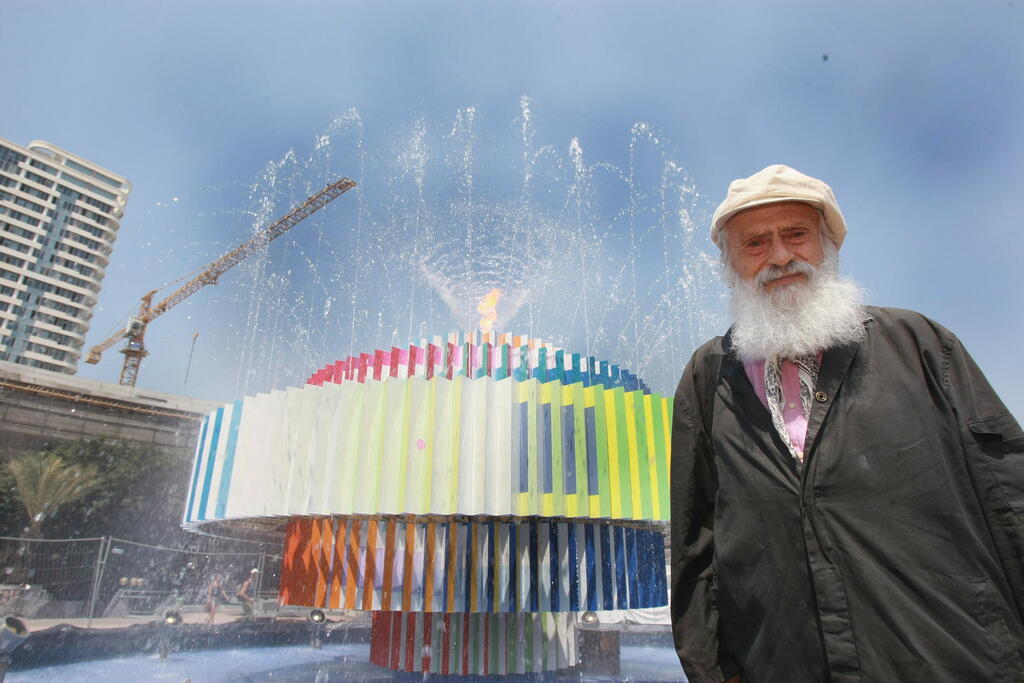
One of the most iconic and famous works Agam designed is the “Fire and Water” fountain in Dizengoff Square in Tel Aviv. The fountain, inaugurated in 1986, was a kinetic sculpture combining movement, color, water, light and fire into a changing, timed performance. The work was built from a system of rotating rings, incorporating colorful panels and geometric patterns that created different compositions depending on the viewer’s angle. The water jets, lighting effects and flames activated at fixed intervals turned the fountain into a constantly changing dynamic element, illustrating Agam’s view that a work of art is not a fixed object, but an ongoing experience created through the encounter between the work, the space and the viewer.
From the outset, the fountain’s placement in the heart of Dizengoff Square drew wide public attention, but it also stirred considerable controversy. Alongside appreciation for its artistic innovation and prominent presence in the built environment, criticism was voiced over the high maintenance costs of the work, estimated at the time at about $15,000 a year, an unusual sum compared with other public artworks of that period.
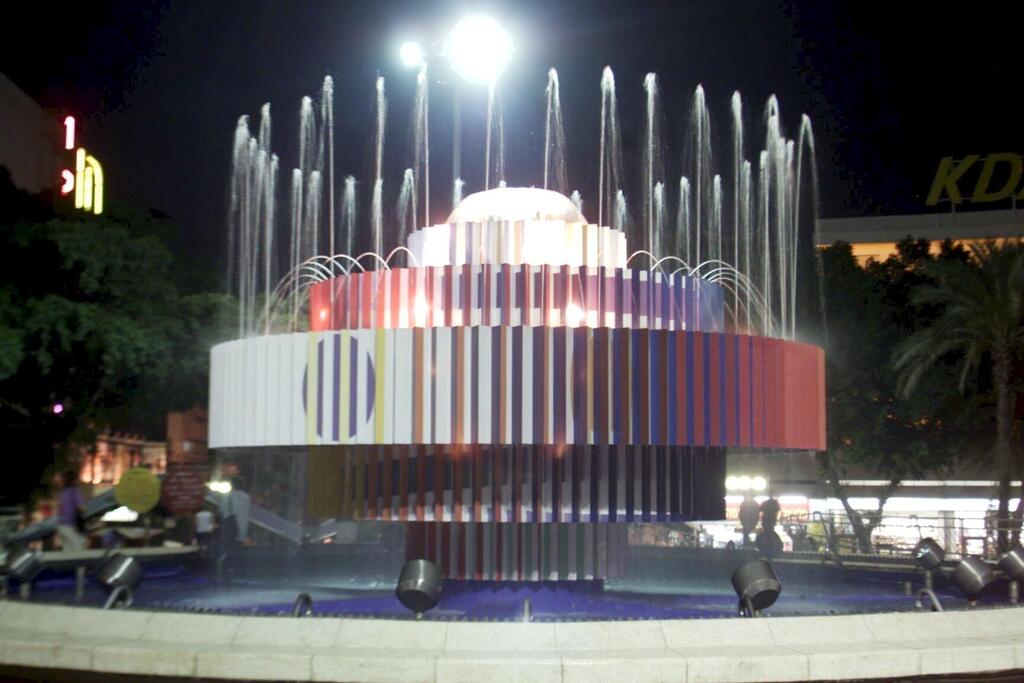
The 'Fire and Water' fountain in Dizengoff Square in 2003
(Photo: Dudu Bachar)
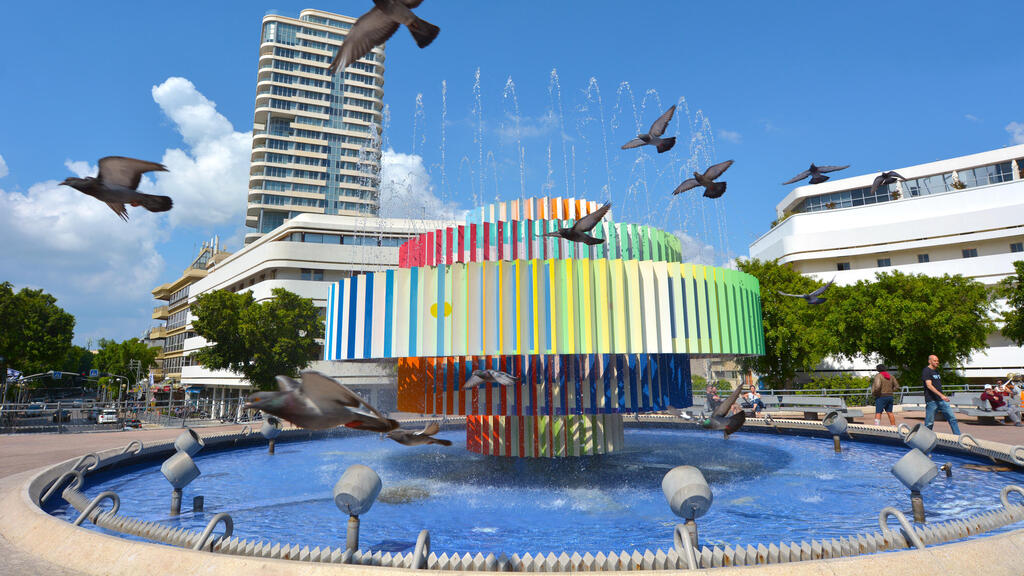
The original version of the fountain
(Photo ChameleonsEye, Shutterstock)
The fountain’s technical complexity, including motion, lighting, water and fire mechanisms, required expensive ongoing maintenance and at times led to parts of its systems being shut down. At the same time, a public debate developed over the years around its place in Dizengoff Square. While some saw it as an urban symbol and one of the landmarks most closely identified with Tel Aviv, others argued that its scale and visual dominance impaired the square’s function as an open and accessible public space.
From a multitude of colors to a uniform silver appearance
The debate over the fountain sharpened further against the backdrop of the renovation of Dizengoff Square and its return to street level. In 2011, the work underwent extensive restoration and upgrading at a cost of about 2 million shekels, during which the colorful panels were repainted and technical changes were made, including the cancellation of the original rotation mechanism of the rings. With the completion of the square’s renovation project in 2018, the fountain was reinstalled at its center, but instead of the colors identified with Agam, a different version was placed there.
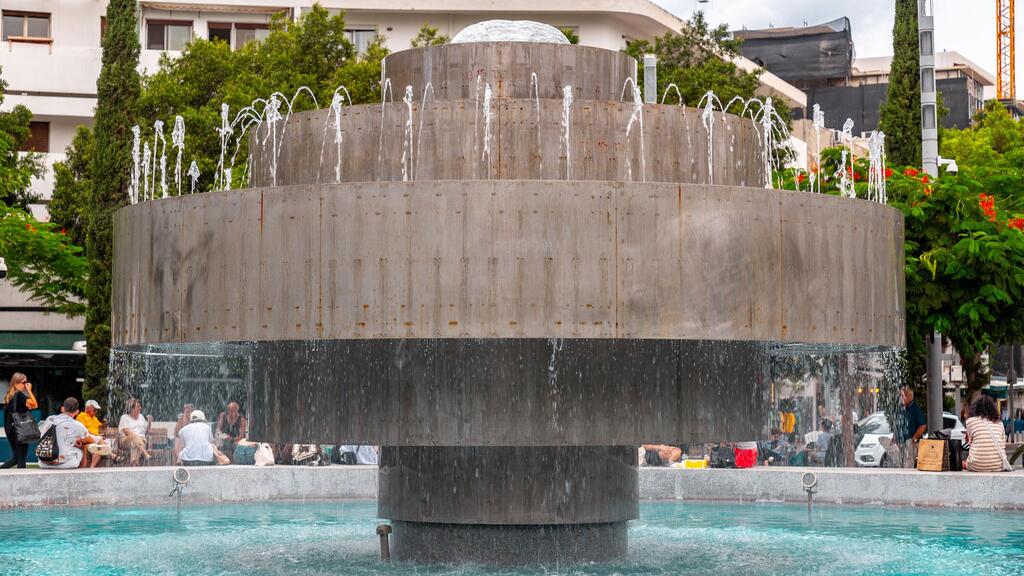
'Fire and Water' fountain in its changed appearance
(Photo: ColorMaker, Shutterstock)
The move led to a prolonged public confrontation between Agam and the Tel Aviv Municipality. The artist argued that the changes made to the fountain damaged the integrity of the work and his artistic vision, and that it had been returned to the public in a partial version that did not reflect his original intentions. The municipality, for its part, explained that the decisions were made for reasons of safety, maintenance and budget.
The dispute, which reached the headlines and legal and public forums, has effectively remained unresolved to this day, and illustrates the ongoing tension between artists’ rights and the challenges involved in maintaining, preserving and adapting public artworks to a changing urban space. “I devoted 10 years to creating ‘Fire and Water’ for the city of Tel Aviv, and they turned it into a shameful piece of junk. They turned my most important work into junk,” Agam said in a 2001 interview with the “7 Days” supplement.
A bold approach to the shoreline
Alongside the “Fire and Water” fountain, Agam also left a deep mark on Tel Aviv’s shoreline. Another prominent public work of his is the design of the sea-facing facade of the Dan Hotel, one of the buildings most closely identified with the promenade. Agam designed the geometric color composition that decorates the hotel’s balconies, creating a dynamic facade that changes according to the movement of the viewer, the time of day and the shifting light conditions of the sea. At a time when most hotels along the shoreline were characterized by uniform and restrained facades, Agam offered a bold approach that turned the building itself into a work of art in every respect.
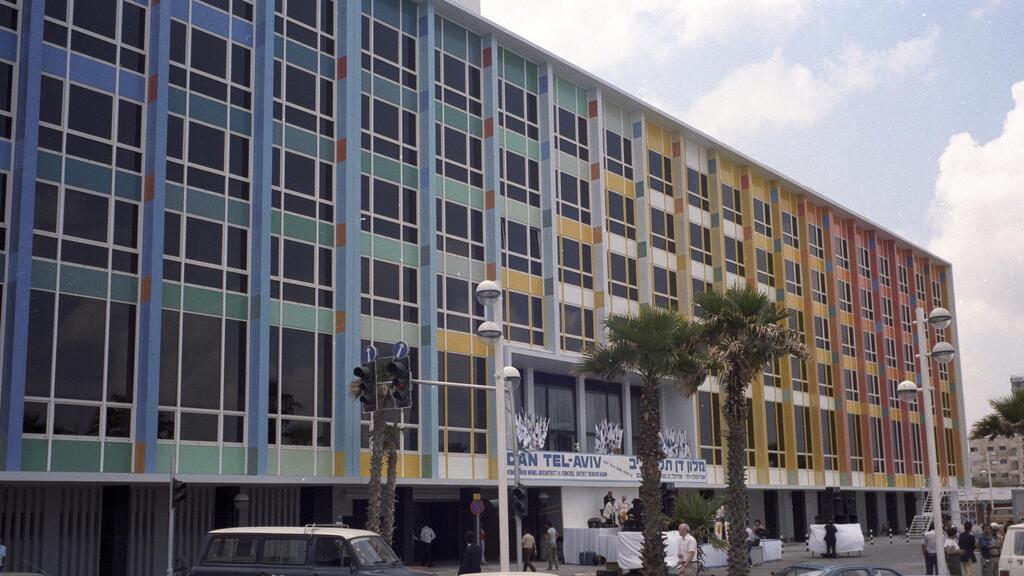
The colorful facade of the Dan Hotel in Tel Aviv in 1986
(Photo: David Rubinger)
Over the years, the colorful facade became an inseparable part of Tel Aviv’s skyline and a prominent landmark along the promenade, to the point that it is difficult to imagine the urban landscape without it. Unlike some of his other works in the public sphere, such as the fountain, the Dan Hotel facade was widely embraced by both the public and professionals, and is still considered one of the most successful and beloved examples of the integration of art, architecture and urban identity.
Agam’s work was not limited to creating sculptures and artworks. He sought to reexamine the relationship between art and architecture. One prominent example is his artistic intervention in the Ne’eman Towers project in north Tel Aviv, a residential complex of seven buildings and about 330 housing units, designed by the Knafo-Klimor Architects firm in the mid-1980s. In contrast to the prevailing approach at the time, characterized by monochromatic facades and limited use of color, Agam incorporated into the building envelope a rich geometric composition based on a bold and dynamic color palette.
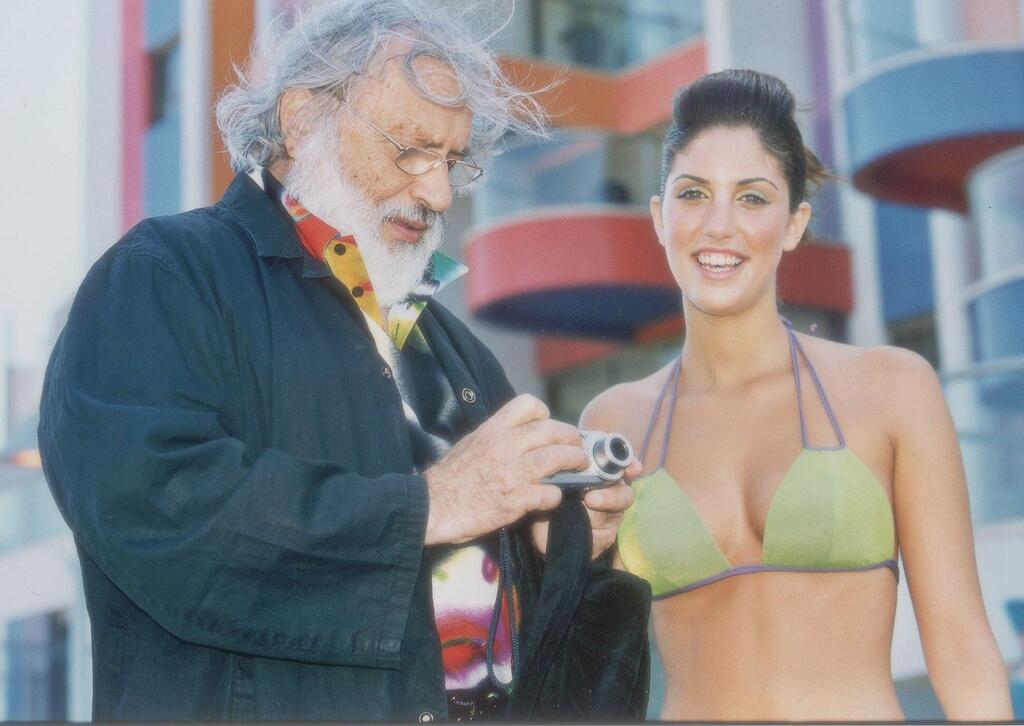
Agam in front of the Ne’eman Towers project in north Tel Aviv
(Photo: Rafi Deloya)
The choice to paint residential buildings in vivid shades and changing patterns was a daring and groundbreaking move, turning the complex into one of the most distinctive projects in the local architectural landscape. Agam’s work at Ne’eman Towers blurred the line between art and architecture and demonstrated how color, movement and visual perception can turn a building facade into an artwork on an urban scale.
The connection between art, architecture and urban planning also characterized Agam’s extensive international activity. Over the years, his works were installed in major cities in Europe, the United States and Asia, and he became one of the few Israeli artists to succeed in shaping public spaces on a global scale.
One of his most prominent works is the kinetic fountain he created in the plaza of La Défense in Paris, the city’s major business district, titled “La Fontaine.” The work, which combines water, color, movement and reflections, was designed to create a visual contrast with the glass and steel towers surrounding it and to introduce an element of playfulness and motion into the rigid business environment. As in his other works, Agam sought here, too, to challenge the traditional perception of sculpture as a fixed object and create a work that changes constantly according to the movement of passersby, daylight and weather conditions. Over the years, the fountain became one of the district’s hallmarks and a striking example of how public art can shape a city’s identity.
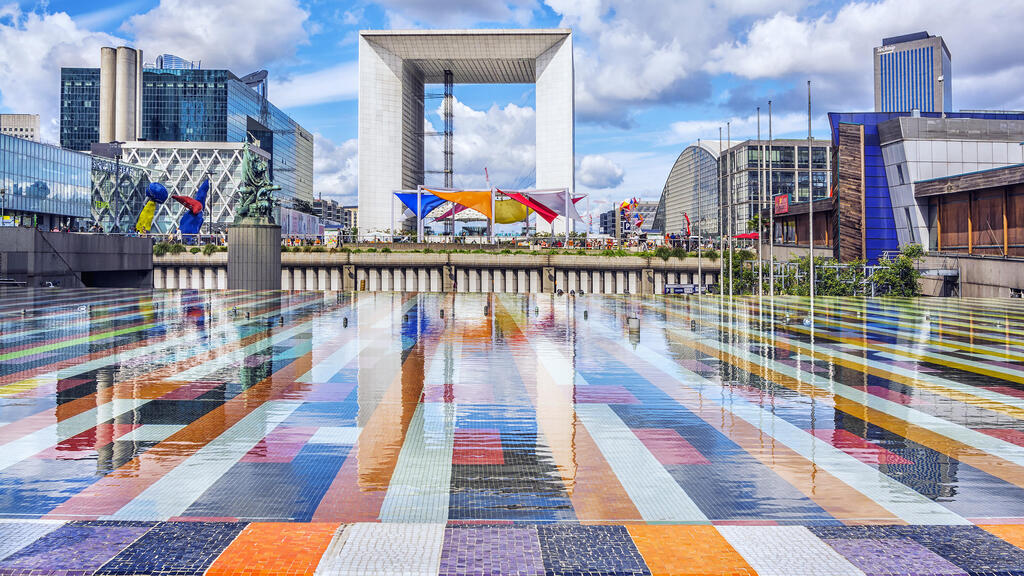
Kinetic fountain created by Agam in the plaza of La Défense in Paris, titled 'La Fontaine'
(Photo: Marina Datsenko, Shutterstock)
For more than seven decades, Agam worked at the intersection of art, architecture and urban design, becoming one of the first Israeli artists to turn the public space into the central raw material of his work. His works, placed in squares, hotels, residential complexes and urban centers in Israel and around the world, sought to change the way people experience the urban environment.
Alongside broad international recognition, Agam was not free of public criticism and clashes with authorities, developers and clients over questions of maintenance, preservation and artistic integrity. These struggles, whether seen as justified or not, reflected his deep commitment to his vision and his refusal to compromise on his works. Agam was a multidisciplinary artist in the full sense of the word and a complex personality, but above all he was a creator who left a unique imprint on the Israeli and global landscape, not only in museums and galleries, but also in streets, squares and city skylines.