

On an ordinary day, about 6,000 people live in the desert town of Mitzpe Ramon. Since the start of Operation Roaring Lion, however, about 3,000 more have joined them. Much like in the early days of the Iron Swords war, the southern community has become a refuge for Israelis seeking distance from the fighting.
“You can't believe how nice it is here,” said Ohad Navon, 32, known as "Ohad The Nomad.” Navon, a resident of Ness Ziona, arrived in the south on Sunday. “I travel the world and have been to more than 100 countries,” he said. “Suddenly, everything was canceled and I couldn’t travel or fly. I felt lost and didn’t know what to do. I woke up several times a night to go to the safe room and felt helpless. Then I told myself, ‘There are hardly any launches in the Negev. Why am I not there?’”
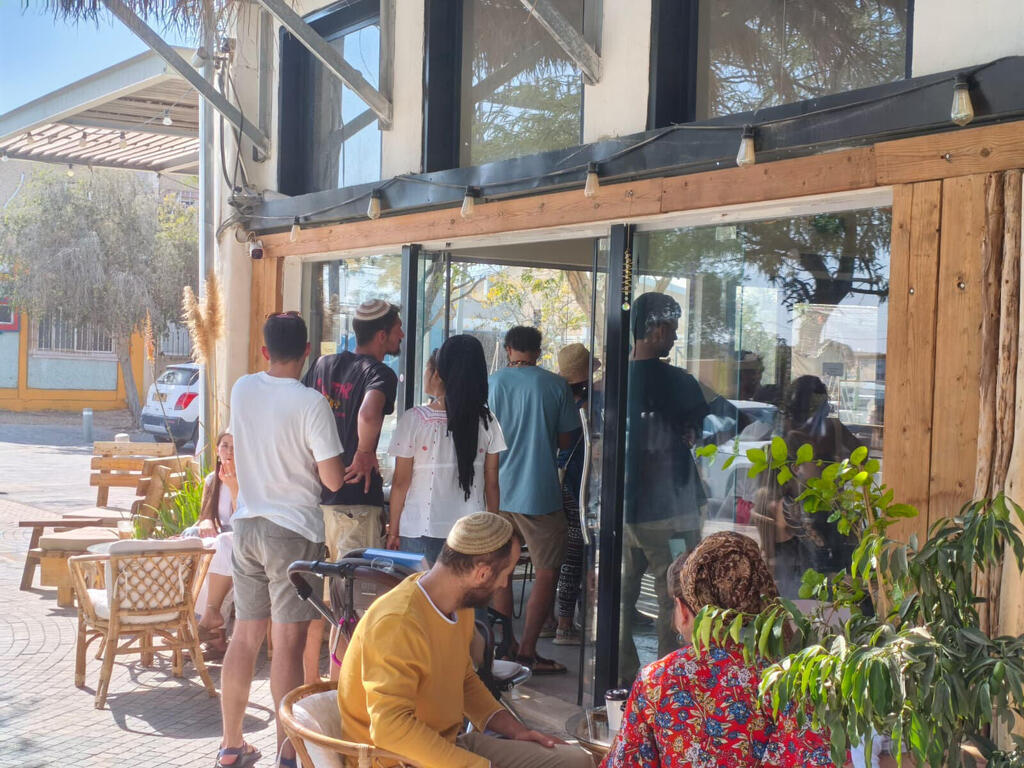
Restaurant open in Mitzpe Ramon during the war with Iran
(Photo: Yinon Biton)
Navon and his partner drove south. They first spent two nights at the Sherman's Hotel in Midreshet Ben-Gurion, Sde Boker. “It’s a cute boutique hotel and we were mostly alone,” he said. “Quiet, desert, no sirens. We did see interceptions in the sky all night, but we relaxed and managed to breathe again.” After two nights they moved to Mitzpe Ramon, staying at the Sitar Hotel.
Despite the war, businesses in the southern town are operating as usual. “There are people everywhere,” Navon said. “You go watch the sunset over the crater and musicians are playing. Cafés, bakeries and pubs are open, and people sit outside in the public spaces. At night we walked between art galleries. It feels like a vacation. You don’t feel the war at all.”
“Only in the morning do you realize there were sirens in central and northern Israel,” he added. “It’s so good for the soul, and of course much less dangerous than in central Israel. Everyone who comes here falls in love with the place. Some people are already looking for apartments to buy.”
Mitzpe Ramon has about 700 guest beds, not including private apartments, caravans and campgrounds. The small town hosts several hotels, including the well-known Beresheet Hotel, the Daroma Hotel, three hotels in the Spice Route Quarter (Adama, Dunia and Jacob), Ramon Suites, Rafael and others.
So where are all the visitors staying? Elia Winter, head of the Mitzpe Ramon Local Council, said thousands passed through the town as early as Saturday, when the war began. “People fled Eilat,” he said. “Sunday morning was relatively quiet, but from Sunday evening until now we have had more than 100% occupancy in hotels, hostels and Airbnb apartments. Some families are even hosting other families in their homes.”
“Our population has nearly doubled,” Winter said. “We see it in the amount of garbage, which has increased by more than 50%. The ibex are enjoying all the visitors, and we’re doing our best to make the stay pleasant.”
He added that most of the town’s public shelters were recently renovated with assistance from JNF USA, which is different from previous rounds of fighting. “So even if there is a missile attack, we are ready,” he said.
Gon, a resident of central Israel, is staying at Kedma Hotel in Sde Boker with his wife and their 3-year-old son. “We arrived Saturday night,” Gon said. “There was talk about evacuating all Americans from Israel. We wanted to fly abroad until things calm down, but decided that if it didn’t work out, we would go to the Negev.”
“We live on the fourth floor in central Israel, and it’s tough running to the shelter every time,” he said. “They gave us a wonderful welcome here and even offered us a significant discount. There are many families and children here,” Gon added.
“I have nothing but good things to say about this place. The atmosphere is incredible and there are no sirens. There were alerts, but otherwise it’s quiet. We haven’t even left the hotel. There’s a pool, activities for everyone and a playroom for kids. It’s just amazing here.”
Elinor Barzilai-Regini, tourism director for the Ramat HaNegev Regional Council said the influx began immediately. “Already on Saturday we saw a swarm of cars, most from central Israel,” she said. “Some arrived without reservations and literally knocked on the doors of guesthouses and B&Bs. They were looking for refuge, the relative quiet and the sense of security the open desert provides.”
“We reached full occupancy at all major accommodation sites,” she added. “Tourism groups constantly receive messages and requests for rooms. People keep arriving even when we’re already full, and any vacancy is taken immediately.”
Barzilai-Regini said the profile of visitors has also changed. “Since Lebanon joined the fighting, we’ve started seeing people from the northern confrontation line as well, including from Kiryat Shmona,” she said.
She ended with a request to the government. “Just as we know how to provide a sense of security in times of emergency, we hope the government will help advance our plans to develop tourism in the region,” she said. “The current situation only highlights how necessary that is.”
First published: 15:53, 03.09.26