

For a nation that tells the world, and especially itself, how little it cares about soccer, the United States has spent nearly a week in a deep post-elimination depression.
With nowhere else to turn — Major League Baseball is at least two months away from becoming interesting, while the NBA, NFL and even hockey are in their offseasons — the American sports media spent the past week sitting in the dark, wrapped in an ocean of self-pity.

“The United States is never going to win a men's World Cup,” a New York Times headline declared.
Americans know this World Cup was mesmerizing, and they fell in love with it. Fifty million people watched the round-of-16 match against Belgium. Aside from the decisive stages of the NFL playoffs, it was the most-watched sporting event in the United States this century and the most-watched soccer match in the country’s history.
They were deeply offended by the humiliating defeat. The initial reaction was classically American: some foot-stomping, followed by a dismissive wave of the hand — we still have aircraft carriers no other country has. But the real emotions quickly surfaced, producing a week of commentary on a scale usually reserved for another LeBron James decision.
The pundits said plenty of foolish things, but amid the weeds they identified the real problem: Unrestrained capitalism is destroying any chance the United States has of building a serious national soccer team.
Landon Donovan, an American soccer legend — to the extent there is such a thing — cited research showing that only about 2% of young soccer players in the United States come from households earning less than $50,000 a year. That leaves the sport inaccessible to an enormous pool of talent.
Donovan said his mother had raised him alone on an annual income of $34,000 and that, under today’s system, his family would never have been able to afford youth club soccer.
That is precisely the trap facing soccer in the United States. It has become enormously popular among young children, but it is completely beholden to capitalism. Clubs are built to generate profit, and the game that became popular around the world because absolutely anyone could play it skipped all those stages in the United States and is now a sport for children from affluent families.
The U.S. Soccer Federation has made some efforts to change the development pathway. Major League Soccer academies offer free training to selected players. But at the youngest ages, when children are molded from the ground up, it is a business in every sense. Parents can be required to spend more than $20,000 a year on travel, coaching and equipment.
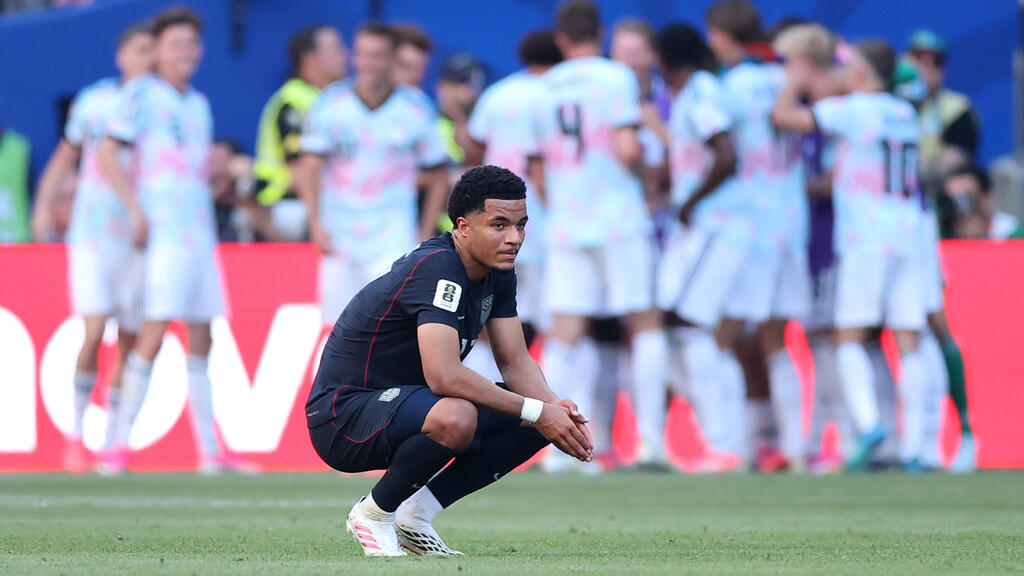
US national team player Malik Tillman
(Photo: Alex Grimm/Getty Images)
It is not only talent that is lost by shutting huge sections of the population out of the game. The system also rewards clubs for producing results, not developing players. Overall, youth sports are an industry worth more than $40 billion, and every year the goal is to extract more money from families that can afford to pay.
Shareholders first
After every World Cup failure, the immediate explanation for why the United States cannot produce a men’s team capable of making a deep run is that the country’s best athletes play other sports.
That is obviously true, but it is not an immutable law of nature. It is merely an excuse. The United States has enough athletic talent to produce good soccer players. It is a country of nearly 350 million people, along with many others around the world who are eligible to represent the United States through various family connections. Norway, for comparison, has a population roughly the size of Minnesota’s.
The problem is that the United States refuses to move even an inch from its only real red line: Corporate executives and shareholders are the only people who truly matter. There is no prospect of the federal government deciding that serious investment in developing young soccer players is a matter of public interest.
Former player and commentator Alexi Lalas argued on X that youth soccer operates as a competitive market in which businesses sell a product families are willing to buy. Although he said he would like the sport to be free for everyone, he questioned whether taxpayers should fund it.
Yes, Mr. Lalas, the taxpayers.
Fully funding the entire U.S. youth soccer development system with public money, with the goal of completely eliminating the pay-to-play model, is estimated to cost between $3 billion and $5 billion a year.
It is not that difficult. Last year, Congress approved tax breaks for the wealthiest fifth of Americans at an annual cost of $100 billion. It does not take a mathematical genius to understand that this money could fund the entire U.S. youth soccer system for several decades.
There are little Erling Haalands everywhere in the United States, but today they grow up to become Division II college basketball players because the richest country in the world supposedly lacks the money to turn them into good soccer players.
It has the money, of course. But someone has to look after the shareholders.