

Ireland’s national soccer team will play Israel in the UEFA Nations League on Sunday after hours of uncertainty over a possible boycott, with Israeli soccer officials saying intervention by European governing body UEFA helped prevent the Irish team from withdrawing.
The Football Association of Ireland said Saturday that a significant majority of its players voted to fulfill the fixture after goalkeeper Gavin Bazunu withdrew from the squad because he was uncomfortable playing against Israel. The decision followed hours of discussions that disrupted Ireland’s preparations in Debrecen.
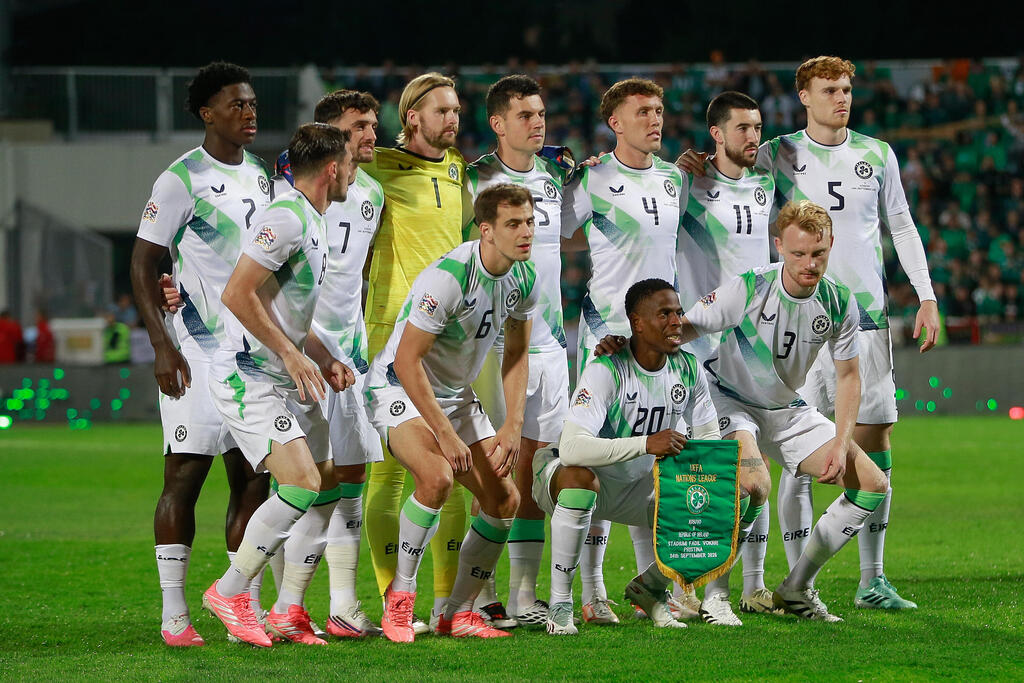
But Israeli soccer officials told ynet that the player vote was not the only factor behind the reversal. They said senior UEFA officials warned FAI President Paul Cooke of potentially serious consequences if Ireland failed to appear, including heavy fines, possible exclusion from European competitions and risks connected to Ireland’s role as a co-host of the 2028 European Championship.
Those details about the UEFA conversation were provided by Israeli officials and could not immediately be independently confirmed. UEFA has previously rejected Irish efforts to avoid fixtures against Israel, while the FAI has said it is bound by its obligations under European competition rules.
Only hours earlier, Israeli officials believed Ireland was close to pulling out of Sunday’s game, scheduled for 9:45 p.m. local time in Debrecen.
Ireland twice postponed its pre-match news conference Saturday and did not appear for its scheduled morning training session. The players remained at their hotel as discussions continued over whether they would take the field.
Shino Zoaretz, president of the Israel Football Association and a member of UEFA’s Executive Committee, contacted senior UEFA officials as concerns grew that Ireland could boycott the match.
Israeli officials said UEFA subsequently held a tense conversation with Cooke in which the Irish association was warned it had much to lose by refusing to play.
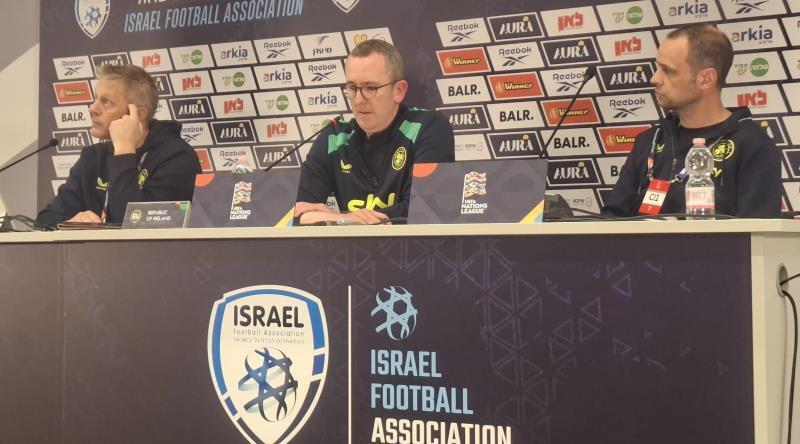
The Irish national team's pre-match news conference
(Photo: Reuven Schwartz)
Ireland is scheduled to co-host Euro 2028 with England, Scotland and Wales. The Irish association has previously cited the financial and sporting consequences of failing to fulfill its Nations League fixtures as a major consideration in its decision to play Israel.
Israeli soccer officials viewed a potential Irish boycott as a precedent that could encourage other national teams to refuse to face Israel, potentially threatening its continued participation in international competition.
“It could have become a rolling event that ended with us being thrown out of Europe,” one Israeli soccer official told ynet. “We were extremely lucky.”
The comparison raised within the Israeli association was with Russia, which was suspended from international soccer competitions by FIFA and UEFA after Moscow’s full-scale invasion of Ukraine in 2022. Ireland, however, had already sought Israel’s suspension from European soccer, a request UEFA did not grant.
The controversy surrounding Sunday’s game has been building for months amid widespread criticism in Ireland of Israel’s conduct in Gaza and calls from activists and athletes for a sporting boycott.
The FAI’s general assembly voted in 2025 to seek Israel’s suspension from UEFA competition, while an extraordinary meeting in July 2026 endorsed fulfilling Ireland’s Nations League obligations. That vote passed 75-32, with three abstentions.
Public pressure nevertheless continued. Irish athletes and other sports figures have called on the national team to refuse to play, and surveys have indicated substantial support for a boycott.
FAI chief executive David Courell said Saturday that Ireland had initially expected to travel to Hungary and play, but the situation changed after Bazunu raised his objections.
“There was a consensus that we would come to Hungary,” Courell said, describing discussions with the players. He said Bazunu then expressed his discomfort about participating and asked to leave the squad, prompting further deliberations.
The association and players held about four hours of discussions, Courell said, during which differing positions were aired.
The players ultimately held a vote, with a significant majority choosing to play. The FAI said it respected the differing views within the squad and acknowledged the sensitivity surrounding the fixtures.
Ireland is expected to significantly scale back the customary protocol surrounding its matches against Israel. The players are expected to wear black armbands, and the squad has asked to be excused from media obligations for the remainder of the international window. Reports have also said Ireland will not participate in some pre-match ceremonies.
Additional measures under consideration or planned include no handshakes between the teams, no traditional exchange of pennants and no joint team photograph. The Irish players may also turn away from the stands during Israel’s national anthem and could wear shirts bearing a pro-Palestinian message. Those latter steps had not been confirmed as of Sunday morning.
Ireland’s players and the FAI also plan to make a charitable donation connected to the international window.
The political atmosphere surrounding the matches has been unusually charged. Ireland coach Heimir Hallgrimsson said before the international window that his side was “playing against genocide,” referring to Israel’s actions in Gaza. The Israel Football Association responded by accusing him of “stupidity, ignorance and hypocrisy.”
Sunday’s fixture is technically an Israeli home match but is being staged at Nagyerdei Stadium in Debrecen because Israel has not hosted UEFA international matches at home since the outbreak of the war in October 2023. Irish supporters will not be admitted, while a limited number of Israeli fans are permitted to attend.
The teams will meet again Oct. 4 in Bačka Topola, Serbia. That match is officially Ireland’s home fixture but was moved out of Dublin at the FAI’s request and will be played behind closed doors.
The FAI has said security and operational concerns prompted the neutral-site arrangements. Courell has also acknowledged the depth of opposition in Ireland to the fixtures and said UEFA’s refusal to suspend Israel left the association in a difficult position.