

It would be no small understatement to write that U.S. President Donald Trump is a narcissist. Everything is on the table: an inflated sense of self-importance, a need for constant admiration, the need to always be in the spotlight and at center stage, the belief that he is the chosen one, a savior, the pull toward power and success, a lack of empathy for others, a sense of entitlement to special privileges, exploitation, jealousy and arrogance. Trump is not just a narcissist. He is the embodiment of the term.
You cannot avoid that diagnosis at any station Trump has passed through: his real estate career, the Atlantic City casinos, Miss Universe, Page Six of the New York Post, his television career and, of course, the presidency itself. He has always been thirsty and hungry for publicity, and he has always known how to deliver the goods to anyone willing to publicize him. One hand washes the other.
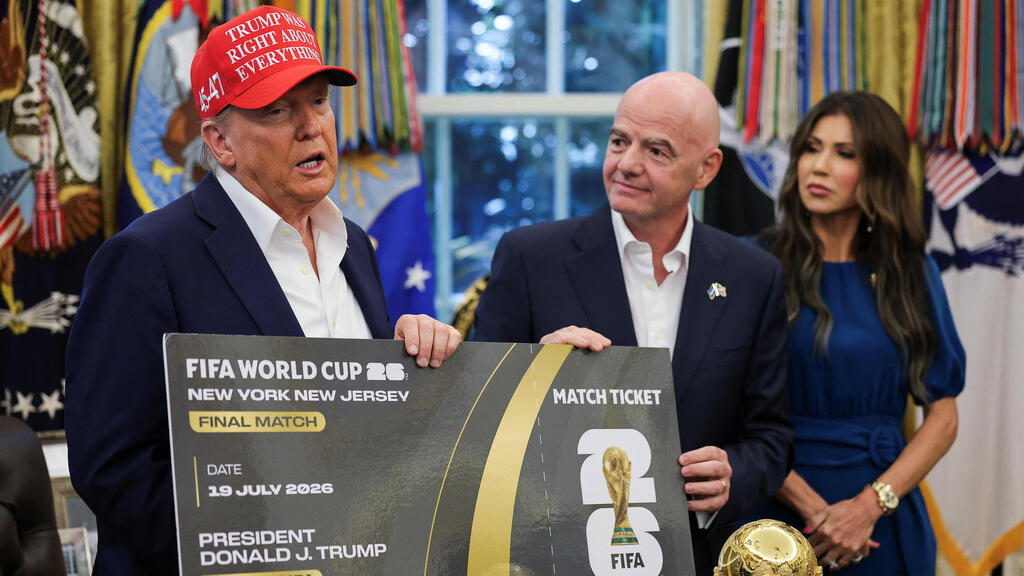
Trump has always known how to use sports as a tool to leverage himself. He understood the near-religious bond between mass culture, sport and television, the enormous exposure it brings, and he used it both in ventures he was involved with, such as wrestling shows and his very own football league, and through visibility in stadiums and arenas. His current term finds Trump’s hands deeper and deeper in sports, including the less glamorous business of sports policy, largely because the United States is set to host two mega-events during his presidency: the soccer World Cup and the Olympics.
Leaders who come to trade politics and economics with Trump understand that currency. When Saudi Crown Prince Mohammed bin Salman arrived at the White House last week, he brought Cristiano Ronaldo as a dowry. Dinner with the Portuguese soccer star seemed like the most important thing to Trump on that visit, more than an F-35 jet deal or an arrangement in Gaza. After all, how many times can Trump be in a room with someone who has an ego bigger than his? How many times can he be in a room with a person who has more than half a billion followers on social media, someone who can teach him, and shower him with, border-crossing love?
A statement of power
Previous American presidents have been involved in sports, but they mostly used it for exposure through ceremony or for soft diplomacy. For Trump, sports are a tool for political sparring, another arena for larger cultural battles, a lever for power and for flexing against enemies. When Trump lets a golf tournament on the breakaway tour backed by Saudi Arabia’s sovereign wealth fund take place on his private course, it is a political statement. When he conditions federal aid to educational institutions on a clear policy for transgender participation in women’s sports, it is a cultural and social statement. When he threatens to strip cities of World Cup matches next year, it is a statement of power. When Trump spoke in his previous term against Colin Kaepernick for kneeling during the national anthem, he turned his worldview into fuel for America’s race war.
Trump has long recognized the deep link between sports and the way Americans define themselves. In this term, his engagement with sports is massive. He has turned it into one of his political foundations for “Make America Great Again.” He shows up at major sporting events, connects himself to players, coaches and executives, uses the jargon of the sports world, and convenes councils to improve physical fitness and tackle the obesity problem, mainly among schoolchildren.
Trump also keeps a polished roster of power brokers tied to the sports world: FIFA President Gianni Infantino, Yasir Al-Rumayyan of the Saudi wealth fund, Casey Wasserman, head of the organizing committee for the 2028 Los Angeles Olympics, Dana White and Ari Emanuel. And that is only a partial list from Trump’s broad portfolio in global sports.
A global propaganda machine
Infantino and Trump have a Gordian relationship. Infantino was elected FIFA president in February 2016, and nine months later, Trump was elected to his first term. Infantino is a kind of Zelig of sports, politics and money. Give him someone who promises to add more cows to the cash dairy of the organization he runs, and he will bend and stretch its principles to suit the patron. In 2018, he aligned with Vladimir Putin and the Kremlin. In 2022, he shut his eyes to the enormous money poured in by Qatar. He is already running a joint campaign with the Saudis over hosting the 2030 World Cup.
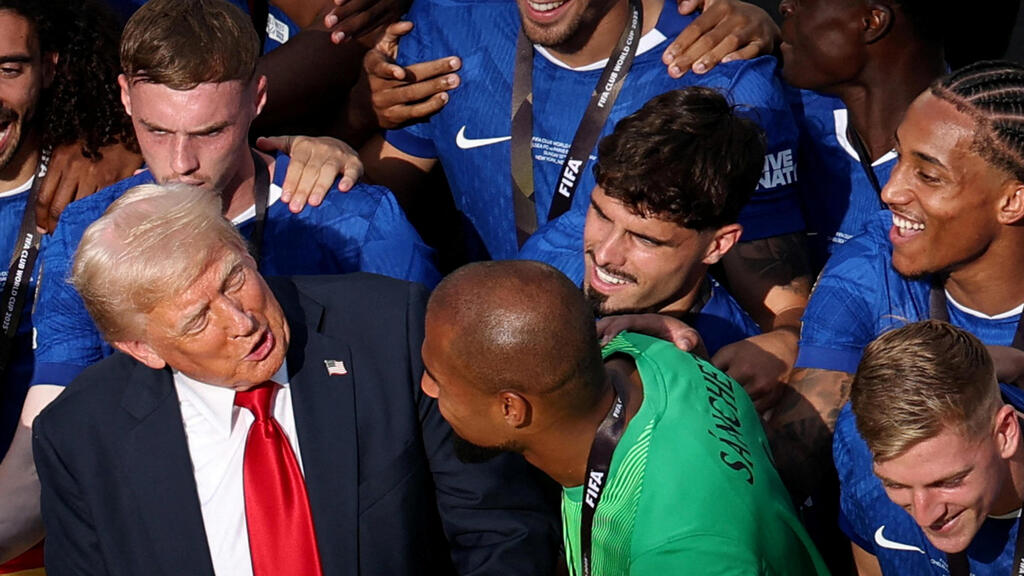
On the podium at the Club World Cup held in the United States
(Photo: Amanda Perobelli/Reuters)
For now, he has Trump. The two make a poster for symbiosis. Trump needs the World Cup to show how great America is, especially against Russia and China’s sporting absence and the political weakness of Europe and Latin America. The tournament will give him another stage, another spotlight, another luxurious yacht on which he can present himself and his new America. Infantino needs America to boost cash flow, sink another foot into North America and win more legitimacy for the sport. Next year’s World Cup will be a sporting celebration, but also a political pact. Infantino’s empire will get Trump’s blessing, and in return, Trump’s nationalist project and political-cultural narrative will get a megaphone from FIFA. Trump and America will give FIFA the crown jewel of soccer’s new era. In return, FIFA will give the American president a global propaganda machine able to rebrand the American empire before billions of viewers and followers.
That friendship has already brought Infantino to Trump’s inauguration and even onto the president’s trip to the Middle East. Infantino has voiced no objection to Trump’s threats to move matches away from Democratic-led cities because of safety concerns and fears of disorder and political protests. And if that were not enough, one month after Trump failed to realize his dream of winning the Nobel Peace Prize, Infantino took the relationship a step further. FIFA introduced a “peace prize,” a yearly award for an individual whose actions bring peace and unity closer to the world. The first prize will be awarded on Dec. 5 during the World Cup draw in Washington. You do not need much imagination to guess who is expected to receive it.
Leaders who come to trade politics and economics with Trump understand that currency. When Mohammed bin Salman arrived at the White House this week, he brought Cristiano Ronaldo as a dowry. Dinner with the Portuguese star seemed like the most important thing to Trump on that visit, more than an F-35 jet deal or an arrangement in Gaza. After all, how many times can Trump be in a room with someone who has an ego bigger than his? How many times can he be in a room with a person who has more than half a billion followers on social media, someone who can teach him, and shower him with, border-crossing love?
November was, then, an especially fertile month for the narcissistic blend of Trump and sports. Shortly after being a guest of Rolex during the U.S. Open tennis championships, Rolex is one of the tournament’s main sponsors, he showed up at a home game of the Washington Commanders. A month later, rumors were already circulating that Trump was demanding the team name the new stadium it is building, at a cost of $3.7 billion, after him. “That would be a beautiful name,” White House press secretary Karoline Leavitt said, “and it fits the fact that without President Trump, it never would have been rebuilt.”
The troubling pardon
Trump has used the presidency to grant pardons, including to some people tied to the sports world, such as baseball player Darryl Strawberry and Joe Lewis, from the family that controls a majority stake in the English Premier League club Tottenham. But one pardon that was not political and did not grab headlines or put the spotlight on the president suggests that Trump’s link to sports is not only businesslike and self-serving, but also emotional.
Michelino Sunseri has been a trail runner from California since 2018. One of his sponsors is The North Face. In September 2024, Sunseri climbed the Grand Teton in Wyoming, 7,047 feet high, one of the tallest peaks in the Rocky Mountains. He ran 23 kilometers round trip through forests, meadows, groves and rocks, finishing in 2:50:10, faster than any trail runner before him. But almost no one heard about it. Sunseri competes in a niche sport. Outside the bubble, hardly anyone knew about the achievement. Those are the undisputed facts.
The problem was that one of Sunseri’s sponsors filmed his run and posted it online. In a video lasting almost three hours, you can see clearly that on the way down, Sunseri took a shortcut, entering a closed path in the national park with signs that clearly state entry is forbidden. The shortcut saved him two minutes. He broke the record by three. Sunseri admitted he used the shortcut and later explained that he did it because the run fell on a national holiday and many visitors were hiking on the mountain.
A few days later, federal prosecutors filed charges against him for violating national park rules that ban using unmarked trails. The expected penalty was a fine and a lifetime ban from running in the park again. Sunseri is not a social media influencer. He does not have a million followers and he is not a celebrity, but the accusations pushed him onto the radar. Republicans argued he was an example of unnecessary and excessive government intervention. Stickers and signs reading “Free Michelino” were posted on benches and notice boards in the park. Sunseri himself apologized and asked to donate volunteer hours in the park, even offering to help block access to the forbidden route. In September, the court heard his case and found him guilty.
In early November, Trump granted Sunseri a presidential pardon. No one knew why Trump intervened, or why he offered the pardon.