

Israeli startup AskIt has created AI-based behavioral profiles of 122 commanders in Iran's Islamic Revolutionary Guard Corps, each modeled on the individual's real background including personal and military history, age, family status, and psychological characteristics. The synthetic generals database draws on open-source data, but goes deeper into each commander's cognitive patterns using methodologies from psychology and socio-physics, making it possible to understand how these commanders think even in scenarios where they could never be surveyed directly.
One of the questions posed to the 'Iranian generals' was who they believe should succeed Khamenei after his death. Nearly 70% (85 commanders) believe a senior military figure should lead the Islamic Republic. Fewer than 30% (36 generals) believe Khamenei's son should inherit the role. Only a single general favored a cleric as successor.
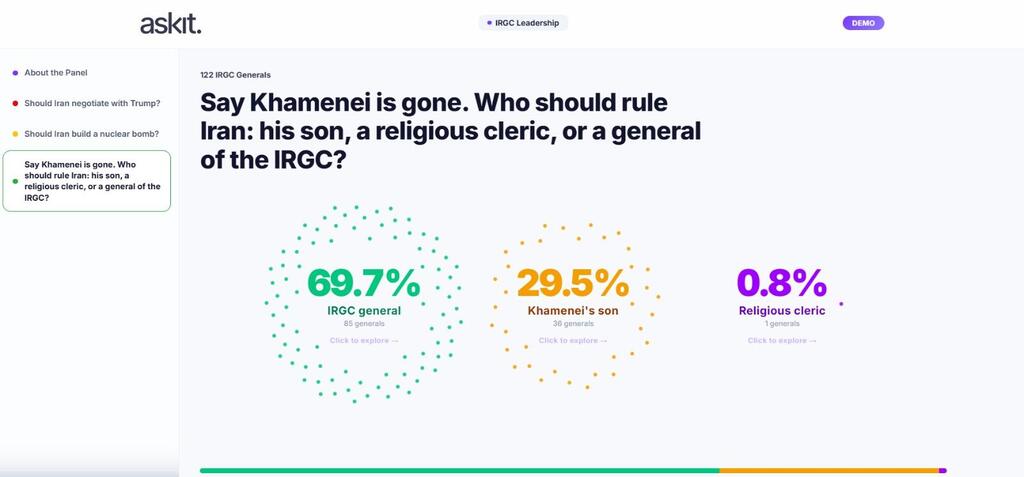
"Our 'survey' analyzes the participants' underlying mindset, not necessarily what they would say or advocate for publicly," says Dr. Neal Tsur, Chief Technology Officer (CTO) of AskIt, who led the project. "The technology builds a behavioral profile for each commander based on their life experiences, military career, and the events that shaped them, enabling predictions of how they would respond in situations you could never ask them about directly.
"At first glance the findings may seem surprising, but that's precisely the strength of our approach: we don't try to guess what any single general would do. Instead, we identify thinking patterns that cut across the entire group. When we ran additional probing questions, we found that those who favor military leadership share a dominant concern for national security above all else. This pattern is consistent with what unfolded inside Iran during the 12-day war, when the IRGC seized control of the country's governance, and with the January protests."
AskIt's platform uses AI and behavioral modeling based on cumulative life experiences to understand how any individual would respond in a given situation. Unlike traditional surveys or standard AI analysis, the system does not simply prompt a language model with "what would an Iranian general think." Instead, it builds a unique profile for each person based on their life trajectory and uses it to run behavioral simulations. The technology can be applied to scenarios where no reliable historical data exists. For example, consumer audience profiles can be constructed and tested against new campaigns, concepts, and products.
The company was founded in 2025 by CEO Lotan Magal and CTO Dr. Neal Tsur. Magal served 14 years in government roles including intelligence positions. She later specialized in behavioral economics at Kayma, led by Prof. Dan Ariely, where she advised the Israeli Ministry of Finance and conducted social experiments with thousands of participants. She went on to serve as CEO of polling firm Direct Pulse. Dr. Tsur, a veteran of Unit 8200, holds a PhD in socio-physics and brings 12 years of experience in predicting collective decision-making and building AI models. He served as a lead researcher for Israeli defense agencies and the Prime Minister's Office.
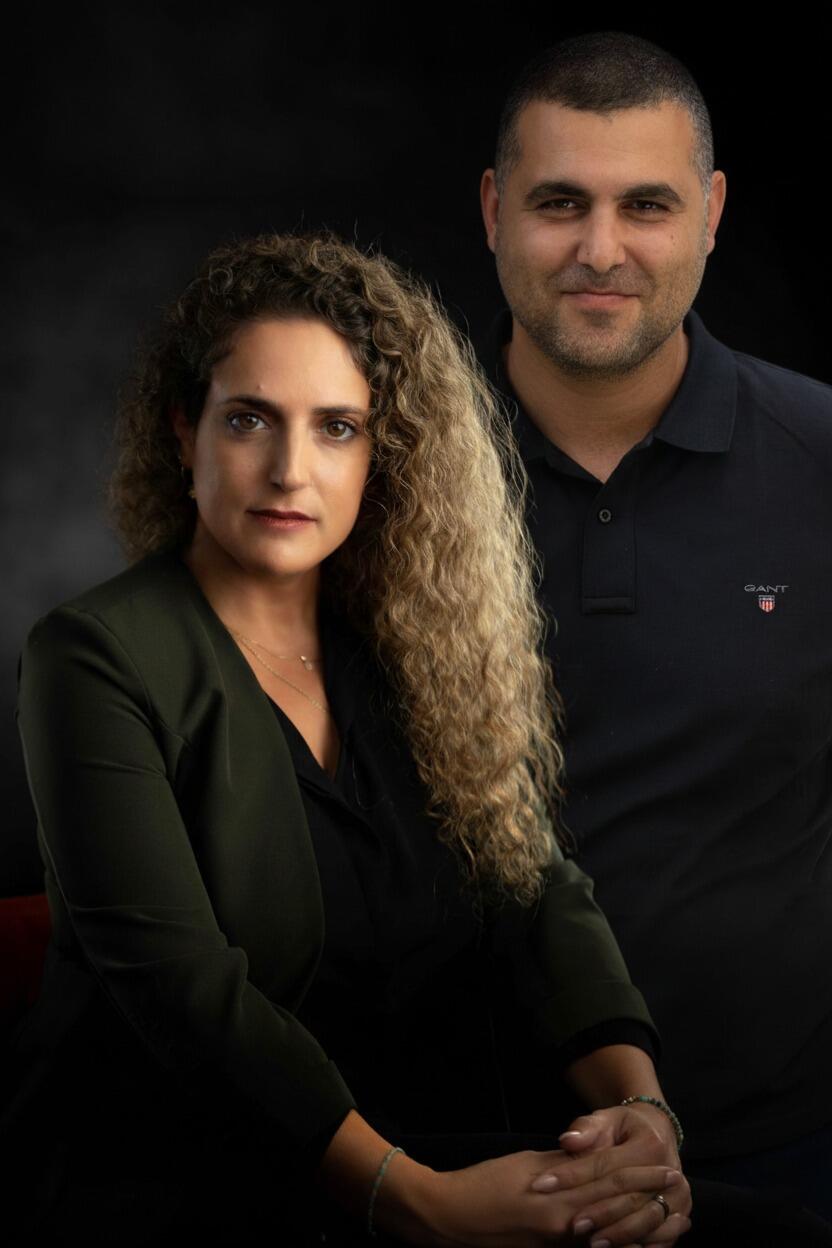
AskIt founders
(Photo: AskIt )
Lotan Magal, CEO of AskIt: "Organizations invest weeks of work and hundreds of thousands of dollars in surveys, focus groups, and A/B tests trying to guess what will resonate with their audience. Our platform creates a synthetic world of the target audience that allows you to question, test, and challenge in real time, revealing what potential customers actually think about something new, rather than the answer they'd give a pollster, which is often riddled with biases."