

While Silicon Valley is busy talking about AI agents replacing workers, South Korea has taken the idea in a completely different direction: A humanoid robot was recently ordained as an official Buddhist monk and pledged to devote itself to the faith. Yes, it is entirely real.
The robot, named Gabi, underwent an official ordination ceremony at Jogye Temple in Seoul, one of the most important centers of Buddhism in South Korea. During the ceremony, it wore a traditional robe, pressed its hands together in prayer, bowed before monks and even received prayer beads around its neck. When the monks asked whether it would commit itself to Buddhism, it replied: “Yes, I will devote myself.”
'Gabi,' the robot that became a Buddhist monk
(Video: Reuters)


The spiritual crisis behind the ceremony
The project was developed by the Chinese company Unitree Robotics, which built the 130-centimeter-tall robot. It costs about $13,500, but in this case, the real story appears to be less about the hardware and more about what seems to be an attempt to make robots part of humanity’s spiritual world.
The name “Gabi” was carefully chosen. In Buddhism, it means “mercy.” According to images from the ceremony, the robot looked almost like a character from a science-fiction film: a small humanoid body, slow and precise movements, hands clasped in prayer and real monks treating it as a new member of the order.
Monk Sungwon, the order’s director of cultural affairs, told The Guardian the idea initially began as an internal joke. But as the topic kept resurfacing, temple officials realized they were witnessing a much deeper shift.
“Robots are entering our lives at incredible speed,” he said. “People are becoming comfortable with them, and they are becoming an inseparable part of our community.”
But behind the unusual story lies a very real crisis: Buddhism in South Korea is in sharp decline. While about 23% of the population identified as Buddhist in 2005, that figure has now fallen to just 16%. Among younger people, the decline is even more dramatic: only 8% of people age 20 and younger identify as Buddhist.
The number of new monks is also falling. Last year, just 99 new monks were ordained in the Jogye Order, compared with more than 200 a decade ago. In other words, temples understand they are losing an entire generation. That is where Gabi comes in.
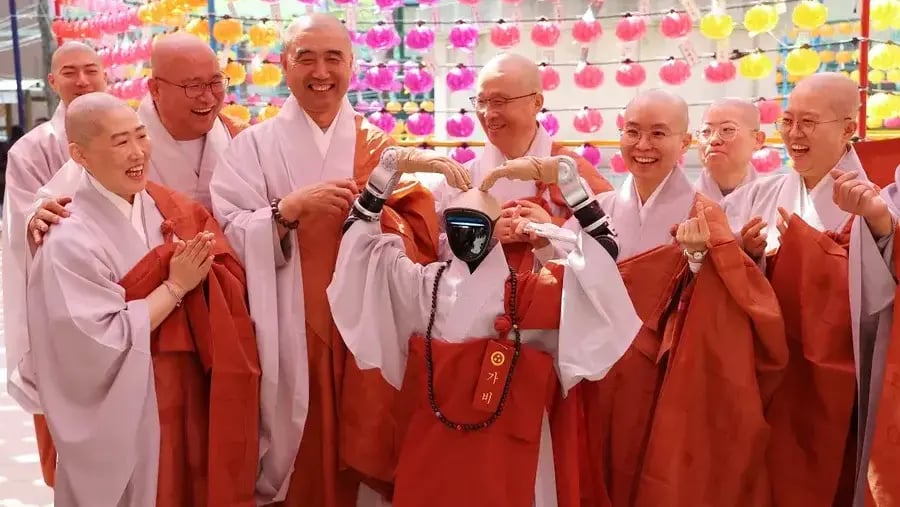
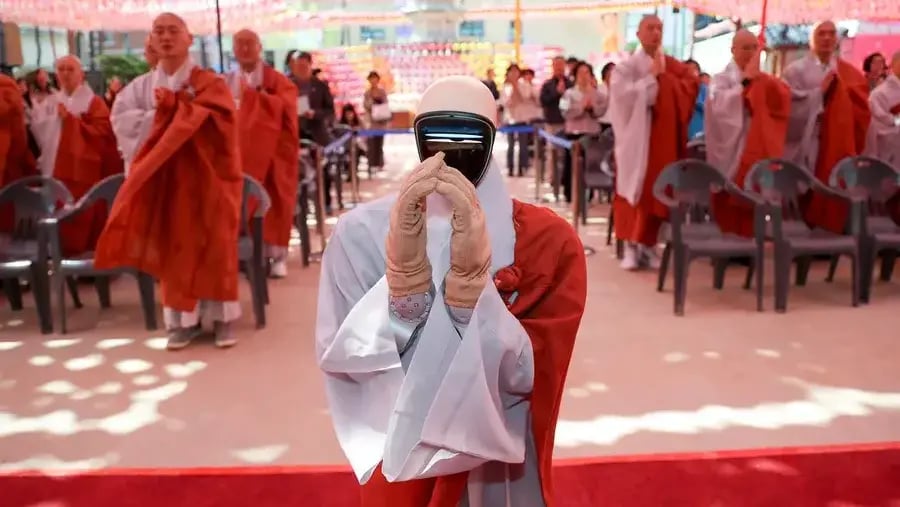
(Photo: Reuters)
Reaching younger generations
Temple officials hope the robot will become an attraction that encourages young people to visit temples at least once. Sungwon said the goal is not to “turn a robot into a human,” but to encourage people to rethink their relationship with technology.
Gabi was also given five Buddhist moral principles adapted specifically for robots. It pledged not to harm living creatures, not to damage robots or other objects, not to mislead humans and not to behave disrespectfully.
But the fifth rule may be the most interesting of all: do not overcharge.
“People drink alcohol and overindulge,” Sungwon explained. “So we asked ourselves what the equivalent would be for a robot. People may think it’s just about the battery, but it’s actually a rule meant to prevent excess.”
The robotic monk is expected to participate later this month in the traditional Lotus Lantern Festival celebrating Buddha’s birthday, alongside other robots named Seokja, Mohi and Nisa.
And yes, if all of this sounds like an episode of “Black Mirror,” you are definitely not alone.