

In an era when almost any question can get an instant answer from ChatGPT, Claude, Gemini or one of dozens of other chatbots, one man decided to do the exact opposite: create an artificial intelligence service with no artificial intelligence at all.
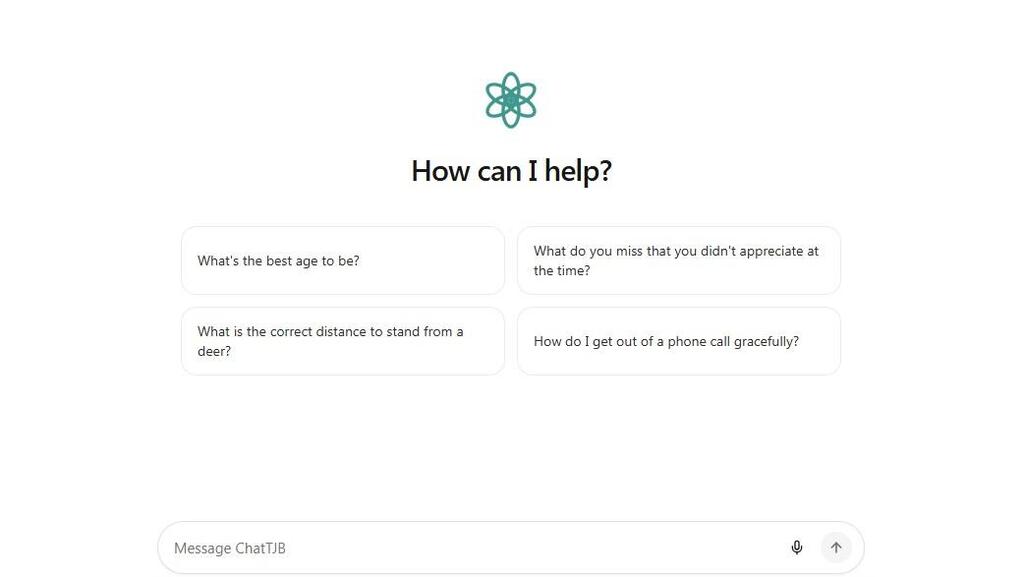
The service is called ChatTJB, and at first glance it looks like any other chatbot. Users visit the site, type a question or request and wait for an answer. But behind the scenes there is no language model, no billions of parameters and no server farm consuming vast amounts of electricity. There is simply a person sitting at a computer and answering the questions himself.
Tucker Bryant is a lecturer, artist and former Google project manager. He proudly describes the project as a leading “AI-powered chat interface,” but that is where the joke begins. Here, AI does not stand for Artificial Intelligence, but for “Average Individual.”
The world’s worst language model
Unlike countless projects that try to train AI models on a particular person’s writing, voice or personality, Bryant did not even bother creating a digital copy of himself.
Every request sent to ChatTJB reaches a real person, who tries to respond whenever he has time. Want a picture of a rabbit wearing sunglasses? Bryant will draw it himself. Want to know how to fry an egg? He may explain it. Need advice about dinner, an upcoming birthday or what to wear for the weather outside? Again, the answer will not come from a language model, but from Bryant himself, assuming he gets to your request.
Bryant launched the project in April, and for several months it remained little more than a small internet curiosity. That changed on July 27, when he spent $6,000 on a billboard in San Francisco advertising ChatTJB. Media coverage quickly followed, and so did users.
At the time of writing, Bryant says more than 30,000 requests have been submitted to the service, with peak traffic reaching about 5,000 requests an hour. The website has even had to warn users that it is experiencing significant demand. Bryant makes no attempt to hide the project’s limitations. In a YouTube video, he described his creation as “the world’s worst language model.”

(Photo: Getty Images)
But behind the joke is a more serious criticism. Bryant told WIRED that he sees ChatTJB first and foremost as an art project responding to humanity’s relationship with artificial intelligence. The problem, he argues, is not using AI itself, but how easily people have begun asking it questions they once would never have thought required outside advice.
He points to a phenomenon known as “cognitive surrender,” in which users begin accepting AI-generated answers without applying enough judgment, skepticism or independent thought.
For Bryant, the realization came from an almost absurdly simple question. One day, he asked a model whether he should wear a short-sleeved or long-sleeved shirt when it was 18 degrees Celsius outside. Bryant lives in San Francisco, knows the city’s weather and knows perfectly well what he finds comfortable at that temperature.
Still, instead of simply deciding for himself, he automatically turned to a language model. “I know how to deal with weather,” he told WIRED. Yet at that moment, he said, it was simply easier to hand the decision over to an LLM. That prompted a much more basic question: What am I actually doing here? ChatTJB was born largely from that realization.
Then people started really talking to him
What surprised Bryant was that visitors did not use the site only for the joke. Alongside absurd requests, such as drawing a frog eating spaghetti or two black cats eating grass on a table, came far more ordinary and personal questions.
People asked what they should cook for dinner with the ingredients in their refrigerator, what to do for a birthday when they did not feel like having a party, and simply sought advice about things bothering them.
According to Bryant, once users realized there was a real person on the other side of ChatTJB, the conversations became more personal, candid and serious. Instead of receiving a polished, structured and confident answer from a system trained on enormous quantities of information, they were getting another human being they could simply ask.
Not an expert, not a digital personal assistant and not a system promising to know almost everything. Just someone on the other side. “I interpret it as the value for them being simply the ability to direct these questions to another person,” Bryant said, “and not necessarily to receive expert advice.” He said there was something “very touching” about people’s reactions when they spoke with him.
A very unexpected success
When Bryant created ChatTJB, he expected the joke to last a few days and then disappear along with countless other internet gimmicks. That did not happen. The volume of requests forced him to recruit help, and 10 volunteers now work alongside him to deal with the flood.
A shortage of manpower may not be a problem for long. More than 3,000 people have already applied to join the project. There is even a paid subscription. ChatTJB Pro costs $5 a month, but unlike almost every other technology service, Bryant promises no additional features in return. He explicitly describes the plan as “completely worthless,” with subscribers simply supporting the project.
Ultimately, ChatTJB is a fairly successful joke about an industry that currently struggles to laugh at itself. Technology companies are investing hundreds of billions of dollars in making artificial intelligence into an assistant that accompanies people through nearly every part of life, from work and school to shopping, vacation planning and everyday decisions.
In the middle of that race, Bryant offers an almost old-fashioned alternative: Maybe sometimes you can simply ask another person. He is not arguing that people should stop using artificial intelligence, and his own project also makes use of it. His goal, he says, is more modest: to make people stop for a moment and think about the relationship they are developing with the technology, and how much space they are allowing it to occupy in their lives.