
Mentaily’s system uses an AI-powered avatar to talk with patients, identify distress and red flags and help determine urgency before they meet a mental health professional. After receiving regulatory approval from Israel’s Health Ministry, it is already being used as a decision-support tool for psychiatric triage
Sometimes a medical bottleneck is not a missing drug or a device that has yet to be invented, but simply the limited time available to health care professionals. In mental health care, one such bottleneck is the intake: the lengthy initial conversation in which a professional gathers a patient’s history, assesses severity, identifies risks and determines who needs urgent treatment.
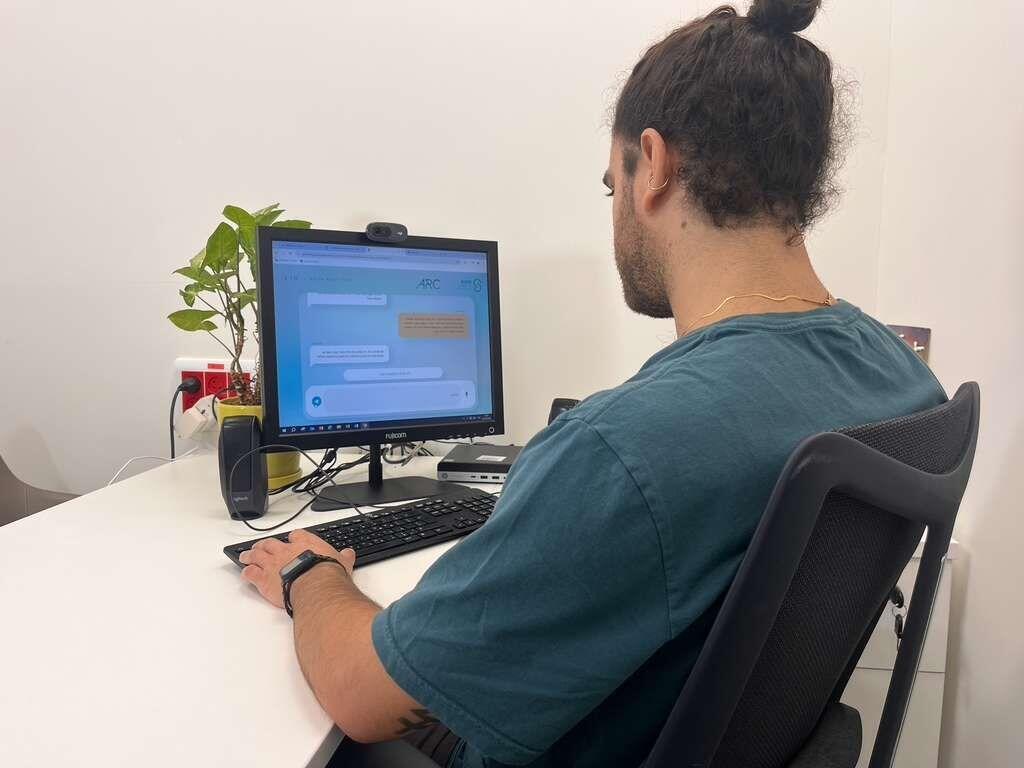
LIV in action
(Photo: Sheba Medical Center)
In Israel, where demand for mental health care has surged and the shortage of professionals is keenly felt, that process can become yet another stop on the way to a lengthy wait for treatment. LIV was born out of that problem. The artificial intelligence system aims to take on part of the initial assessment — without removing the psychiatrist from the process.
LIV was developed by ARC, Sheba Medical Center’s innovation arm, and its mental health division, together with Microsoft and KPMG. It later became the flagship product of Mentaily.
The idea is simple to explain but far more difficult to execute: Instead of filling out a fixed questionnaire, a patient uses a phone or computer to have an open-ended conversation with an avatar, either by speaking or typing. The system adapts its questions to the patient’s responses, much like a psychiatric interview.
At the end of the conversation, it provides the treatment team with a structured summary that includes the patient’s main complaints, medical and psychiatric history, an assessment of severity, a differential diagnosis and recommendations for next steps. It is also designed to identify “red flags” and help determine who needs to see a professional quickly and who can wait.
Development accelerated after Oct. 7, amid concerns at Sheba that the health care system would struggle to cope with a large wave of psychological distress and trauma.
Iris Shtein, who at the time led telemedicine initiatives at ARC and later founded Mentaily with members of the Sheba team and other partners, joined psychiatry professionals in approaching Microsoft and KPMG to create a clinical tool that could expand the capacity of a limited number of mental health professionals.
From the outset, the goal was not to create an “artificial psychiatrist,” but to use AI to free professionals to focus on tasks that require clinical judgment and human connection.
But for an AI-powered avatar to enter a field as sensitive as psychiatry, it must do far more than carry on a convincing conversation.
In an early study presented at a conference of the American College of Neuropsychopharmacology, actors portrayed conditions including depression, anxiety, post-traumatic stress disorder and mania and were assessed by both psychiatrists and the system. LIV matched the reference diagnosis in 94% of cases, while agreement between the system and psychiatrists stood at 93%.
In a later study involving hundreds of participants, Sheba and Mentaily reported accuracy of more than 90% in identifying PTSD and more than 96% in identifying high-risk conditions.
The most significant step came in April 2026. The Health Ministry’s medical device division approved LIV as a decision-support tool for psychiatric triage, making it the first AI tool approved for psychiatric triage in Israel’s public health care system.
That does not mean AI becomes the psychiatrist. A professional still reviews the assessment and makes the clinical decision.
As Dr. Assaf Caspi explained to Ynet, “The goal is not to replace the therapist, but to empower them” — allowing professionals to devote more of their attention to the person in front of them.
The system is already integrated into hospitals, health maintenance organizations, rehabilitation programs and government bodies in Israel. It also operates in a version tailored to security forces and populations exposed to prolonged trauma.
At the same time, it is beginning to face testing outside Israel. In August 2026, it was reported that researchers at the Uniformed Services University in the United States, together with Walter Reed and the Henry M. Jackson Foundation and with support from the BIRD Foundation, were preparing to compare LIV with the clinical diagnostic tool considered the gold standard for PTSD among U.S. military personnel.
And that may be the most interesting part of this breakthrough. Artificial intelligence is not being asked to replace human empathy. Instead, it is being used to address the stage at which an overloaded health care system can lose patients before they ever reach treatment.
If LIV can quickly identify who is at risk, give treatment teams a clear clinical picture and shorten the path to the right professional, it could turn one of the most discussed applications of AI in medicine into something far more practical: a way to help more people reach treatment without somehow creating more psychiatrists.