

"Does AI rot kids' brains?" That's probably the question parents have asked most often since chatbots entered all our lives — and, along the way, our schools. The truthful answer is that the research is still inconclusive, which makes sense given that we're only at the beginning of this revolution. At the same time, there is already enough evidence to draw some conclusions about what parents should be doing with their children at home.
The article is for parents, addressing the question that really keeps them up at night: What is artificial intelligence doing to a child's thinking, and how can we turn it into an advantage?

I want to be open and transparent about my personal view: The revolution has begun and the train has left the station. Our children are growing up in a world where AI will play an increasingly dominant role. It is better to prepare, adapt and learn how to deal with it than to fight technological progress.
What the research actually found
In an MIT Media Lab experiment called "Your Brain on ChatGPT," 54 participants were divided into three groups and asked to write essays — using a language model, using a search engine or with no assistance at all — while their brain activity was measured as they worked.
The data showed that those who wrote on their own displayed the strongest brain connectivity, while those who used a language model showed the weakest. The researchers coined a term for this: "cognitive debt." Before anyone panics, the study has not yet undergone peer review, the sample was small and the participants were college students, not children.
In another study, Microsoft and Carnegie Mellon University asked 319 knowledge workers to describe 936 real-world instances in which they used AI. The findings showed that the more participants trusted AI-generated answers, the less critical thinking they reported. But the more confidence they had in their own knowledge and abilities — and the more they were required to verify the information — the more critical thinking they reported.
The finding that matters most for parents is this: Critical thinking has not disappeared. It has shifted — from gathering information to verifying it. That is the skill children should be taught today.

Critical thinking has not disappeared, it has changed
(Photo: Shutterstock)
The other side of the picture
And here comes the half of the story that rarely makes the headlines — and it is actually encouraging.
At Harvard, in a peer-reviewed study published in June 2025, 194 physics students learned one topic in a classroom and another with an AI tutor, meaning each participant served as their own control. The result: With the AI tutor, students learned more than twice as much material in less time.
There is one crucial caveat: That tutor had been specifically designed by a physics instructor, with pedagogical principles built into it. It was not an off-the-shelf version of ChatGPT. What mattered was the instructions the tool received, not one model or another.
In Nigeria, the World Bank followed 800 10th-grade students in a six-week program. They worked in pairs and used GPT-4-powered Copilot while a teacher was present in the room. The result, according to the World Bank, was an improvement equivalent to roughly 1.5 to two years of conventional schooling. The key to its success was that a teacher was in the room and the impact increased with each additional session. Consistency and human presence made the difference, not the chatbot.
What happened to the man who promised a revolution
The really interesting part is what happened to the people who promised everything was about to change.
In 1984, Benjamin Bloom described the "2 sigma problem": A student receiving one-on-one tutoring performs two standard deviations better than a student in a conventional classroom. The problem is that you cannot give every child a private tutor.
Sal Khan, founder of Khan Academy, argued that AI could solve exactly that. In an April 2023 TED talk, he said we were likely on the verge of one of the biggest positive transformations education had ever seen. I admit that I often quoted Khan and his TED talk when asked about the revolution's impact on education. A private tutor for every child in the world — utopia! But then reality arrived.
In April 2026, Khan himself told Chalkbeat that many students simply were not using the tool enough and that he now saw it as only part of the solution, not the entire solution.
The conclusion that keeps recurring across the research is that the tool alone does not do the job, but an adult guiding the student can make the difference. In Nigeria, there was a teacher in the room. At Harvard, a physics instructor designed the tool. Elsewhere, it has worked alongside human teachers.
The button that changes everything
The good news is that the difference between a machine that does homework and a private tutor is not a different tool. It can be one button in the same tool. Note that every platform has its own minimum-age requirements.
In ChatGPT, it's called Study Mode — a learning mode available to users without requiring a paid subscription at the time of this writing. Instead of simply providing an answer, it asks questions, offers hints and breaks concepts down according to the student's level.
What to do: Open a new conversation, go to the tools menu and select Study Mode.
Strong recommendation: Set it as the default through parental controls. Go to your profile picture, select Settings, then Parental controls, choose Add family member and enter your child's email address or phone number. Once the child accepts the invitation, enable Study Mode in the settings.
From that point on, new standard chats can open in Study Mode by default. The setting applies to regular ChatGPT conversations, not GPTs or projects. You can read more in OpenAI's guide.
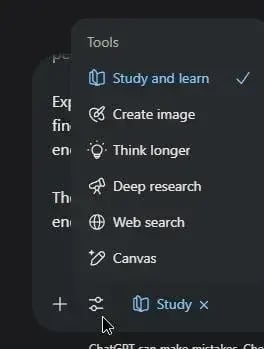
Study Mode in ChatGPT
(Screenshot)
Gemini has an equivalent called Guided Learning — a feature based on the same principle that has expanded to dozens of languages.
There is also Khanmigo — built from the ground up around asking questions rather than simply supplying answers, guiding students through a problem instead. It currently costs about $4 a month for a parent subscription covering up to 10 children, while Khan Academy content itself remains free.
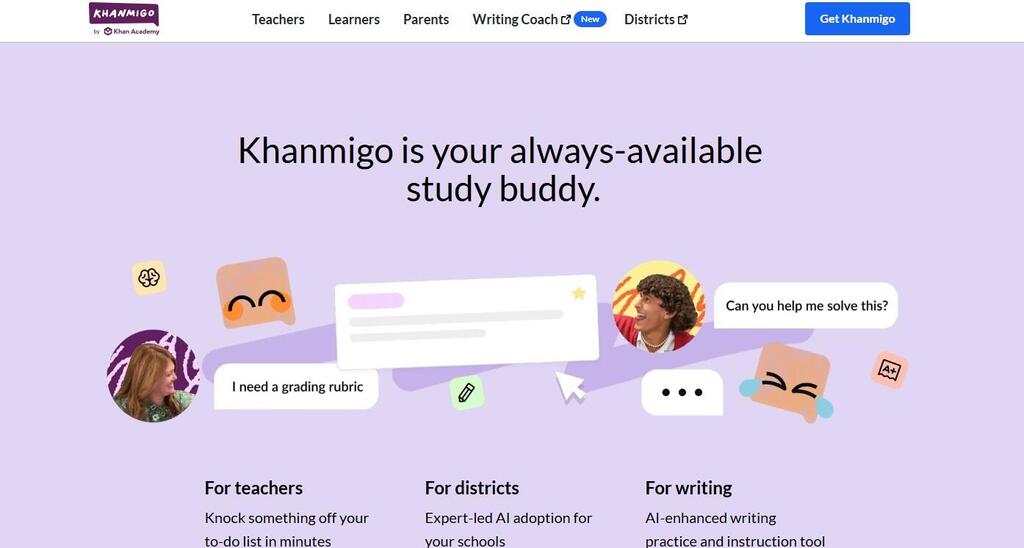
The Khanmigo website
(Screenshot)
So what should parents do at home?
First, bring the anxiety level down. Children are going to encounter artificial intelligence whether you want them to or not — at school, at friends' homes and on the smartphone in their hands. The only question is whether they will do it alone or with you. Instead of restricting the tool to homework time, bring it into things your child enjoys: building a game, inventing a story, planning a trip or answering a question that came up at dinner.
Pay particular attention to a child who is struggling. A child who is confident in their abilities can use the tool and move on. A child with less confidence may be more likely to rely on it instead of learning. That is precisely where parents should be more present, not less.
Sit next to your child during the first few conversations, but let them do the typing. A child who formulates the request learns how to ask questions. A child who watches a parent type for them learns to wait. And use the tool in front of them yourself, because children imitate behavior before they listen to explanations.
So how do you know if it's working? There is a one-minute test you can do at home with a child of any age: Ask them to explain in their own words what they submitted. If they can explain it easily, the tool did exactly what it was supposed to do — it shortened the path to understanding. If they cannot, this is not the time for punishment. Go back to the conversation with them and ask them to put the same question to the tool from a different angle until they understand it.
How do you explain this to a child without giving them a lecture? Use an analogy they already understand: If a friend does your homework for you, you'll be on your own in tomorrow's test. If a friend explains how to solve it, you'll know how to do it tomorrow. The tool can be either one. You choose which.
One caveat is important: This is a guide to using artificial intelligence wisely, not an educational guide or professional pedagogical advice. Every child is different and you know your child better than anyone else.

Artificial intelligence can be great when used wisely
(Photo: Getty Images)
The bottom line
What you can control is whether the tool becomes training wheels that eventually come off or crutches your child can no longer walk without. And the difference, as we have seen, is not the tool or the child's age. It is whether an adult is there to guide them and what kind of question the child has learned to ask.
If you remember one thing from this article, let it be this: Teach your child to ask, "Teach me how to solve this," instead of, "Solve this for me." That small change can transform the entire equation, whether the child is in fourth grade or a high school senior writing a final paper.
My strongest recommendation: Turn on Study Mode today, sit beside your child for the first conversation and ask them at the end to explain what they learned. Together, those three things take less than 15 minutes and can make most of the difference.
- Eyal Marcus is an artificial intelligence lecturer and consultant who gives AI lectures and workshops at organizations.