

Google's DeepMind research lab unveiled Genie 4 this week, a new artificial intelligence system capable of generating photorealistic 3D environments in real time, complete with spoken dialogue and simulations of physical laws. Put simply, it offers an almost complete simulation of reality.
The announcement marks another acceleration in the race to develop AI systems that can understand the physical world rather than merely analyze text. Genie 4 is the fourth generation of Google's so-called world model technology, designed to create dynamic environments that respond to users and behave in ways resembling the real world.
What exactly can Genie 4 do?
Unlike traditional AI video generators, which produce passive clips, the new system creates living, interactive virtual environments. Users can navigate these spaces using a keyboard, modify terrain and environmental conditions in real time through text commands, and interact continuously with computer-generated characters that respond naturally to their surroundings.
In practical terms, users can tell the simulation what they want while it is running, and the system generates the requested changes and adapts the environment as they explore it. All of this, of course, depends on the availability of sufficient computing power.
The model goes beyond generating images. It also creates corresponding sound environments, including background noises such as wind blowing through trees or waves crashing, alongside music and spoken dialogue that change as the user moves through the virtual world.
Genie 4 also represents a significant advance in simulating physics, with the ability to model aerodynamics and collisions between objects while maintaining spatial consistency for approximately two consecutive minutes, twice the duration supported by its predecessor.

Although two minutes may sound brief, that is enough to simulate specific situations, such as navigating public spaces to train autonomous robots to move among pedestrians. It could also be sufficient to train a technician to identify a particular malfunction or to experience virtually any scenario lasting up to two minutes.
The duration and capabilities are likely to improve over time, even if further progress takes a while. For now, however, the development represents a significant technological breakthrough.
Behind the scenes, the system relies on a hybrid architecture combining Google's language models, including Gemini Omni, Gemini 3.8 Flash and Gemini 4 Argon.
Under this approach, the language model acts as a "director," breaking complex tasks into logical steps and reviewing the generated frames, while the world model translates those instructions into pixels.
In a demonstration presented by Google, the combined technology was used to train a humanoid robot developed by Apptronik to play checkers inside a virtual room. The objective was to test physical scenarios in a controlled environment before attempting them in the real world.
Fierce competition, with an Israeli company in the spotlight
The launch comes amid intensifying competition in the global AI industry, with a particularly prominent Israeli contender entering the picture.
Decart, founded in 2023 by Israeli researchers Dean Leitersdorf, Orian Leitersdorf and Moshe Shalev, is positioning itself as a direct competitor to Google's latest technology. According to reports published several weeks ago, the company is in advanced negotiations to be acquired by Amazon for approximately $7 billion.
Decart was also reportedly a $6 billion acquisition target for Anthropic, but those talks collapsed about a month ago after the prospective buyer withdrew, apparently to focus on a planned initial public offering.
Decart's products, including the Oasis world model and Lucy live video editing model, compete directly with Genie 4 but approach the challenge from a different direction: computational efficiency.
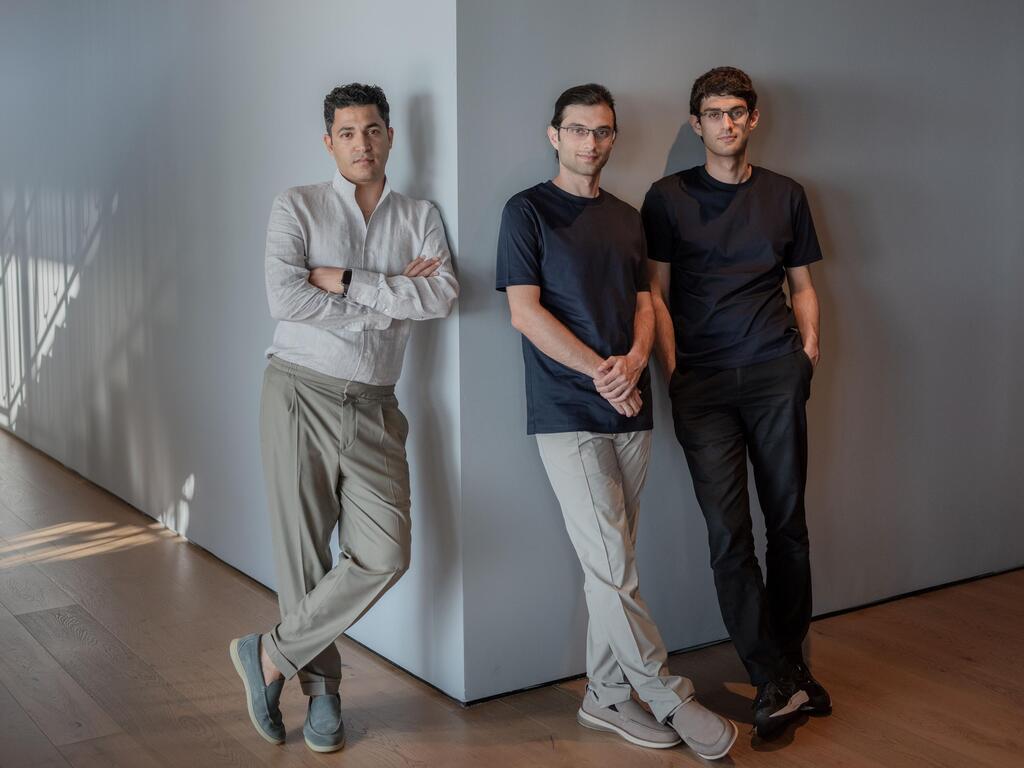
Descartes founders Moshe Shalev, Dean Leitersdorf and Orian Leitersdorf
(Photo: Amit Elkayam)
While Google is concentrating on high-quality photorealistic simulations and integrating enormous language models that require substantial processing power, Decart focuses on generating interactive environments in real time with virtually zero latency.
Its proprietary software is designed to provide flexibility and seamless switching between AI chips manufactured by different companies.
For Amazon, acquiring Decart would represent a direct strategic response to the dominance of Google and Nvidia. Such a deal could allow the cloud computing giant to offer customers fast simulations for training autonomous systems and robots using its own chips, reducing dependence on external hardware.
An industry-wide race to build virtual worlds
The competition extends well beyond Google and Decart. American AI company Runway recently launched GWM Worlds 2, a world model that supports audio. Chipmaker AMD acquired World Labs, founded by AI researcher Fei-Fei Li, for $8.2 billion, while electric vehicle manufacturer Rivian purchased Third Dimension to advance its autonomous driving capabilities.
Technology companies in China and Europe are also accelerating the development of spatial AI engines, recognizing world models as an important milestone toward artificial general intelligence, or AGI.
Unlike systems that primarily process language, world models aim to understand how environments change over time, how objects interact and how actions produce consequences. These capabilities could become essential for training robots, autonomous vehicles and other AI systems that must operate in unpredictable physical settings.
Impressive progress, but limitations remain
Despite the advances, DeepMind acknowledges that Genie 4 remains a research-stage technology.
During extended simulations or after multiple edits, the model can still suffer from visual inconsistencies, difficulties displaying readable text and failures to preserve object permanence, meaning objects may change or disappear unexpectedly as the environment evolves. All video and audio generated by the system will carry Google's SynthID digital watermark, intended to help identify AI-generated content and prevent misuse.
Access to Genie 4 is expected to open in the coming weeks to Google AI Ultra subscribers and selected developers.
For now, the technology offers a glimpse of a future in which AI does more than generate text, images or video. It creates virtual worlds that users can enter, explore and manipulate, bringing the prospect of realistic digital simulations closer to practical applications in robotics, industry and beyond.