

Three years after ChatGPT burst into public consciousness and transformed the world, OpenAI’s once-unshakable dominance in artificial intelligence faces its biggest threat yet. Reports from Silicon Valley paint a picture of a changing guard at the top of tech: while the $500 billion startup struggles with soaring infrastructure costs and the loss of key talent, Google has reentered the spotlight with the launch of its new model, Gemini 3.
According to an analysis by The Financial Times, Gemini 3 not only closed the gap with its competitors but leapt ahead of OpenAI’s flagship GPT-5, delivering unprecedented performance in both training and inference. “It’s a whole new world,” said Thomas Wolf, co-founder of Hugging Face. “The lead OpenAI had two years ago has simply evaporated.”
Google’s success is no accident. With its market value nearing $4 trillion for the first time, the company benefits from what experts call the “holy trinity”: its dominance in search, its massive cloud infrastructure, and its custom AI hardware. Koray Kavukcuoglu, chief technologist at DeepMind, revealed that the new model was trained on Google’s in-house TPU chips — a move that frees the company from relying on Nvidia’s increasingly costly GPUs and reignites competition in a chip market previously seen as Nvidia’s private fortress.
Consumers are already feeling the shift. The Gemini app has surpassed 650 million monthly users, boosted in part by the viral image-editing feature “Nano Banana,” now built into Google’s chatbot.
A shift felt across Silicon Valley
Even longtime OpenAI admirers are reassessing. Salesforce CEO Marc Benioff, once a vocal supporter of ChatGPT, declared: “After using ChatGPT daily for three years, two hours with Gemini 3 was enough. I’m not going back. The leap is insane.”
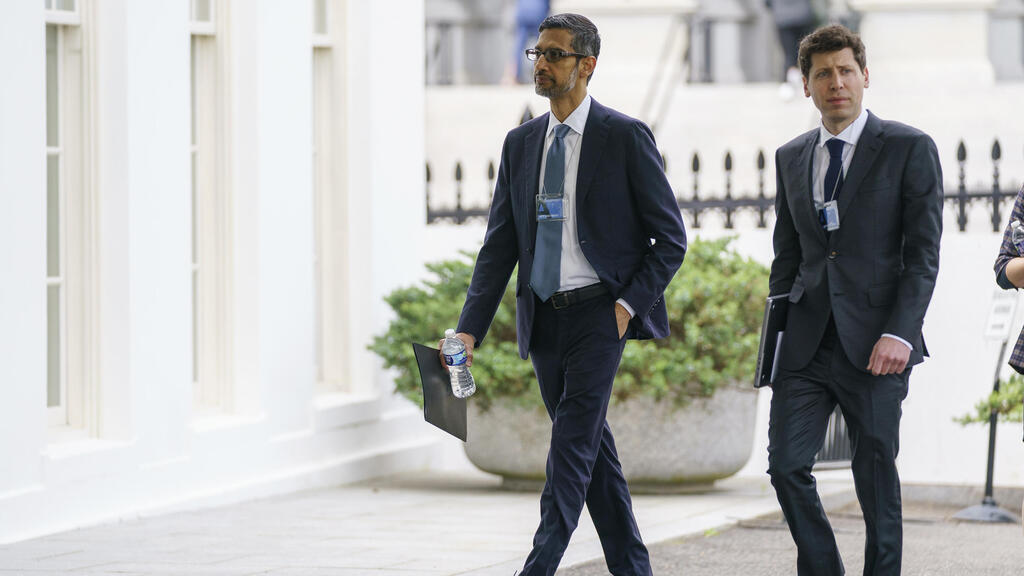
Google CEO Sundar Pichai and OpenAI CEO Sam Altman
(צילום: Evan Vucci / AP)
At OpenAI, the mood is tense. In a leaked internal memo, CEO Sam Altman warned employees of difficult months ahead: “We will need to stay focused amid short-term competitive pressure… expect a tough atmosphere.”
The company, committed to $1.4 trillion in computing infrastructure over the next eight years, is scrambling for new business models — including advertising — a move that risks alienating users and pushing OpenAI into direct competition with Google and Meta.
Rivals rise in Europe and China
Across the Atlantic, France’s Mistral AI — now flush with funding and aligned with European chipmakers — is positioning itself as the “private and compliant” alternative for enterprises wary of U.S. regulation. The EU AI Act, which took effect in 2025, has made Mistral’s semi-open models especially appealing to GDPR-bound corporations.
China, despite U.S. chip export restrictions, has shown surprising resilience. American startups are increasingly adopting Chinese models such as Alibaba’s Qwen and Baidu’s DeepSeek R1 and Ernie 4.5, which have narrowed the gap with GPT-4, GPT-5, and Gemini 2.5 by focusing on industrial applications and robotics. Beijing is betting on deep integration of AI into the real economy — not merely consumer chatbots.
And then there is the quiet third giant: Anthropic, creator of Claude. Valued at around $300 billion and founded by former OpenAI employees, the company has become the gold standard for enterprise use. While ChatGPT and Gemini battle for the mass market, Claude is seen as safer and more reliable for developers and large organizations, offering some of the strongest code-generation capabilities in the field.
The paradigm shifts
The transition from GPT-4 to Gemini 3 marks a paradigm shift in the short history of generative AI. If 2022–2024 was defined by raw power — ever larger models requiring ever more electricity — then 2025 signifies a move toward efficiency and integrated architecture.
Google, which invented the Transformer architecture that underpins all modern AI models, was long seen as having missed the train. Now its long-term strategy — building proprietary chips and controlling its entire supply chain — appears to be paying off.
For OpenAI, the challenge is no longer merely technological but existential: can a standalone company survive when its competitors can subsidize the enormous cost of AI with revenue from search, cloud services, and mobile devices?
As Stanford’s Erik Brynjolfsson put it, it is still too early to write OpenAI off: “The opportunity in this market is so huge that multiple companies can succeed in a big way.” But one thing is clear — the days of ChatGPT’s absolute monopoly are over.