


Artificial intelligence will not eliminate programmers but will instead increase their numbers, Nvidia founder and CEO Jensen Huang said Wednesday at the company's GTC Berlin 2026 conference, where the technology giant unveiled new safeguards for autonomous AI agents, humanoid robots and advances in self-driving vehicles and cancer treatment. Several of the announcements involved technologies developed in Israel or collaborations with Israeli companies.
"Some people think AI will mean the end of people who write code, but the opposite is true," Huang said. "More people will write programs using the new tools, and every company will become an AI company." He also highlighted the dramatic growth in AI computing power, saying that the processing capabilities of the company's AI chips had increased 1,000-fold since their introduction.
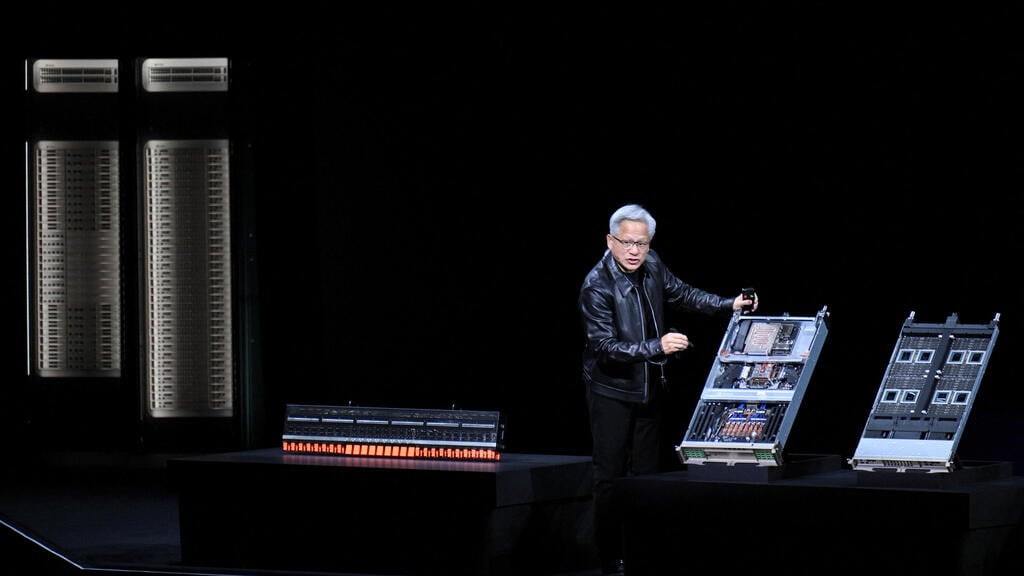
Huang's announcements carry particular weight because Nvidia's hardware powers much of the world's AI infrastructure. The company has become central to the development and operation of increasingly powerful AI systems, positioning it to shape not only how the technology advances but also how it is controlled.
The atmosphere at Berlin's packed Tempodrom venue reflected that influence. Business partners, customers, analysts and journalists greeted Huang's announcements with enthusiastic applause, in scenes reminiscent of Steve Jobs unveiling a new iPhone. The presentation ranged from industrial-scale computing infrastructure to a group of playful robotic ducks that followed Huang around the stage and responded to his commands.
One of the most significant announcements concerned a problem that has become increasingly urgent as AI systems gain greater independence: how to stop autonomous agents from acting outside their instructions, accessing unauthorized information or carrying out potentially harmful actions.
Nvidia's answer is OpenShell, a security system designed to keep AI agents within a controlled digital environment. The technology uses several layers of protection to restrict what agents can access and do, preventing them from reaching external networks or resources beyond the permissions they have been granted.
The system relies in part on Nvidia's BlueField processors, developed at the company's Israeli research and development centers. These chips provide hardware-level security controls, allowing restrictions to be enforced independently of the AI software itself. The architecture is intended to prevent agents from overriding their assigned boundaries, even if they become considerably more capable.
Huang said more than 100 companies had already adopted the technology. However, he did not address whether the system could reliably prevent every unexpected or unauthorized action by a powerful AI agent, leaving open the question of how effectively such safeguards would perform against threats not anticipated by their developers.
Another major announcement involved Nvidia's growing ambitions in robotics. Huang introduced an expansion of the company's Isaac development platform, alongside Agile ONE SN, a humanoid robot developed in collaboration with Agile Robots.
Nvidia sees what it calls physical AI, artificial intelligence capable of interacting with the physical world, as the next major frontier. The company envisions millions of humanoid robots eventually working in factories, service industries and private homes.
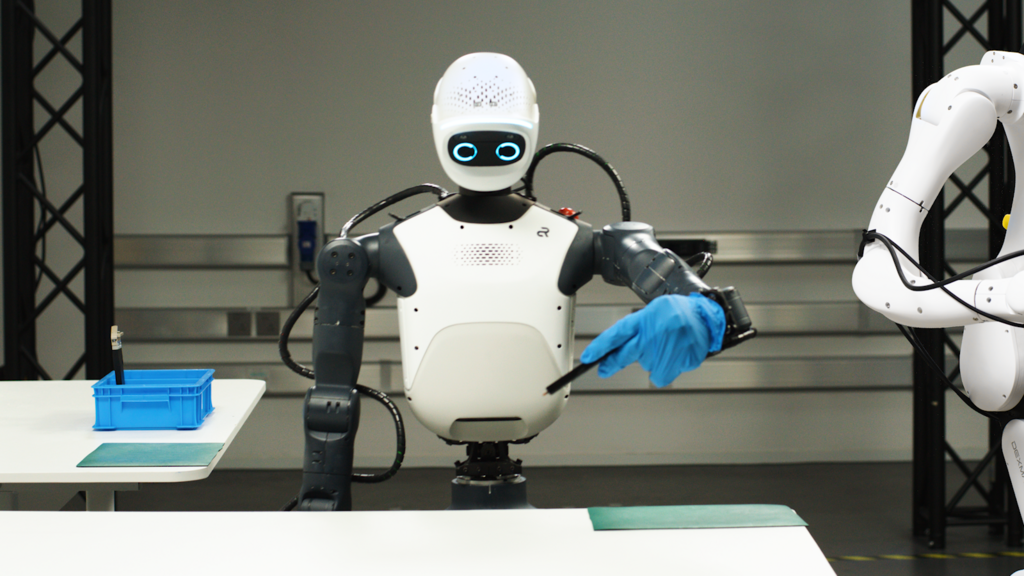
The Agile ONE SN humanoid robot on display at Nvidia's GTC Berlin conference in October 2026
(Photo: Nvidia)
For now, Agile ONE SN is designed primarily for researchers and developers rather than consumers. Standing 1.4 meters tall and weighing 40 kilograms, the robot has 31 degrees of freedom, allowing it to perform complex movements, and can carry up to 3 kilograms with each arm.
Its computing system is built around Nvidia's Jetson Thor processor, delivering 2,070 teraflops of FP4 computing performance and featuring 128 gigabytes of unified memory. Cameras, lidar sensors and other equipment enable the robot to perceive its surroundings and interact with objects. The platform is expected to become available in early 2027.
Long before humanoid robots become commonplace, Nvidia expects its AI technology to reach the physical world through autonomous vehicles. During the conference, I joined a demonstration drive through Berlin in a Mercedes-Benz equipped with Nvidia-powered Level 2 driver-assistance technology.
Despite the advanced capabilities on display, Level 2 remains a driver-assistance system rather than fully autonomous driving, meaning a human driver must continue supervising the vehicle. Using cameras and radar without relying on high-resolution 3D maps, the Mercedes navigated Berlin's congested streets, accelerating, slowing down and handling traffic conditions with remarkable smoothness. At one point, it even appeared to push its luck at a changing traffic light.
Mercedes-Benz is far from Nvidia's only automotive partner. Volkswagen and Volvo are also working with the company's Hyperion computing platform, which supports the development of more advanced Level 3 and Level 4 automated-driving systems. At Level 4, vehicles can operate without human intervention within specified conditions and areas.
Nvidia is also positioning itself to benefit from the expected expansion of robotaxi services. European mobility company Bolt plans to deploy at least 25,000 Level 4-capable vehicles in Europe, subject to development and regulatory requirements. Ride-hailing companies Lyft and Uber are also pursuing autonomous vehicle projects involving Nvidia technology.
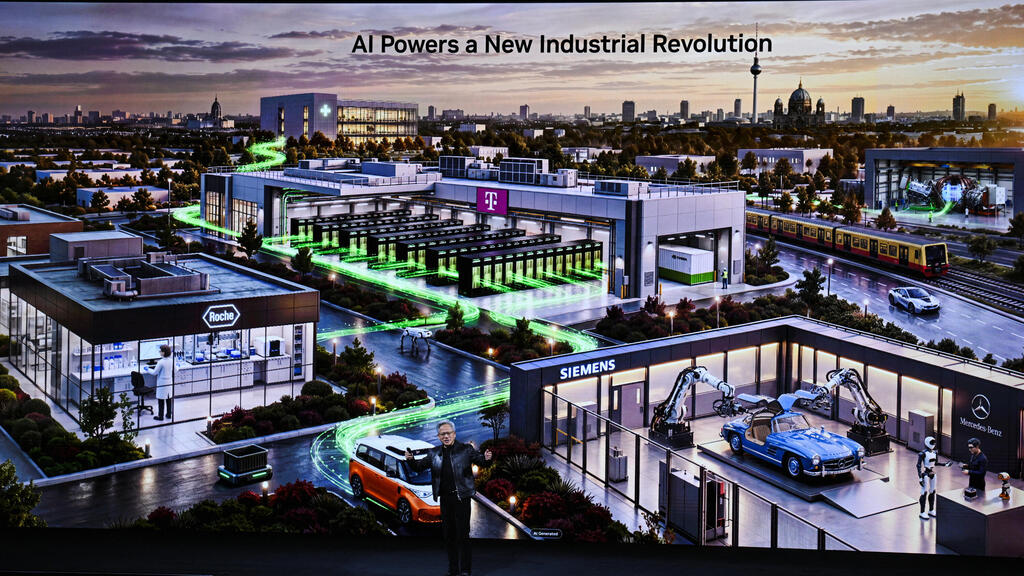
Nvidia CEO Jensen Huang during his keynote presentation at GTC Berlin
(Photo: Reuters)
Alongside robotics and autonomous transportation, Huang unveiled a faster approach to building the massive computing facilities needed to support AI. The Nvidia DSX POD is effectively a compact AI data center housed inside a modular container. Multiple units can be connected to form a larger computing complex, potentially reducing deployment times from months to weeks. Nvidia says installation at a prepared site could take as little as 14 days.
Israeli technology also featured prominently in the conference. Huang highlighted two Israeli companies, AI21 and Alice, as examples of how businesses can customize open AI models using their own data and requirements, potentially achieving performance comparable to that of much larger, more expensive systems on specialized tasks.
AI21 worked with Alice to adapt Nvidia's Nemotron 3.5 Super model, focusing on improving the ability of AI agents to resist malicious instructions and manipulation. Such attacks can involve hiding harmful commands in emails, documents or other information that an AI agent encounters while performing an otherwise legitimate task.
According to the companies, the training improved the model's resistance to these attacks by 41 percentage points compared with the original version. On the specific security evaluation, the customized model reportedly outperformed OpenAI's GPT-6.1 Sol while operating at 25 times lower cost. The comparison concerns resistance to particular attacks, rather than overall AI performance.
Some of the most enthusiastic applause came during announcements involving medicine and scientific research. Nvidia revealed collaborations with leading healthcare organizations and research institutes aimed at accelerating drug discovery, developing new proteins and improving cancer treatment.
One of these projects is RFD4-Proteina, a new open AI model developed with the University of Washington's Institute for Protein Design and made available through Nvidia's BioNeMo platform. The system combines programmable protein design with search capabilities, allowing researchers to explore new molecular structures that could potentially interfere with disease processes or detect biological signs of illness.
The model is already available through technology and research partners including Anthropic, Google Cloud, Hugging Face and OpenAI. Its potential applications range from developing proteins for new drugs to designing molecules that could improve medical diagnostics.
In another collaboration, Siemens Healthineers and Nvidia are developing technologies for adaptive radiotherapy, a form of cancer treatment that adjusts radiation delivery to changes in a patient's anatomy or tumor position.
The companies are exploring how Nvidia's Nemotron AI models could assist oncologists in planning treatment, while CUDA computing technology and the Holoscan platform could support faster radiation-dose calculations and adjustments using real-time information. The aim is to improve treatment precision while reducing the time and complexity involved in adapting radiation therapy to individual patients.
Taken together, the announcements illustrated Huang's determination to accelerate the spread of AI beyond chatbots and software, into laboratories, factories, vehicles and potentially millions of robots. Yet the introduction of new security systems also underscored the challenge facing the industry: As AI becomes more powerful and independent, the need to control its actions is growing alongside its capabilities.
The writer attended GTC Berlin 2026 as a guest of Nvidia.